ADHD Productivity: How to Become a Productive Adult with ADHD


Productivity with ADHD is not about trying harder. It is about building external systems that do the jobs your brain struggles to do on demand: remembering, prioritizing, starting, and keeping track of time.
The adults who thrive are not the ones with the most discipline. They are the ones who stopped relying on discipline and started relying on structure that works the way their brain actually works.
This guide covers why standard productivity advice tends to fail people with ADHD, what is actually happening in the brain, the systems and habits that hold up under real conditions, and how to put one together without burning out in week two. It is written for adults, including the large number of people who were diagnosed late or are still wondering whether the chaos has a name.
Key takeaways
- An estimated 6.0% of U.S. adults, about 15.5 million people, currently have an ADHD diagnosis, and more than half of them were diagnosed as adults.
- Most mainstream productivity advice assumes an executive function that ADHD brains cannot summon reliably, which is why planners and willpower-based systems so often collapse.
- The systems that work share one principle: move the cognitive load out of your head and into something external and visible.
- Start with one habit, not ten. All-or-nothing overhauls are themselves an ADHD trap.
Why ADHD productivity is a different problem

The struggle is not laziness, and it is not a character flaw. ADHD is best understood as a disorder of executive function, the set of mental processes that let you plan, start, organize, hold information in mind, and regulate attention toward a goal.
- This matters because the entire productivity industry is built for a brain that has those processes on tap. "Just make a list." "Just block your calendar." "Just build the habit." Every one of those instructions assumes the exact machinery that ADHD makes unreliable. So when the advice fails, the person blames themselves, tries harder, fails again, and the shame compounds. The advice was never built for them.
- ADHD is also far more common in adults than the old numbers suggested. According to CDC data published in 2024, roughly 6.0% of U.S. adults, around 15.5 million people or one in sixteen, currently carry an ADHD diagnosis.
- Notably, more than half of them received that diagnosis at age eighteen or older, which means a huge share of adults spent decades thinking they were just bad at the things everyone else seemed to manage.
- Earlier estimates from the National Comorbidity Survey Replication put adult prevalence around 4.4%, so even the conservative figures describe a very large group of people.
If you have spent years assuming the problem was you, the science offers a more accurate and more useful story.
Six ways ADHD affects your productivity
Productivity advice tends to treat the symptom. To fix the system, you have to understand the underlying obstacles. These are the six that do the most damage, each rooted in how the ADHD brain processes information.
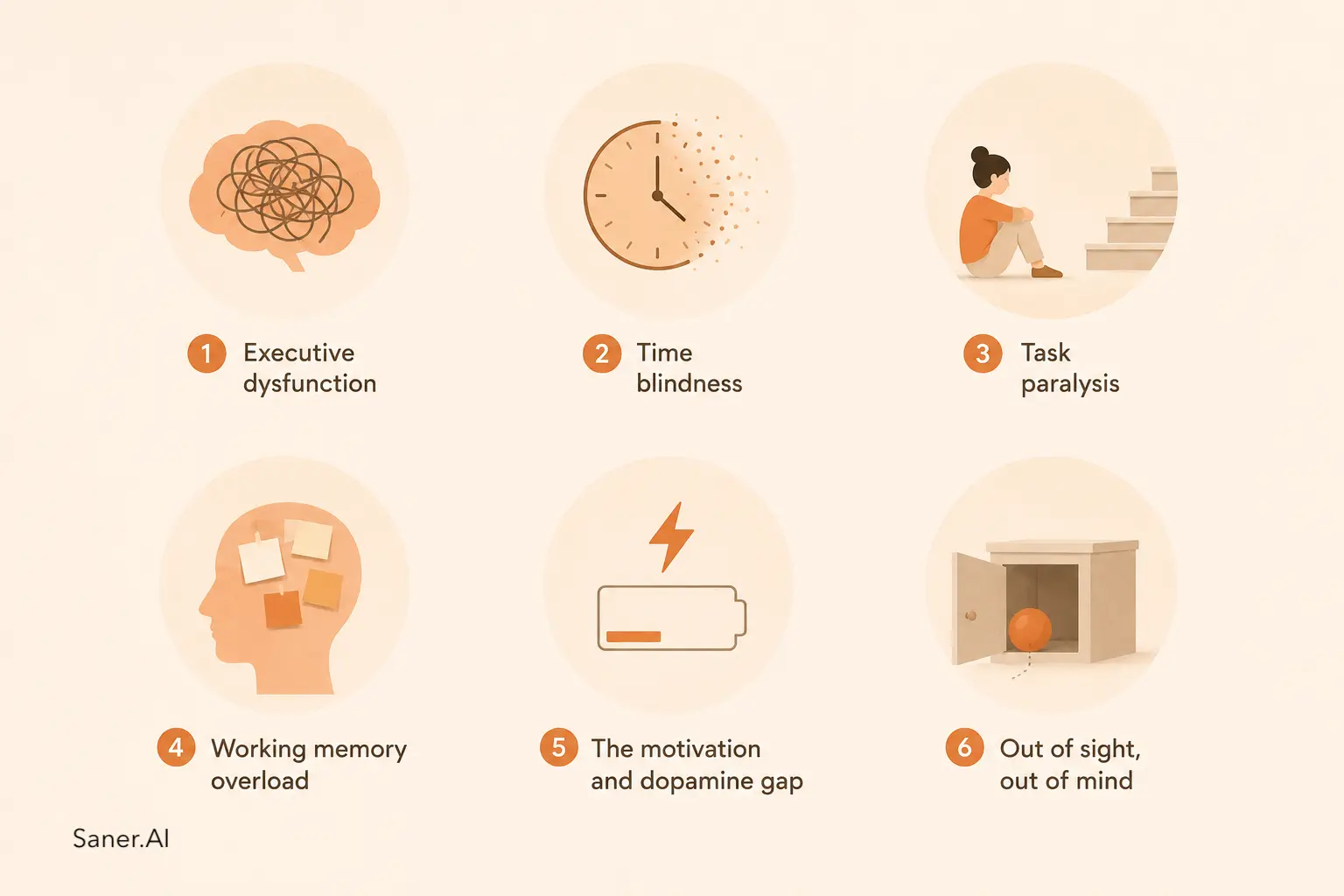
1) Executive dysfunction
Executive functions are the brain's management system. They cover working memory, inhibition, task initiation, planning, and self-monitoring. The evidence that these are impaired in ADHD is strong.
- A frequently cited meta-analytic review of the executive function theory of ADHD found significant differences between people with and without ADHD across all thirteen executive function tasks examined, with a moderate overall effect size. Neuroimaging research has linked this to reduced activity in the brain's frontal regions and the fronto-striatal circuits that support self-regulation.
What it feels like: you know what to do, you want to do it, and you still cannot make yourself begin. That gap between intention and action is executive dysfunction, and it is the umbrella over almost everything else here.
👉 If you want to go deeper into the tools that target it specifically, our deep dive about executive dysfunction and roundup of the best apps for executive function break down what helps.
2) Time blindness
Many people with ADHD experience time differently. The future feels abstract until it is suddenly the present, and an hour can vanish without registering.
- This is not a metaphor. Researchers have documented genuine differences in time perception in ADHD, including a study describing evidence for a pure time perception deficit tied to the same executive and working memory systems above.
What it feels like: deadlines that are two weeks away do not feel real, so they generate no urgency until the night before. You are not procrastinating because you do not care. You genuinely cannot feel the deadline approaching.
👉 If you want to go deeper into what it is and how to handle it, our deep dive into time blindness can help.
3) Task paralysis
This is the freeze. A task sits in front of you, sometimes a task you actively want to do, and you cannot start. It often gets worse the more important the task is, which makes no logical sense and no emotional sense.
Task paralysis usually comes from a pileup: the task is ambiguous, the first step is unclear, and the working memory needed to break it down is already overloaded. So the brain protects itself by avoiding the whole thing.
- Barkley (2012) classifies task initiation as a core executive function, and its failure in ADHD is rooted in how the prefrontal cortex and dopamine interact. Without sufficient dopamine activation, the brain cannot fire the signal that moves intention into action.
👉 If you want to go deeper into the topic, our post on ADHD task paralysis solution breaks down what helps.
4) Working memory overload
Working memory is the mental scratchpad that holds information while you use it. In ADHD, it tends to be smaller and leakier.
- A meta-analysis of working memory in adults with ADHD found reliable deficits, with effect sizes that are substantial on well-designed measures.
What it feels like: you walk into a room and forget why. The brilliant idea you had in the shower is gone by the time you find a pen. You cannot hold the steps of a plan in your head long enough to act on them. This single obstacle is why the most important productivity principle for ADHD is to get things out of your head immediately.
5) The motivation and dopamine gap
ADHD involves differences in the brain's reward and motivation system. The widely discussed dual pathway model describes two routes to ADHD symptoms: one through executive control and one through motivation and an aversion to delayed rewards.
In plain terms, the ADHD brain is wired around interest, novelty, urgency, and challenge, not around importance. A boring but important task can be almost impossible to start, while a pointless but interesting one is effortless.
- A 2011 PET imaging study by Volkow et al. in Molecular Psychiatry measured the dopamine reward pathway directly in adults with ADHD and found reduced function in the midbrain and nucleus accumbens — the regions most involved in motivation and reward.
What it feels like: you can hyperfocus for six hours on something that grabs you and cannot manage six minutes on something that does not. The category "boring but necessary" is your hardest terrain.
6) Out of sight, out of mind
Closely related to working memory, many adults with ADHD struggle with task object permanence.
- A study in the Journal of Attention Disorders found adults with ADHD performed significantly worse on visual working memory tasks than adults without ADHD.
If a task is not visible, it effectively stops existing. The note filed neatly in a folder is gone. The email scrolled past is forgotten. This is why tidy, hidden systems often fail and why visibility beats organization for ADHD brains.
Now let's dive into the solution to increase your productivity with ADHD.
The ADHD systems that actually work
Now the useful part. Every effective ADHD productivity system, regardless of the specific app or method, follows the same core principle: stop asking your brain to do the things it is bad at, and offload them to something external. Here is how that plays out in practice.
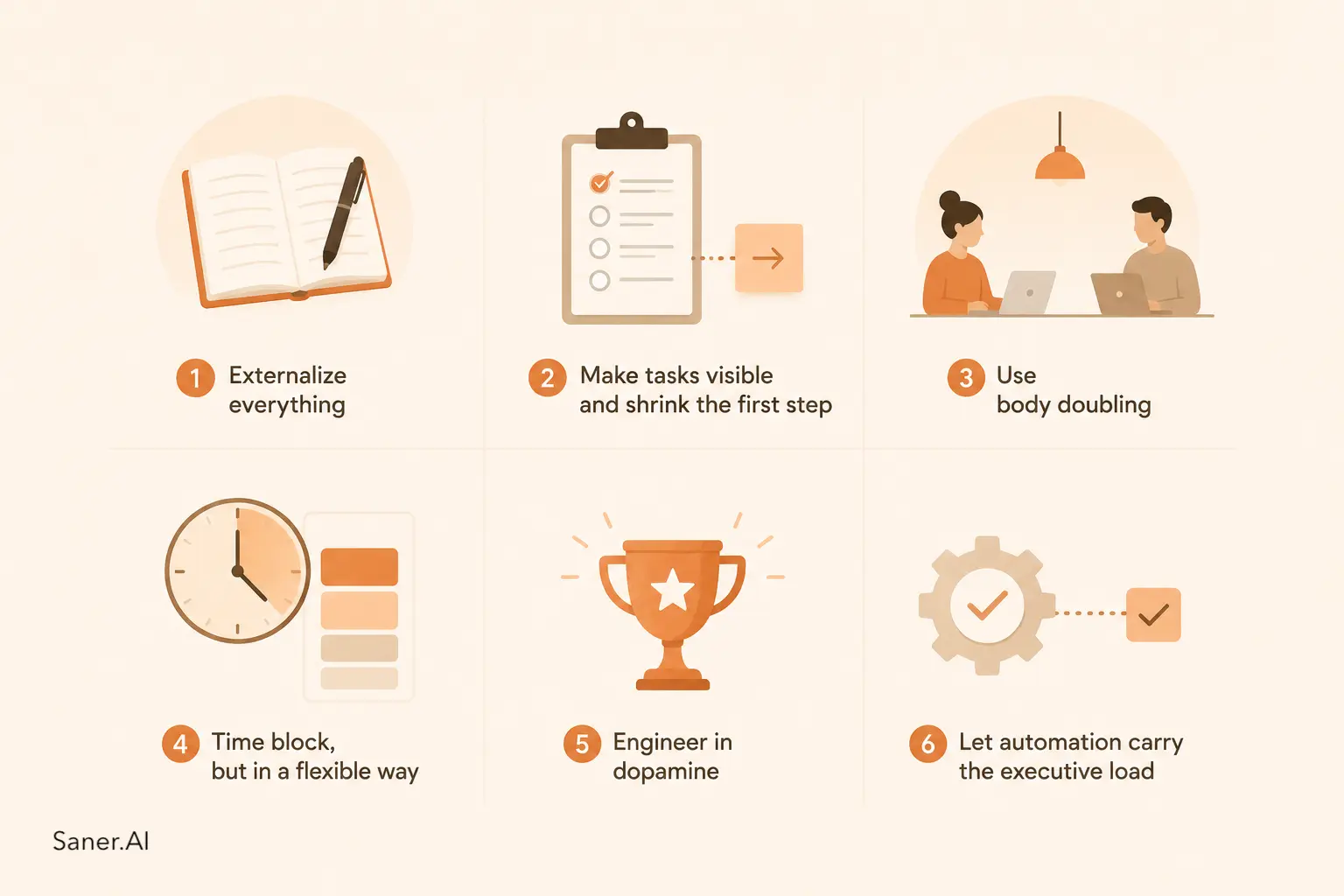
1. Externalize everything, immediately
Your brain is for having ideas, not holding them. Given the working memory research above, the single highest-leverage habit is frictionless capture: the moment a thought, task, or reminder appears, it goes somewhere outside your head before it evaporates.
The keyword is frictionless. If capturing a thought requires opening an app, choosing a folder, and tagging it, your brain will not bother, and the thought is lost. The best capture system is the one you will actually use in the two seconds you have. That usually means:
- One single inbox for everything, not five tidy ones.
- Capture by whatever is fastest for you, whether that is typing, voice, or a quick message to yourself.
- Sorting comes later. Capture and organize are two different jobs, and trying to do both at once kills the habit.
👉 This is the entire logic behind a brain dump practice, where you empty everything onto the page first and impose structure afterward.
2. Make tasks visible and shrink the first step
Because of task object permanence, anything you cannot see is at risk of disappearing. Keep your active tasks on a surface you cannot avoid looking at. A list buried three clicks deep does not count.
Then attack task paralysis by shrinking the activation energy. The freeze usually breaks when the first step is small enough to feel trivial.
- Not "write the report" but "open a blank document and type the title."
- Not "do my taxes" but "find the folder."
You are not lowering your standards. You are giving your brain a door it is willing to walk through.
👉 Our guide to task management with ADHD covers the topic deeper.
3. Use body doubling
Body doubling means doing a task in the presence of another person, in the room or on a video call, even if they are working on something completely different. The presence of another person creates a gentle external accountability that makes starting and staying with a task far easier for many people with ADHD.
- A 2024 peer-reviewed study in ACM Transactions on Accessible Computing formally examined body doubling with neurodivergent participants and found strong self-reported effectiveness.
It is one of the most reported community strategies for a reason. If you have ever cleaned your whole kitchen because a friend was coming over, you already know how it works.
4. Time block, but in a flexible way
Standard time blocking, where you assign every task to a rigid slot, tends to fail for ADHD because it has no give. One task runs long, the whole day collapses, and the shame spiral begins. The adapted version keeps the benefit, which is making time visible to a brain that cannot feel it, without the brittleness:
- Block in rough themes, not rigid minute-by-minute slots.
- Build in deliberate buffer time, because everything takes longer than you think.
- Protect one or two priorities per day rather than scheduling twelve.
- Treat the plan as a hypothesis, not a contract.
👉 Because time blindness is doing real work against you here, leaning on a calendar that actively reminds and reshapes your day helps. Our guide to the best calendars for ADHD covers the options.
5. Engineer in dopamine
Since the ADHD brain runs on interest and urgency rather than importance, you can work with that instead of against it:
- Pair a boring task with something stimulating, like music or a change of location.
- Add artificial urgency with a short timer. Many people find a focused sprint of fifteen or twenty-five minutes is enough to break inertia.
- Make progress visible. Crossing things off, streaks, and small rewards feed the reward system that ADHD underuses.
- Rotate tasks before boredom kills momentum, rather than forcing yourself through a wall.
6. Let automation carry the executive load
This is where the principle of externalizing reaches its logical end. The less a system depends on you remembering, deciding, and initiating, the better it survives contact with an ADHD brain. The most useful tools are the ones that:
- Capture tasks from wherever they appear, including your notes and your inbox, so nothing depends on you transcribing them.
- Resurface things at the right moment instead of waiting for you to check a list you will forget exists.
- Reduce the number of separate apps you have to juggle, because context switching is its own tax on a brain that is already managing a lot.
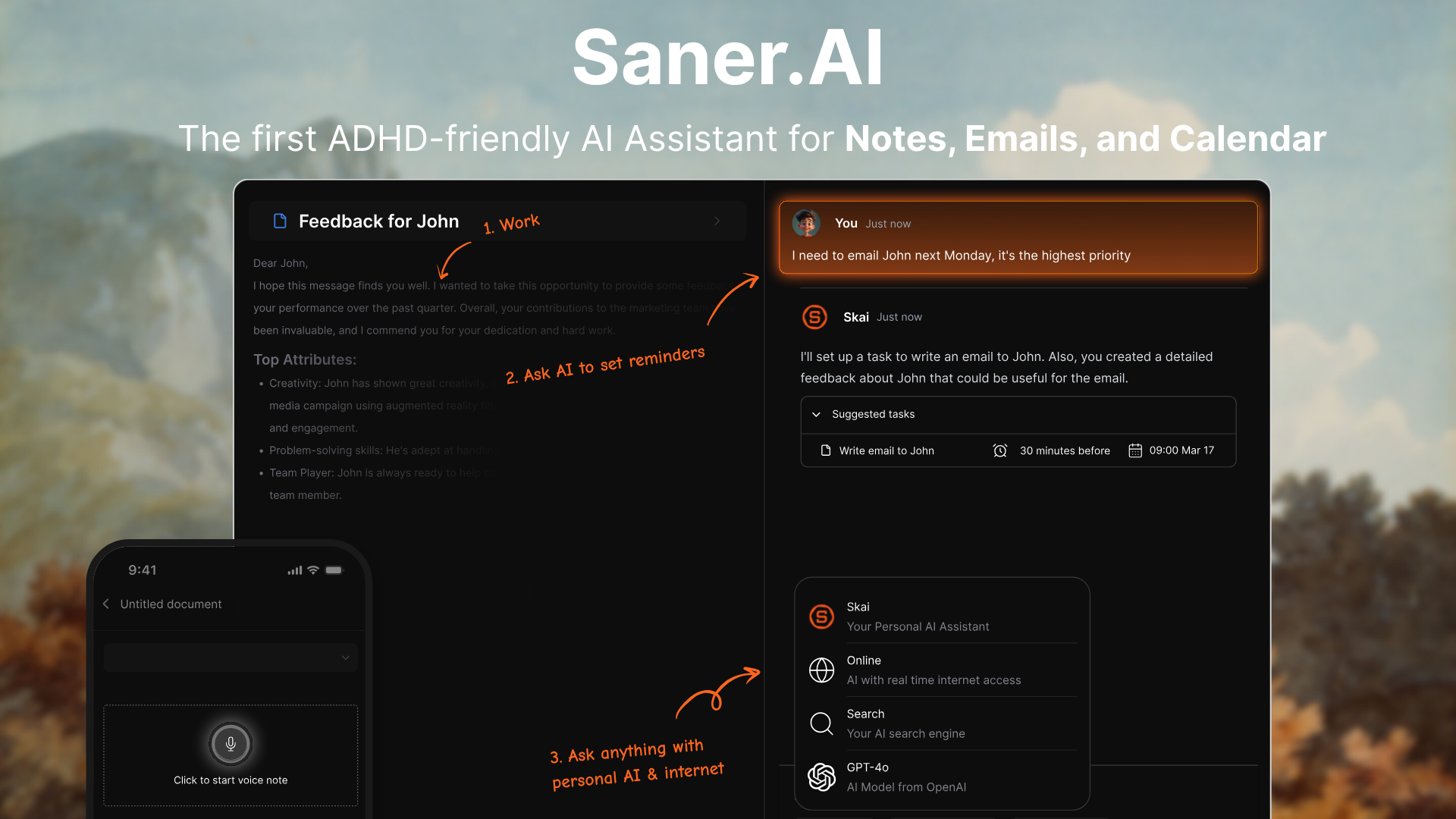
👉 This is the gap that a single assistant that captures, organizes, and reminds is built to fill, rather than handing you five empty apps and asking you to supply the executive function yourself. If task capture specifically is your weak point, our roundup of the best AI task managers goes deeper into tools that turn scattered inputs into an actual plan.
Quick pick guide: Match the ADHD tools to your obstacle
This is a quick guide to choosing the best tool for the problem you are trying to solve. Each link goes to a detailed comparison.
- You lose ideas before you can capture them: start with a brain dump tool.
- You forget tasks and appointments: look at dedicated ADHD reminder apps.
- You struggle to plan your day: look at dedicated ADHD planner apps.
- Your schedule falls apart by mid-morning: see the best calendars for ADHD.
- You struggle to start, plan, and follow through: review the best apps for executive function.
- You want one all-in-one system: compare the best ADHD apps and the broader neurodivergent apps for adults.
- You run a business or work for yourself: the best apps for ADHD entrepreneurs is the place to start.
The honest advice: do not buy six tools.
Pick the one that solves your single worst bottleneck and use it for a month before adding anything.
How to build your system, step by step
Do not try to build all of this at once. The instinct to overhaul everything on day one is itself part of the pattern, and it almost always ends in abandonment by week two. Add one piece, let it become automatic, then add the next.
- Set up one capture inbox. Pick the single fastest way for you to get a thought out of your head, and route everything there. Master this before anything else. It is the foundation.
- Choose one visible task surface. Whatever you will actually look at every day. Your active tasks live here and nowhere else.
- Pick one daily highlight. Each morning, choose the single most important thing. Not a list of ten. One. Protect it.
- Add a shutdown habit. A two-minute end-of-day ritual where you capture loose ends and glance at tomorrow. This is how you stop carrying open loops in your head overnight.
- Run a weekly reset. Once a week, clear the capture inbox, look at the week ahead, and adjust. This is the maintenance that keeps the whole thing from silently decaying.
If you only ever do steps one and two, you will still be dramatically better off than a perfect system you cannot sustain.
Why most ADHD productivity advice fails
You have probably been handed all of this before:
- "Just use a planner." A paper planner you have to remember to open relies on the exact memory and habit formation ADHD impairs. The planner becomes another thing you forget.
- "Just build discipline." Discipline is a function of the self-regulation system that ADHD affects at a neurological level. Telling someone with ADHD to use more willpower is like telling someone who is nearsighted to squint harder.
- "Just wake up at 5am and follow a morning routine." Rigid routines with no novelty or external accountability are exactly the conditions under which the ADHD motivation system disengages.
- "Just stop getting distracted." Inhibition, the ability to suppress a distraction, is one of the core differences documented in the executive function research. This is not a focus you can simply choose.
The common thread is that all of this advice asks the ADHD brain to manufacture the very capacities it is short on. The systems in this guide do the opposite. They assume those capacities are unreliable and build around them.
The bottom line
The goal was never to turn yourself into a neurotypical productive person through sheer effort. That project has failed for you before, not because you did not try hard enough, but because it was the wrong project. The real goal is to build a set of external systems that carry the load your executive function cannot carry on its own, so that less and less of your day depends on willpower you cannot summon on command.
Start small. Capture everything. Keep your tasks visible. Make the first step tiny. Let tools remember the things you will forget. The chaos was never a verdict on who you are. It was a sign you were using tools built for a different kind of brain.
Stay on top of your work and life
Frequently asked questions
Why is productivity so hard with ADHD? Because ADHD affects executive function, the mental processes that let you plan, start tasks, hold information in mind, and manage time. Research shows measurable differences in inhibition, working memory, and time perception in people with ADHD, which means standard productivity methods that rely on those abilities tend to break down.
What is the best productivity method for ADHD adults? There is no single method, but the most effective approaches all follow one principle: externalize the work your brain struggles to do. Capture every thought outside your head, keep tasks visible, shrink the first step, and use reminders and automation so success does not depend on memory or willpower.
Do planners work for people with ADHD? Paper planners often fail because they rely on remembering to open and update them, which is exactly what ADHD makes unreliable. Visible, low-friction, and ideally reminder-based systems with an AI personal assistant tend to work better than traditional planners.
How do I stop procrastinating with ADHD? ADHD procrastination is usually task paralysis or a motivation gap, not laziness. Shrink the first step until it feels trivial, add a short timer to create urgency, and try body doubling so the presence of another person provides accountability.
What is body doubling, and does it actually work? Body doubling means working alongside another person, in the room or virtually, even if they are doing something unrelated. Many adults with ADHD find that another person's presence makes it far easier to start and stay on task. It is one of the most widely reported community strategies.
How do people with ADHD manage time? By making time visible, since many people with ADHD experience time blindness and cannot easily feel time passing. Flexible time blocking, generous buffers, timers, and calendars that actively remind and adjust help compensate for the difference in time perception.
Can AI tools help with ADHD productivity? Yes, when they reduce the executive load rather than add to it. The most helpful tools capture tasks automatically from notes and email, resurface things at the right moment, and consolidate multiple apps into one, so less depends on you remembering and deciding.
👉 You can read this post on the best AI for ADHD to choose a suitable tool for your situation
Why do I start tasks and never finish them? This often reflects the ADHD motivation system, which runs on novelty and interest. Once a task stops being stimulating, momentum collapses. Building in progress markers, variety, and external accountability helps carry you through the unstimulating middle of a task.
Is ADHD productivity advice different from regular productivity advice? Yes. Most mainstream advice assumes intact executive function and asks you to rely on discipline and memory. ADHD-specific advice assumes those systems are unreliable and builds external structure to compensate, which is why generic tips so often fail for ADHD adults.
How do I build a productivity system I will actually stick to? Add one habit at a time. Start with a single capture inbox, then a visible task list, then a daily highlight. Trying to overhaul everything at once tends to fail. A small system you maintain beats a perfect system you abandon.
This article is for general informational purposes and is not medical advice. If you think you may have ADHD, a qualified healthcare professional can provide assessment and guidance suited to your situation.