
What is Executive Dysfunction and How to Overcome It


I spent 45 minutes yesterday staring at a pile of clean laundry on my bed. I needed to move it so I could sleep. I wanted to move it. My shoes were already off, my teeth were brushed, and my bed was right there. But I just stood in the doorway, looking at a stack of t-shirts, feeling this weird, heavy weight in my chest.
My brain knew exactly what steps to take: pick up the clothes, put them on the chair, go to sleep - but the signal between my brain and my body just wouldn't connect.
That frozen feeling is called Executive Dysfunction. It happens when the brain's management system (the part responsible for planning, focusing, and initiating tasks) stalls. It's a neurological hiccup that makes simple steps feel like climbing a mountain.
If you're tired of feeling stuck in your own head, let's look at how executive dysfunction actually works and how to break out of the freeze.
1. What is executive dysfunction?

Executive dysfunction is a disruption in the brain's ability to plan, organize, start, and complete tasks. It affects working memory, impulse control, emotional regulation, and time management. It is commonly associated with ADHD, autism, depression, and anxiety, but can also occur in people without any diagnosis.
2. What causes executive dysfunction?

If you look inside the brain, the main culprit is the prefrontal cortex. This area acts like a strict project manager, handling your attention, timing, and impulses. In a typical brain, dopamine acts like an internal messenger to keep this manager running smoothly.
But if you have ADHD, that dopamine supply is low. Without enough of it, the project manager checks out, leaving you to stare at a task for hours without any idea how to start.
"We can think of the executive functions simply as those capacities for self-control that allow us to sustain action and problem solving toward a goal. So it's goal-directed problem solving and goal-directed persistence." — Child Mind Institute
While executive dysfunction is a core part of ADHD, it doesn’t belong to ADHD alone. Your brain can struggle to manage itself due to several different factors:
- Neurodivergence and mental health: Autism, depression, anxiety, and trauma can all disrupt your brain's processing power.
- Physical and medical conditions: Multiple sclerosis (MS) directly impacts the brain's communication lines, and even severe sleep deprivation can temporarily mimic the executive struggles of ADHD.
There is a massive distinction to make here: executive dysfunction and ADHD are not the exact same thing.
Data from executive function coaching organization Beyond BookSmart shows that things like severe stress, burnout, or separate medical conditions can cause the exact same brain fog and time blindness.
Signs and Symptoms of Executive Dysfunction
If you are trying to figure out why basic tasks feel like climbing a mountain, you are likely looking for concrete signs. Executive dysfunction is not a character flaw, but it does show up clearly in daily routines, whether you are managing a corporate workload or just trying to get through a school day.
1. Executive dysfunction in adults at work

The professional world relies heavily on executive skills, which is why a breakdown here feels so glaring. You might start the day with five critical tasks, get overwhelmed trying to choose the right one, and end up staring at your screen for two hours doing nothing at all.
- The priority trap: You struggle to rank tasks. Everything looks equally urgent, so you clean your desk instead of writing the budget proposal.
- Missed deadlines: You know a project is due, but you cannot find the momentum to start it until the absolute last minute.
- The overwhelm freeze: A single feedback email can cause mental paralysis, making you want to close your laptop and walk away.
2. Executive dysfunction in children & students

Kids do not usually say they are struggling to organize; they just look like they are falling apart. Teachers might complain about a lack of effort, but the issue is usually structural, not motivational.
- The black hole backpack: Backpacks and desks become graveyards for crumpled, half-finished worksheets and lost permission slips.
- Homework meltdowns: A simple math sheet causes tears because the child cannot figure out how to transition from playing to sitting down and remembering the instructions.
- Incomplete tasks: A student might spend an hour writing an essay but leave it on their kitchen table because they forgot the final step of putting it in their folder.
3. Emotional signs of Executive dysfunction

The mental toll of executive dysfunction is often worse than the structural chaos. When your brain refuses to cooperate with your intentions, it leaves a heavy emotional footprint.
- The shame spiral: You look at a pile of unopened mail and feel a deep sense of failure, assuming you are just lazier than everyone else.
- Time blindness: You genuinely believe you have plenty of time to get ready, only to look at the clock and realize forty minutes have vanished while you were putting on one sock.
- The freeze response: When you have too many things to do, your brain protects itself by shutting down, leaving you stuck on the couch scrolling through your phone while your anxiety spikes.
How to manage executive dysfunction
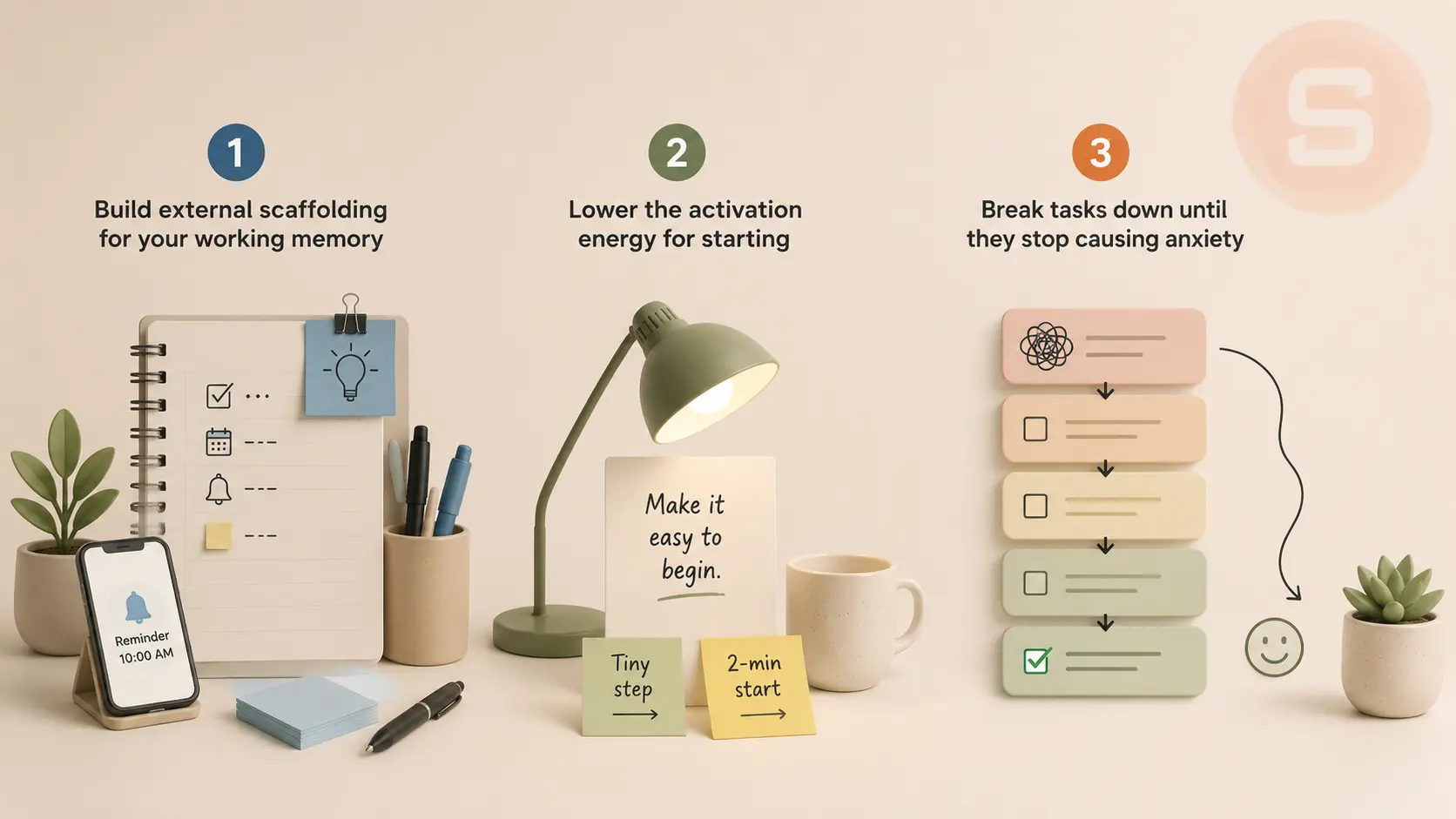
For people with ADHD, traditional advice like "just buy a planner" feels like being told to build a house when you do not even have a hammer. You cannot willpower your way out of executive dysfunction. Instead, you have to work around it by lowering the friction between your brain and the thing you need to do.
1. Build external scaffolding for your working memory
People with ADHD often have an "out of sight, out of mind" working memory. If an obligation or an object is not directly in your field of vision, it basically ceases to exist.
- Make your checklist physical. Digital task apps are convenient until you unlock your phone to check them, see a notification, and spend forty minutes scrolling. Use a dry-erase board on your wall or a paper notepad on your desk. If it sits physically in your workspace, your brain cannot easily archive it.
- Visual cues over hidden storage. Clear plastic bins are better than opaque drawers. If your keys, medication, or work materials are tucked away in a cabinet, you will forget they are there. Keep your daily essentials visible and grouped together where you actually use them.
2. Lower the activation energy for starting
The hardest part of executive dysfunction is the transition between doing nothing and doing something. You can trick your brain into starting by making the first step absurdly small.
- Body doubling. Sit in the same room with someone else who is also working, even if they are working on something completely different. Something is grounding about having another person in the room that keeps an ADHD brain from wandering off. You can do this virtually too, through a video call with a friend.
- The five-minute rule. Tell yourself you only have to work on a task for five minutes. If you want to stop after five minutes, you are allowed to stop. Usually, the biggest hurdle is just breaking the initial paralysis. Once you start, momentum takes over.
3. Break tasks down until they stop causing anxiety
When you write "clean the kitchen" on a list, an ADHD brain sees a massive, overwhelming project and shuts down. You have to break that macro-task into micro-steps.
- Write down the microscopic first step. Do not write "do the dishes." Write "put three forks in the dishwasher." It sounds ridiculous, but three forks feels manageable when the whole sink feels impossible.
- Separate planning from doing. Figuring out how to do a task takes a lot of executive function. Do the planning the night before. Write down exactly what you will do first, second, and third. When you wake up, you do not have to think or make choices. You just follow the recipe you already wrote.
AI tool that helps with Executive Dysfunction
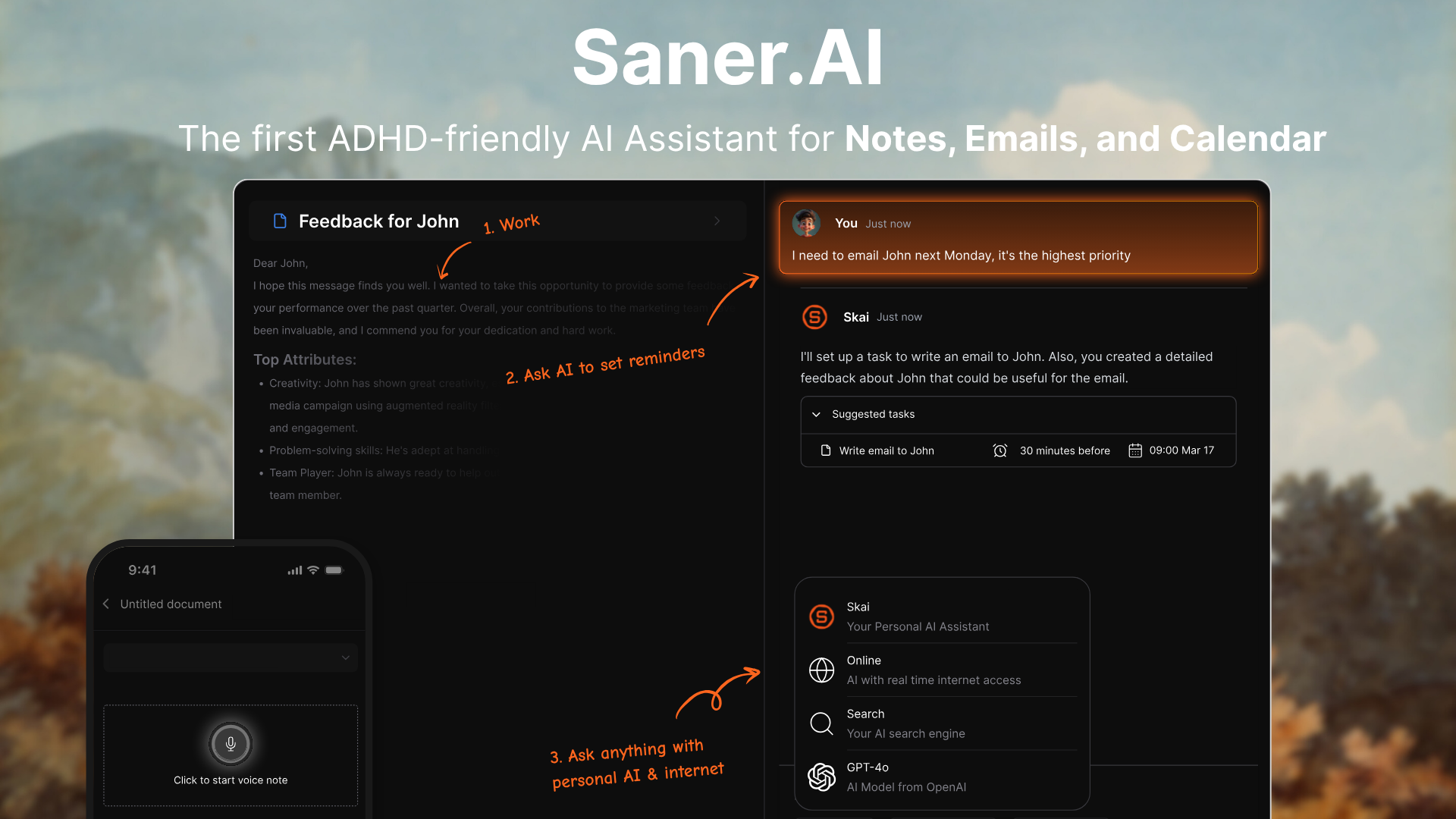
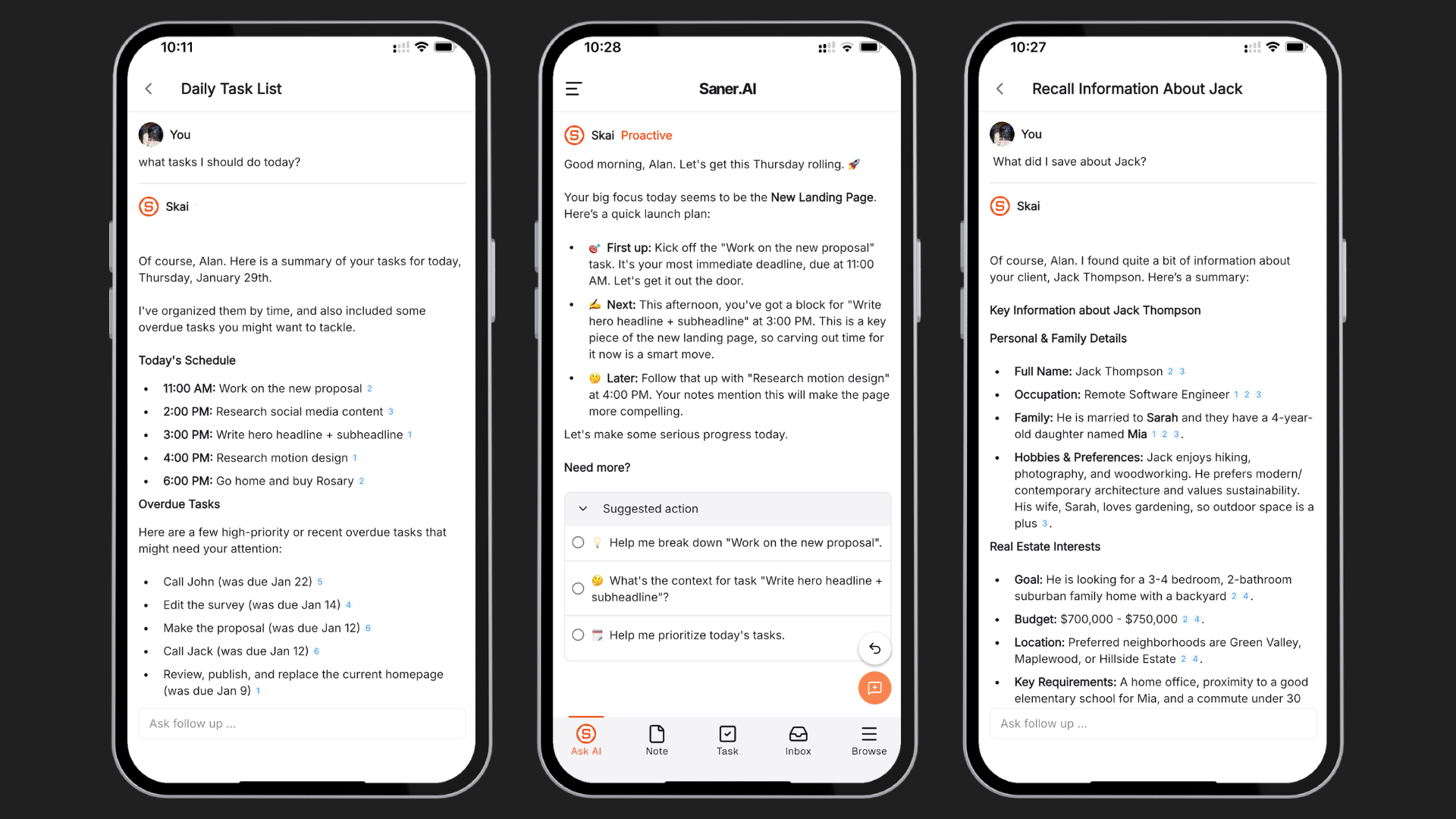
Saner.AI is an AI personal assistant built for users who experience executive dysfunction, cognitive fatigue, and ADHD task paralysis. Rather than forcing you to maintain strict tags, elaborate folder trees, or rigid time blocks, the software serves as an external prefrontal cortex. It captures disorganized speech or text, matches your daily calendar with actual energy levels, and handles the cognitive sorting for you.
Key feature
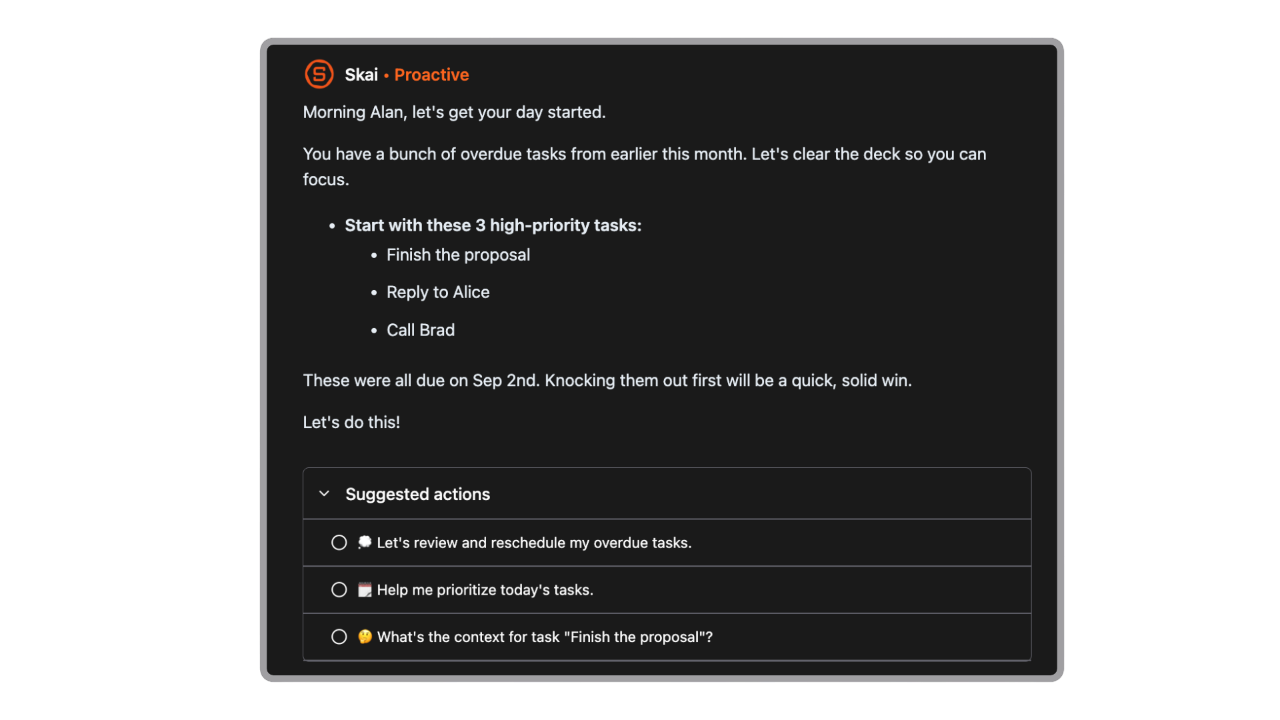
- Proactive energy-aware daily planning
I tested this system during a bad bout of brain fog, and I liked how it recognized my afternoon slowdown by moving an exhaustive writing assignment to the following morning and leaving easy administration tasks in its place.
- Universal natural-language capture
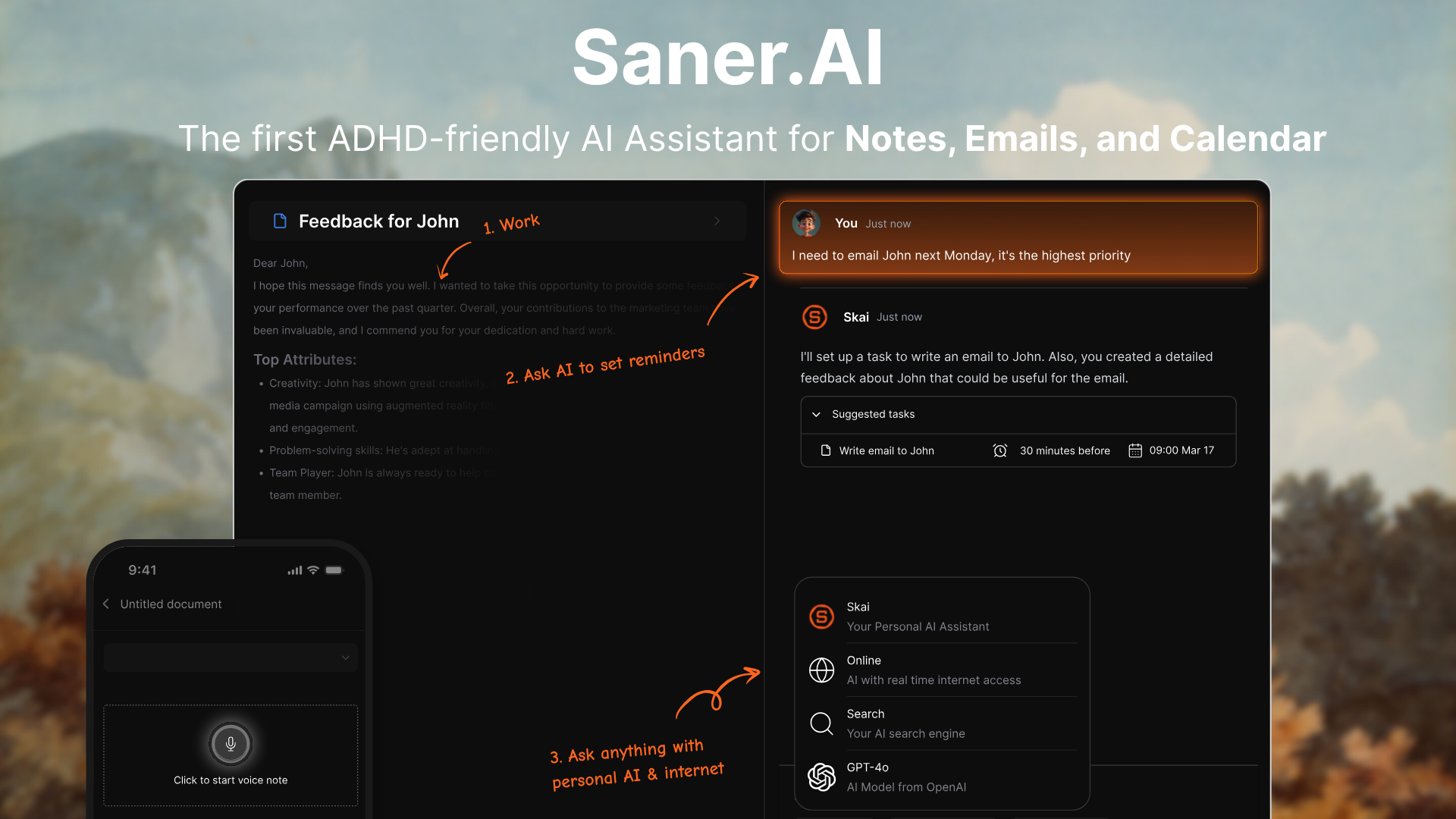
The software provides a simplified capture window designed to instantly log web clips, stray files, PDFs, or raw voice memos without forcing you to decide where they live right away.
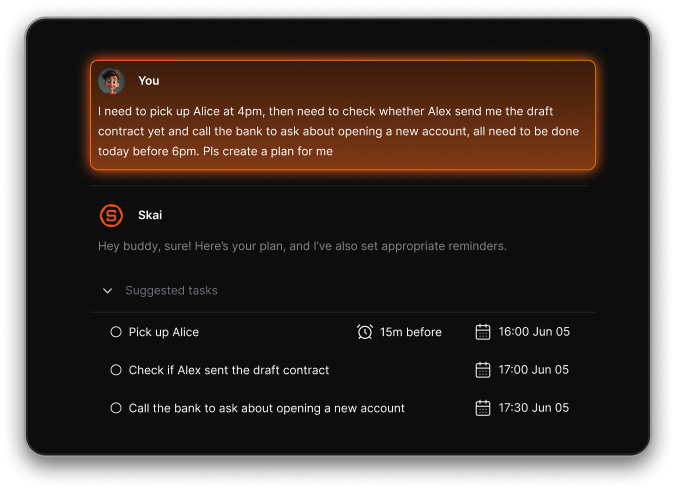
- AI task atomization
When long-range goals cause task paralysis, the built-in universal assistant breaks massive, intimidating objectives down into micro-steps that are easier to initiate.

Pros
- I appreciate that the app accepts raw information fragments, meaning I do not have to waste mental energy organizing folders or tags manually.
- The floating picture-in-picture focus panel is very helpful for keeping my current assignment visible when I browse other tabs.
- The UI is clean and intuitive
Cons
- Saner.AI focuses more on personal task management. not large team project management.
Who is it best for
- Saner.AI is best for knowledge workers, freelancers, and students with ADHD or chronic fatigue who struggle with organization, suffer from task initiation paralysis, and need an assistant to distill loose notes into structured daily plans without adding cognitive friction.
Pricing list
- Free: $0
- Starter Plan: ~$8/month
- Standard Plan: ~$16/month
How to get started
- Step 1: Create an account on the official portal and link your digital calendar to build a core agenda timeline.
- Step 2: Brain dump to the AI chat
- Step 3: Ask Skai assistant to sort your input into small, organized items adjusted to your current energy level.
Stay on top of your work and life
👉 If you want to learn more, this post about executive function tools may help
Conclusion: Executive Dysfunction is a Brain Thing, Not a Lack of Will
If you take only one thing from this, let it be that executive dysfunction is a genuine, documented neurological challenge. It is not a moral failing.
Forgetting a deadline or staring blankly at a cluttered room does not mean you are lazy or broken. Your brain simply manages information and transitions differently. Understanding this shift in perspective is often the most important step in finding strategies that actually work for you, rather than trying to force yourself into systems built for neurotypical minds.
Living with ADHD or navigating self-diagnosed executive challenges means your working memory needs physical, external support to keep you grounded. Instead of relying on mental stamina to track your life, you can offload that heavy lifting to a tool designed to adapt to your thoughts.
If you need a calm, distraction-free space to capture ideas, organize notes, and find what you need without digging through endless folders, take a look at Saner.AI. It acts as a second brain, doing the heavy mental lifting so you can focus on what matters.
Stay on top of Executive Dysfunction
Frequently Asked Questions about Executive Dysfunction
1. Is executive dysfunction a mental illness?
No, executive dysfunction is not a medical diagnosis or a standalone mental illness. It is a term for what happens when the brain systems that handle planning, focus, and emotional control stall out. Think of it as a behavioral pattern that shows up alongside other conditions like ADHD, depression, or autism.
2. Can you have executive dysfunction without ADHD?
Yes. While it is a major feature of ADHD, your executive functions can get thrown off balance by a lot of other things. Depression, chronic anxiety, burnout, sleep deprivation, and even physical brain injuries can cause the exact same mental paralysis.
3. Does executive dysfunction go away?
It depends on what is causing it.
If your executive dysfunction comes from a temporary state like burnout, acute anxiety, or depression, it can improve significantly as you recover and treat those conditions. If it is tied to a neurodevelopmental trait like ADHD, it will not completely vanish, but you can build systems to manage it so it does not run your life.
4. Is executive dysfunction the same as laziness?
Laziness is a choice to avoid work because you do not care. Executive dysfunction is wanting to do the task, staring directly at it, feeling immense guilt, and still being physically or mentally unable to start. It is a neurobiological roadblock, not a character flaw.
5. Can anxiety cause executive dysfunction?
Absolutely. Chronic anxiety keeps your nervous system in a constant state of threat. When your brain is busy panicking or over-analyzing potential dangers, it runs out of processing power for simple daily operations like organizing tasks or remembering details.
6. How do I get tested for executive dysfunction?
Because it is a symptom rather than a disease, you do not get diagnosed with executive dysfunction directly. Instead, neuropsychologists or psychiatrists look at the big picture. They use puzzle-like tests, such as sorting cards by hidden rules or tracing complex patterns, alongside behavioral interviews to see how your brain processes tasks.
7. What is the best app for executive dysfunction?
There is no single magic app because everyone's brain friction is different. However, tools that lower the barrier to entry work best.
For visual people, Kanban-style boards like Trello keep tasks visible so they are not forgotten. For people struggling with time blindness, Saner.AI is highly recommended by the neurodivergent community because it automatically breaks big, overwhelming tasks down into tiny, manageable steps.
8. Why do I freeze when I have too many tasks?
This is often called ADHD paralysis or overwhelm freeze.
When your brain cannot figure out which task to prioritize, it views the entire to-do list as a single, massive threat. To protect you from that stress, your brain simply shuts down motivation entirely.
9. Can you get medication for executive dysfunction?
There is no medication specifically labeled for executive dysfunction. However, medications that treat underlying conditions (like stimulants for ADHD) or antidepressants for depression can help stabilize your brain chemistry. This stability gives you the mental energy required to actually build and use daily routines.
10. Why can I hyperfocus on hobbies but struggle with laundry?
Executive function in ADHD brains is interest-driven, not importance-driven. A hobby provides immediate dopamine, novelty, and curiosity. Laundry offers none of that. If a task feels boring, your brain struggles to generate the activation energy needed to begin, even if you know the task matters.
11. How does executive dysfunction affect relationships?
It can cause real strain if your partner does not understand how your brain works. Forgetting anniversaries, losing track of conversations, or leaving chores half-done can look like a lack of care or disrespect. In reality, your brain's filing system simply dropped the ball.
12. What does "time blindness" mean?
Time blindness is the inability to gauge how much time has passed or how long a future task will take. For many neurodivergent people, time only exists in two zones: "now" and "not now." This makes estimating travel times or meeting deadlines incredibly difficult.
13. Why is working memory so bad with executive dysfunction?
Working memory is the brain's temporary sticky note. When executive function is impaired, that sticky note loses its glue. You walk into a room and instantly forget why you are there, or you lose your phone three times in twenty minutes because your brain failed to log where you put it.
14. What is the difference between ADHD and executive dysfunction?
ADHD is a complex neurodevelopmental condition that involves inattention, hyperactivity, impulsivity, and emotional regulation issues. Executive dysfunction is a specific piece of that puzzle: the breakdown in the cognitive toolkit required to execute tasks. You can have executive dysfunction without having ADHD.
15. How can I help someone struggling with this?
Do not offer generic advice like "just use a planner" or "just do it". Instead, help lower the friction. Offer to sit with them while they do a hard task (body doubling), or help them break a giant project down into three tiny, clear actions. Most importantly, lead with empathy rather than criticism.
Stay on top of your work and life