
What Is Time Blindness (and How to Manage It)


I sat down at my desk at nine in the morning, opened a single research document, and blinked. When I looked up, the sky outside my window was completely dark, and my phone was buzzing with three missed calls from my friend, who was wondering where I was for dinner.
I had lost six hours in what felt like forty minutes. If you have ADHD, you know this exact panic, the sinking feeling of looking at a clock and realizing your afternoon simply vanished while you were trapped in a focus tunnel.
There is a name for this neurological glitch. It is called time blindness, and it is a central part of how the ADHD brain processes the passage of hours and minutes.
In this article, you can learn how this cognitive quirk distorts your daily schedule and find practical, realistic ways to set up your environment so you stop losing track of your days.
1. What is Time Blindness in ADHD?

Time blindness is the difficulty sensing how much time has passed and estimating how much time a task will actually need.
Research links it to lower activity in the prefrontal cortex, the brain region responsible for estimating, tracking, and managing time. It also involves differences in the cerebellum, which plays a role in how we perceive the passage of time. The result: time feels abstract, deadlines feel distant, and hours disappear without.
2. Why Do People with ADHD Lose Track of Time?
Three interconnected systems in the brain work together to give us a sense of time passing: the prefrontal cortex, the basal ganglia, and the cerebellum. Think of them as the brain's internal clock network.
In people with ADHD, the neurological basis of time blindness centers on dopamine deficiency - a hallmark of the condition. Dopamine regulates the brain's internal clock, located in the suprachiasmatic nucleus, which helps maintain temporal awareness throughout the day. When that dopamine signal is inconsistent, the clock doesn't tick reliably.
Some neurological studies have found that children and adults with ADHD have reduced activation in the prefrontal cortex - the part of the brain responsible for executive functioning- which may be directly related to time blindness. Irregularities in the brain's dopamine pathways are also implicated.
The result is what Dr. Russell Barkley, one of the world's leading ADHD researchers, describes as a fundamental shift in how time is experienced. Barkley likens it to nearsightedness: just as a person with myopia struggles to see distant objects, those with ADHD struggle to perceive and plan for the future. You aren't ignoring the deadline. You genuinely can't feel it approaching.
"ADHD creates a blindness to time, or more accurately, a nearsightedness to the future. The further out the event lies, the less capable they are of dealing with it." — Dr. Russell Barkley
There's also a working memory piece. Executive dysfunction compounds the problem by impairing working memory - the mental workspace needed to track time passage consciously. People with ADHD struggle to maintain awareness of elapsed time while simultaneously focusing on tasks, creating a disconnect between time perception and reality.
Psychotherapist Kathleen Spurgin, LIMHP explains: "In the ADHD brain, the perception of time can be distorted, making it difficult to gauge when time has passed, especially when a person is hyper-focused on a task."
The science backs this up at scale.
One particularly telling clue about the biological roots of time blindness: when ADHD medication restores dopamine balance, many people notice that their sense of time "clicks into place" (evidence of its biological origins).
Time blindness isn't a mindset problem. It's a brain wiring difference that responds to the right support.
10 Signs of Timeblindness in ADHD
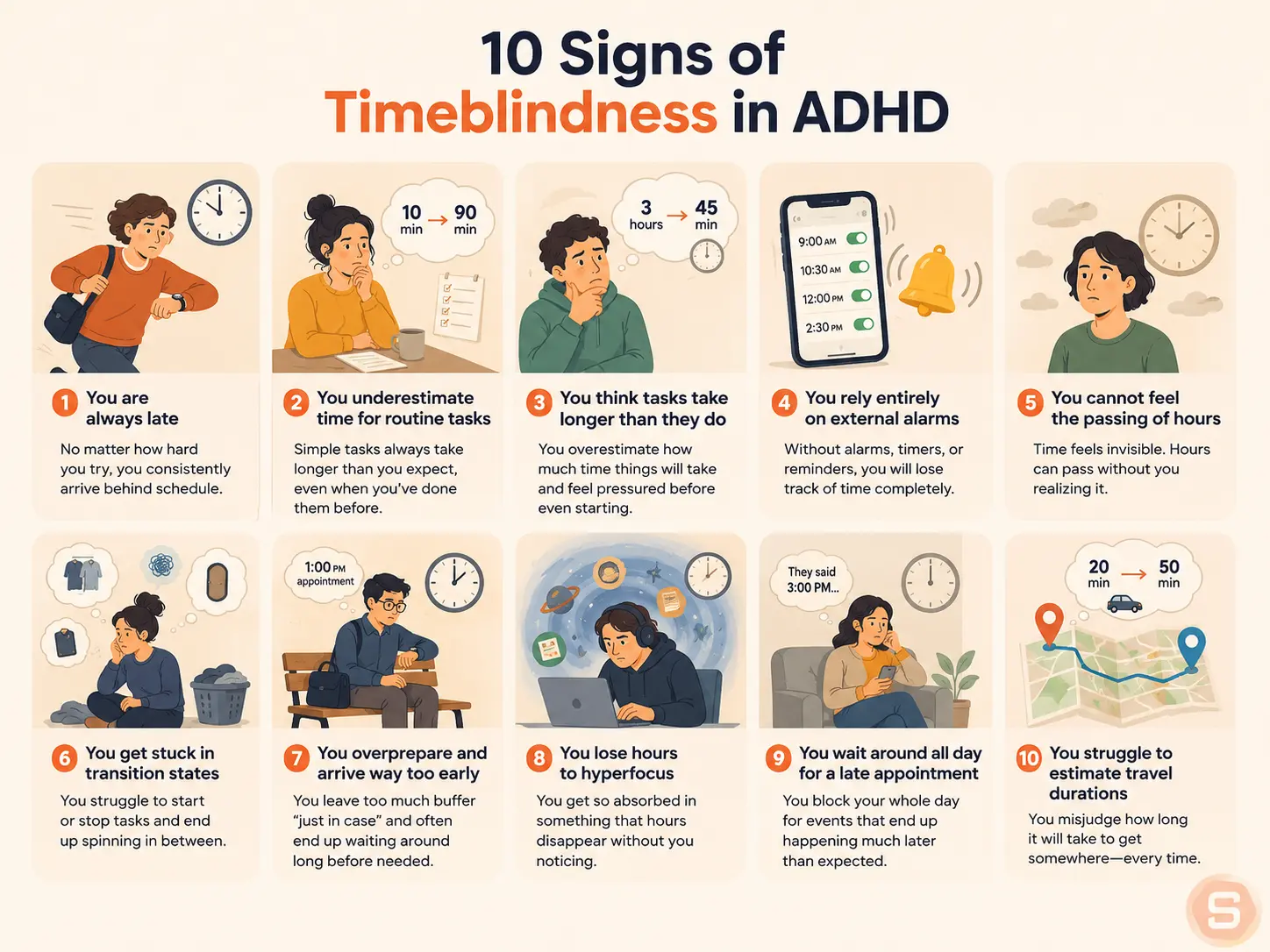
If you have ADHD or suspect you do, time probably feels less like a reliable clock and more like a fluid concept. You might constantly ask yourself, "am I time blind?" after looking at a clock and losing three hours without realizing it. Here are some common signs of time blindness that show how this trait shows up in daily life.
1. You are always late
People assume you do not care about their schedules, but you genuinely want to arrive on time. You simply misjudge how long it takes to get ready and travel. This pattern often makes you feel like the person with ADHD is always late to every single event.
2. You underestimate time for routine tasks
You frequently tell yourself that showering, getting dressed, and brushing your teeth take five minutes total. In reality, these activities require much more room to breathe. You plan your day around these impossible speeds and end up running behind.
3. You think tasks take longer than they do
The opposite happens with chores you dislike, like folding laundry or filing taxes. You avoid starting because your brain tells you the job will consume your entire afternoon. When you finally do it, you realize it only took ten minutes.
4. You rely entirely on external alarms
Without a phone buzzing in your pocket, you lose track of the afternoon completely. You need timers for basic transitions, like leaving the house or cooking dinner. If your phone dies, your entire schedule for the day collapses with it.
5. You cannot feel the passing of hours
You look outside and notice the sun is setting, which surprises you because you thought it was noon. Your internal clock does not track minutes or hours accurately. Time moves in two speeds for you: right now, and not right now.
6. You get stuck in transition states
Changing from one activity to another feels like moving through wet cement. You sit in your car for twenty minutes after arriving home before you can bring yourself to walk inside. Your brain needs extra effort to switch gears between tasks.
7. You overprepare and arrive way too early
Because you are terrified of being late, you overcorrect by arriving an hour before your appointment. You sit in the parking lot wasting time because you cannot calculate a reasonable arrival window. This anxiety is a direct response to a lifetime of accidental lateness.
8. You lose hours to hyperfocus
When a project captures your attention, the rest of the world fades out. You forget to eat, drink water, or use the restroom for half a day. You emerge from the task wondering where the daylight went.
9. You wait around all day for a late appointment
If you have a doctor's appointment at four in the afternoon, you cannot do anything useful at ten in the morning. You feel frozen because you worry any task will cause you to miss the appointment. The whole day gets swallowed by the upcoming event.
10. You struggle to estimate travel durations
You remember that a drive takes fifteen minutes because you managed it once on a Sunday morning with zero traffic. You forget to account for red lights, parking, and finding your keys. You always base your travel plans on the absolute best-case scenario.
IT'S NOT JUST ADHD
People can experience time blindness without ADHD. It's linked to conditions that impair executive functioning, the set of mental skills including memory, planning, attention, and decision-making. Conditions that affect executive function include ADHD, alcohol use disorders, anxiety, autism spectrum disorders, depression, obsessive-compulsive disorder, and traumatic brain injury. (Source: Henry Ford Health, 2025)
In one study, over 80% of autistic participants struggled with time duration tasks, compared to 17% of neurotypical controls.
How time blindness affects work, relationships & mental health
Living with ADHD means navigating a world built for standard clocks with a brain that only registers two timeframes: "now" and "not now." This disconnect makes managing daily responsibilities feel like a constant uphill battle.
1. The workplace toll

At work, time blindness looks like chronically missed deadlines or showing up late to meetings. You might spend hours hyperfocusing on a single task, completely unaware that the rest of your afternoon schedule is falling apart.
"I tell people something requires 8 hours of work and they hear 'I will begin immediately and will dedicate the next 8 working hours to this.' ... If I even get a 1h meeting in between, it messes up my whole schedule." — Reddit user Acceptable_Term_6131
2. Strained relationships

In friendships and romance, your missing internal clock can be misinterpreted as selfishness. When you are late to a dinner date or forget to reply to a text for three weeks, loved ones often think you just do not care.
"I lost count of how many times I disappointed people I love. My family thought I didn't care, but I cared deeply — my brain just didn't register time passing." - A patient perspective (Kolli Psychiatric & Associates, 2025)
3. The self-esteem deficit

The hardest hit usually happens internally. Constantly playing catch-up leads to a heavy amount of shame and anxiety, making you feel like you are failing at basic adulthood.
"ADHD 'time blindness' has caused me to stagnate and waste the first half of my 20s and now I'm filled with regret and hopelessness... I truly have no idea how I let that much time pass me by." — Reddit user 14thCluelessbird
How to manage time blindness with ADHD

1. Use analog clocks instead of digital displays
Digital clocks only tell you the current numbers. They hide the passage of time because you cannot see the hours slipping away. Hang a traditional analog clock with a physical second hand in the room where you spend the most time. Seeing the pie-shaped chunks of the clock face lets you visually measure how much day you have left before you need to walk out the door.
2. Pair transition times with a fixed playlist
Pick three or four songs that always play in the exact same order when you get ready in the morning. Your brain will start to associate the track changes with the passing minutes. When the third song starts, you know you have exactly four minutes left to put your shoes on. This builds an auditory deadline that requires zero clock-watching.
3. Swap standard alarms for visual countdown timers
Traditional alarms just go off when you are already late. A visual timer uses a brightly colored disk that physically disappears as the minutes tick down to zero. Put one on your desk when you start a task. You can glance over and see exactly how much time is remaining without reading numbers or calculating differences in your head.
4. Build buffer blocks directly into your calendar
If a meeting takes thirty minutes, do not log it as a thirty-minute block. Write it down as an hour-long commitment. ADHD brains assume everything takes five minutes, completely ignoring the time required to close laptop tabs, find keys, or walk to the car. Adding fixed buffers around every task protects you from the inevitable transition delays.
5. Anchor your schedule with environmental cues
Tie your daily routines to external events that happen automatically around you. Do not tell yourself you will start cooking at six o'clock. Instead, decide to start cooking when the streetlights turn on or when your roommate walks through the front door. Linking your habits to these physical shifts bypasses the need to track hours entirely.
6. Place smart speakers in every high-traffic room
Keep a voice assistant in your bathroom and kitchen. Use them to set instant reminders the second you think of them, before you get distracted. You can tell the device to remind you to check the oven in twenty minutes without ever opening your phone, which protects you from getting sucked into social media apps.
7. Lay out your physical tools the night before
Time blindness gets worse when you spend twenty minutes hunting for your wallet or shoes right before you leave. Put your keys, bag, and jacket in a designated tray by the front door before you go to sleep. Removing the friction of searching for objects eliminates the hidden time sinks that make you late.
8. Keep a time log for your frequent routines
Spend two days timing how long it actually takes you to shower, get dressed, and make coffee. Write down the real numbers on a sticky note. Most people with ADHD underestimate these tasks by half. Seeing the cold, hard numbers helps you plan your mornings based on reality rather than your best guesses.
An AI tool built for time-blind brains
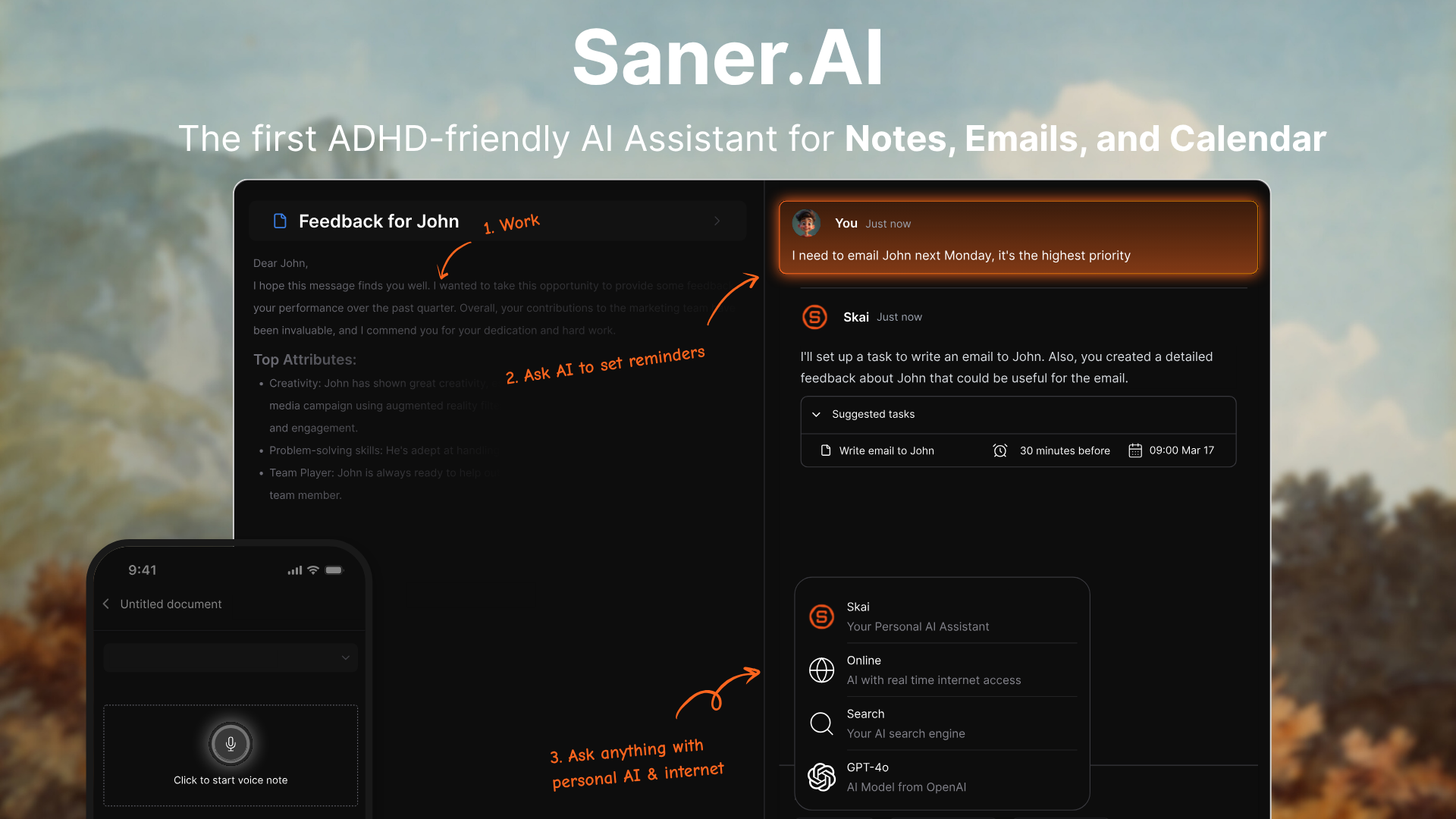
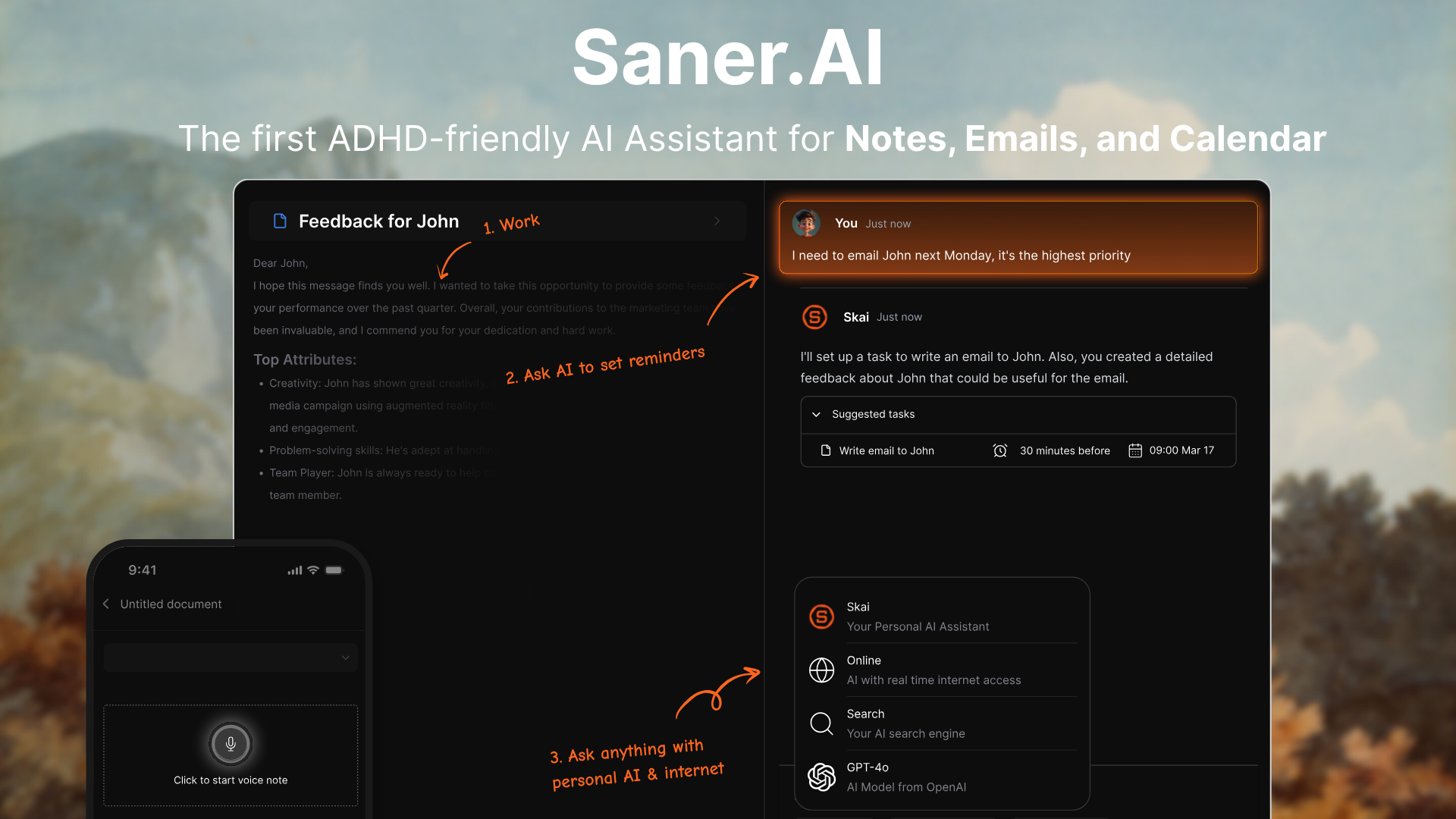
Saner.AI is an AI assistant built to handle the cognitive load that causes chronic time blindness. For people who lose track of hours or get stuck in decision paralysis, the application acts as an immediate external brain.
It captures fragmented data from emails, random notes, and calendar events, turning unorganized thoughts into structured actions. By automatically linking related information, it visualizes your day so you can stay grounded in what needs to happen right now.
Key feature
- Low-friction thought capture: People with time blindness struggle to log ideas because traditional apps require too many steps, leading to lost focus. I tested the quick-capture window and noticed it lets you dump messy text or voice notes instantly, dropping everything into a single inbox without forcing you to pick folders.
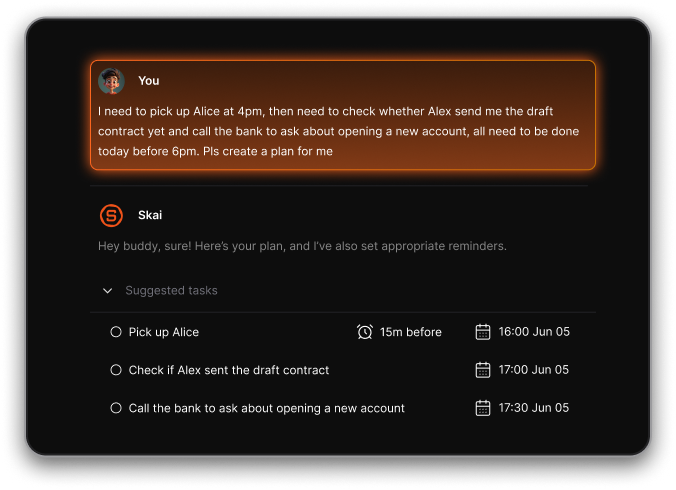
- Proactive daily scheduling: Time blindness distorts how long tasks actually take. I like how Saner.AI looks at your unstructured brain dumps, extracts individual action items, and cross-references them against your calendar to map out realistic goals.
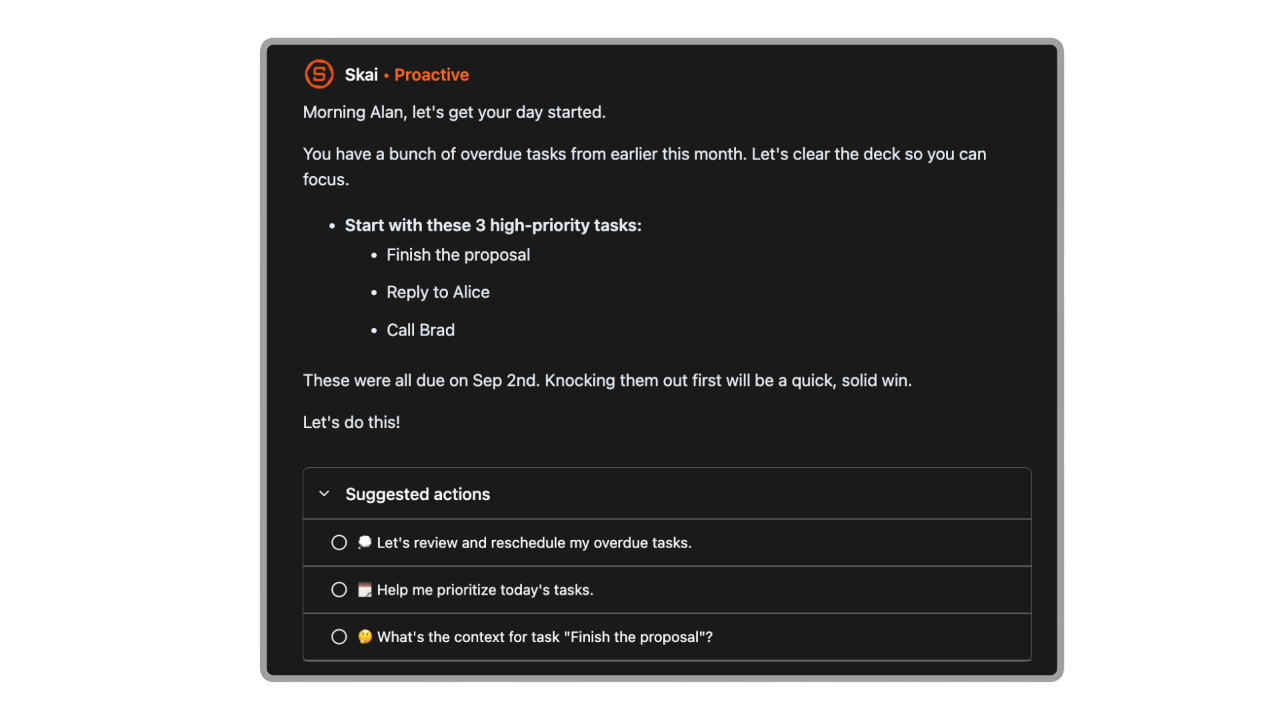
- Automated semantic knowledge graph: Instead of spending hours manually tagging notes, the system groups connected items dynamically. I tried searching my past entries using casual language, and the AI surfaced related emails and old documents even when I could not remember the specific titles.

Who is it best for
- Saner.AI is built for neurodivergent professionals, students, and independent creators who experience ADHD-related time blindness and need an automated system to track their tasks and notes without constant manual maintenance.
Pricing list
- Free Plan ($0/month)
- Starter Plan ($8/month)
- Standard Plan ($16/month)
Saner.AI reviews

How to get started
- Step 1: Download the browser extension or mobile app to log thoughts whenever they arrive.
- Step 2: Link your email and calendar feeds to allow the AI to aggregate your timeline automatically.
- Step 3: Use the central inbox to dump your daily task ideas and let the system organize your schedule.
Stay on top of your work and life
Conclusion - Time Blindness is a long battle, but not impossible to overcome
Living with time blindness means you are constantly fighting against a clock that you cannot see. It is exhausting to feel like you are always letting people down, running late, or losing entire hours to a blank space.
If you are struggling with this right now, please know that you are not broken. Your brain is simply wired differently, and you deserve tools that understand how you actually think.
That is why we built Saner.AI. It is a simple note-taking and executive assistant designed specifically for ADHD minds, acting as the external working memory you need to keep track of your day without the overwhelm.
You can try Saner.AI today to start organizing your life on your own terms.
Stay on top of your work and life
Frequently asked questions about Time Blindness in ADHD
1. What exactly is time blindness in ADHD?
Time blindness is the chronic difficulty in perceiving, estimating, and keeping track of time. It is a neurological difference, not a character flaw. For someone with ADHD, time is often split into just two zones: "now" and "not now." This makes it incredibly hard to feel the passage of minutes or hours, which leads to accidental lateness or missed deadlines.
2. Is time blindness an official medical diagnosis?
No, time blindness is not an official medical diagnosis on its own. It is a descriptive term used by psychologists and the ADHD community to explain an executive dysfunction symptom.
The diagnostic manuals categorize it under the broader umbrella of executive function deficits in ADHD. Even though it is not a standalone diagnosis, the daily impact is very real for millions of neurodivergent individuals who struggle with scheduling.
3. Why do people with ADHD experience time blindness?
The issue stems from the way the ADHD brain processes dopamine and regulates attention. The prefrontal cortex, which acts as the brain's internal clock, handles executive tasks differently in neurodivergent individuals.
Without a steady internal pulse to signal that thirty minutes have passed, you rely entirely on external cues. When you get hyperfocused on an interesting task, your brain ignores those external cues completely, making hours feel like seconds.
4. How does time blindness affect daily life and work?
It turns ordinary routines into daily sources of high stress. You might underestimate how long it takes to get ready, or get swallowed up by a project and miss an important meeting. In a professional setting, this looks like chronic lateness or scrambling at the last minute to finish assignments. It wears down relationships because people mistake your poor timing for a lack of respect or care.
5. What is the difference between time blindness and poor time management?
Poor time management is usually a lack of skills or tools that anyone can learn with a new planner. Time blindness is an inherent sensory deficit where your brain cannot register the passage of time without conscious effort.
A person with typical executive function can feel that they are running late. An ADHD individual genuinely believes they have plenty of time until they look at a clock and realize they are already late.
6. Can you have time blindness without having ADHD?
Yes, you can experience time blindness without having ADHD. It is common in other neurodivergent conditions like autism, and it frequently shows up in people dealing with chronic sleep deprivation, severe depression, PTSD, or traumatic brain injuries.
Anyone experiencing high levels of stress or burnout might find their executive functioning compromised, which mimics the time distortion typical of ADHD.
7. How can I tell if I have time blindness or if I am just lazy?
Laziness implies a conscious choice to avoid work despite being fully aware of the consequences. Time blindness involves a deep desire to be punctual and productive, coupled with a regular inability to gauge the hours required to do so.
If you regularly feel anxious about being late but still find yourself missing deadlines despite your best efforts, you are dealing with an executive function hurdle, not a moral failure.
8. What are some practical strategies to manage time blindness?
You need to make time visible by using external, sensory cues. Traditional planners rarely work because they require you to remember to open them. Instead, switch to analog clocks, visual timers with disappearing red discs, and loud alarms. Alarms should be set for transition times, like when to start getting ready, rather than just the final departure time.
9. How can digital tools like Saner.AI help with time blindness?
Saner.AI acts as an external prefrontal cortex (second brain) by organizing your thoughts and notes without requiring complex folder structures. For time blindness, its strength lies in reducing the mental energy needed to track tasks. By capturing information quickly and resurfacing it when you actually need it, the app prevents important commitments from disappearing into the "not now" void that swallows up standard digital calendars.
10. Does medication help improve time blindness in ADHD?
Stimulant and non-stimulant medications can significantly help by regulating dopamine levels in the prefrontal cortex. This biochemical support improves working memory and focus, which makes it easier to notice the passage of time and switch between tasks.
However, medication rarely fixes the issue entirely. Most people find that a combination of medical treatment and external organizational strategies yields the best results.
11. How can I support a partner or friend who struggles with time blindness?
Avoid lecturing them or taking their lateness personally. Instead, help them build buffer times into social plans, or agree to send a friendly text reminder an hour before you meet. Focus on collaborative problem-solving rather than punishment. Acknowledging that their brain genuinely perceives the world differently can ease the shame that often causes people with ADHD to withdraw from social circles.
12. What is hyperfocus and how does it make time blindness worse?
Hyperfocus is a state of intense concentration where an ADHD individual becomes completely absorbed by an activity. During these episodes, the brain blocks out all peripheral stimuli, including hunger, fatigue, and the passing hours. While hyperfocus can lead to incredible productivity, it completely breaks down your internal clock, causing an entire afternoon to vanish in what feels like fifteen minutes.
13. How do I explain my time blindness to my employer?
Frame the conversation around your needs and solutions rather than excuses. You do not have to disclose your ADHD diagnosis if you feel unsafe doing so. Instead, explain that you work best with clear, incremental deadlines rather than one distant target date. Ask if you can use specific tracking tools or written summaries to keep your projects on track throughout the week.
14. Can kids experience time blindness?
Children experience time blindness frequently, and it often looks like defiance or throwing tantrums during transitions. A child with ADHD cannot easily shift from playing a video game to putting on their shoes because they lack the developmental maturity to track the transition period. Parents can help by using visual timers, countdowns, and predictable daily routines instead of vague warnings like "five more minutes."
15. Is it possible to completely cure time blindness?
You cannot cure time blindness because it is tied to the structural wiring of the ADHD brain. However, you can manage it to the point where it no longer runs your life. By accepting that your brain needs external supports, using tools like Saner.AI to catch slipping tasks, and setting up sensory cues, you can navigate your days smoothly without the constant anxiety of running behind.
Stay on top of your work and life