
ADHD burnout: why you're so tired, and how to climb back out


Quick answer: ADHD burnout is a state of deep mental, emotional and physical exhaustion that builds up when adults with ADHD spend months compensating for executive function challenges, emotional overload, poor sleep and masking. It isn't a formal diagnosis, but research links ADHD to higher job burnout, mostly through problems with time management and self-organization.
Your inbox has 20 unread emails, there's a sink full of dishes, and you've been staring at the same message for twenty minutes. Nothing on the list is hard. You just can't make yourself start any of it, and the guilt about not starting is somehow more tiring than the work would be.
If that sounds familiar and you have ADHD (diagnosed or strongly suspected), you might be running on empty. People in the ADHD community call it ADHD burnout. It's what happens when your brain has been doing extra work for a long time with no real break.
In this guide, we'll cover what ADHD burnout actually is, why ADHD brains seem to hit the wall faster, how to tell it apart from depression, and what helps you climb back out. Though I work at Saner.ai, I'll also be honest about where an AI assistant like Saner.ai can help and where it can't.
What is ADHD burnout, really?

ADHD burnout is the exhaustion that comes from coping with ADHD symptoms day after day, often while trying to look like you're coping fine.
The Attention Deficit Disorder Association (ADDA) describes it as running out of fuel for even simple everyday things, and points out that it isn't an official medical condition or a recognized ADHD symptom. It's a name adults gave to something they kept experiencing.
WHO describes three dimensions of burnout:
- feeling drained of energy or exhausted
- growing mental distance from your job, or feeling negative and cynical about it
- reduced professional efficacy (you feel less able to do the work well)
Here's where it gets messy for ADHD.
The strain doesn't stay at work. It's in remembering the dentist appointment, replying to your sister, paying the bill before it's late, and keeping your face neutral in a meeting you're struggling to follow.
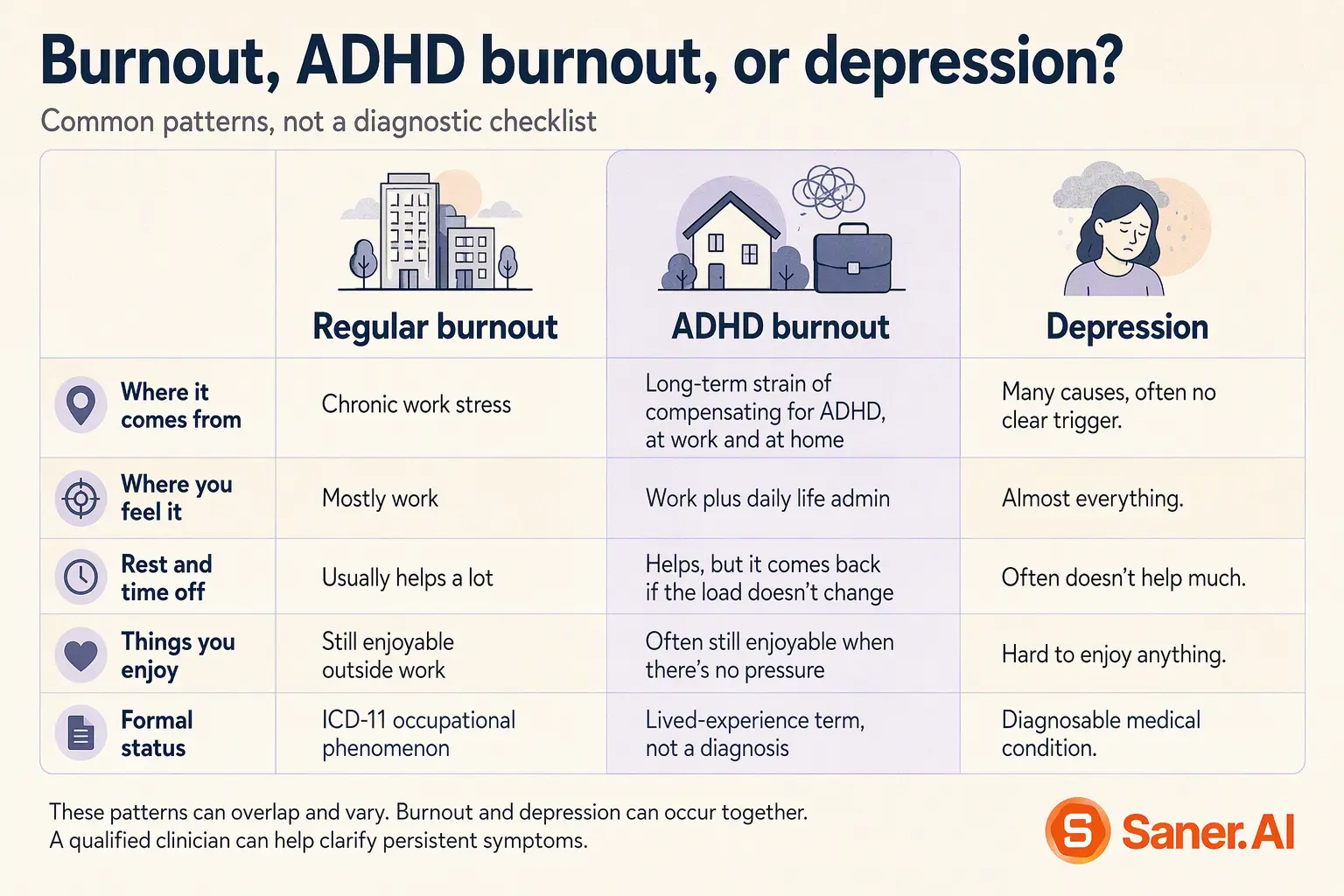
So when people with ADHD say "burnout," they usually mean something wider than the WHO definition. We think that's a fair use of the word, as long as we're honest that it's a lived-experience term and not a diagnosis.
Why ADHD brains burn out faster

Executive function is doing overtime
- A 2024 field study of 171 employees, published in AIMS Public Health, found that workers with ADHD reported higher job burnout than workers without ADHD. The connection ran through executive function deficits, especially managing time and organizing yourself to solve problems.
In plain terms: the burnout isn't coming from the ADHD label. It's coming from the daily friction of planning, prioritizing, remembering, and starting things with a brain that finds those jobs expensive.
Emotions hit harder and stay longer
- A 2023 systematic review in PLOS ONE looked at 22 studies and found that adults with ADHD use non-adaptive emotion regulation strategies more often than people without ADHD symptoms. The authors also linked emotion dysregulation to symptom severity, executive functioning, and other psychiatric conditions. Some researchers now argue it should count as a core feature of adult ADHD.
So a sharp comment from your manager doesn't just sting for a minute. It can eat the rest of your afternoon, and that emotional processing is work too, even if nobody sees it.
Masking is quietly exhausting
- In a 2026 study from Simon Fraser University, published in Research in Neurodiversity, 202 adults with ADHD in British Columbia described how they hide or compensate for their traits at work, in public, and in relationships. HealthDay's write-up reports that more than 91% camouflaged their ADHD traits to some extent.
Lead researcher Marisa Mylett put it this way: masking may help you "get your foot in the door," but it often leaves people "feeling exhausted" and less connected to themselves.
Sleep is often off
Many adults with ADHD are night owls by biology, not by choice. A review in Expert Review of Neurotherapeutics notes that adults with ADHD often have sleep problems caused by a delayed internal circadian rhythm. If your body clock wants you asleep at 2 a.m. and your job wants you sharp at 9, you're starting every day already in debt.
Untreated or undertreated ADHD
The CDC estimates that about one-third of US adults with current ADHD aren't receiving any ADHD treatment. ADDA also notes that burnout usually happens with unmanaged or untreated adult ADHD. When the only tool you have is willpower, you'll run out of it eventually.
Signs you might be in ADHD burnout
In your head and your mood
- Small tasks feel huge, and you can't explain why
- You're irritable or snapping at people you love
- Focus is worse than your normal ADHD baseline
- You procrastinate more, then feel guilty, then procrastinate on the guilt
- You feel detached, flat, or quietly resentful
- Your confidence takes a hit, and the self-talk gets mean
In your body
- Headaches, tight shoulders, or a sore jaw
- Stomach trouble or a changed appetite
- Sleep that's too little, too much, or never refreshing
- Catching every cold going around
At work
- More small mistakes than usual
- Dreading tasks you used to enjoy
- Calling in sick more, or wanting to
- Performance slipping even though you're putting in more hours
One pattern we see a lot is the "boom and bust" loop. You get excited about a new project or system, push hard on hyperfocus, hit a wall of ADHD friction, then crash and feel like a failure. After a while, you recover enough to start again, and the loop repeats. Spotting your own version of the loop is often the first useful step.
How to recover from ADHD burnout
1. Shrink the list to something your brain can hold
A wall of 40 tasks reads as "impossible" to an overloaded brain. ADDA suggests a simple routine of three to five essential tasks with breaks built in. We'd go further during burnout: pick one thing that has to happen today, and let the rest wait without guilt.
2. Get things out of your head

- Psychologist Russell Barkley, one of the most cited ADHD researchers, has long argued that ADHD is a problem of doing, not knowing, and that the fix is to externalize information at the point where you need it
- Reminders, brain dumps, and visible cues do the remembering so your working memory doesn't have to.
3. Protect your sleep like it's medication
The circadian rhythm review we mentioned earlier lists sleep hygiene education, evening melatonin, and morning bright light as treatment options for delayed rhythm in adult ADHD.
4. Unmask somewhere safe
You don't have to disclose your ADHD at work to get some relief. Even one place where you can stop performing helps: a friend who gets it, an online community, or an ADHD support group.
5. Treat the ADHD, not just the tiredness
- A 2023 meta-analysis of cognitive behavioral therapy for adults with ADHD, summarized by Simply Psychology, found CBT reduced both core ADHD symptoms and emotional symptoms such as depression and anxiety.
- A 2024 network meta-analysis in BMJ Mental Health, covering 43 trials and 3,817 participants, found third-wave therapies, behaviour therapy, and CBT all outperformed placebo. Medication is also a first-line treatment for adults, and a clinician can help you weigh options.
6. Lower the stakes on rest
Many of us only rest when we've "earned" it, which with ADHD is never. Try scheduling rest the way you'd schedule a meeting, and keep it boring on purpose: a walk, a nap, a show you've already seen.
Where Saner.AI fits in
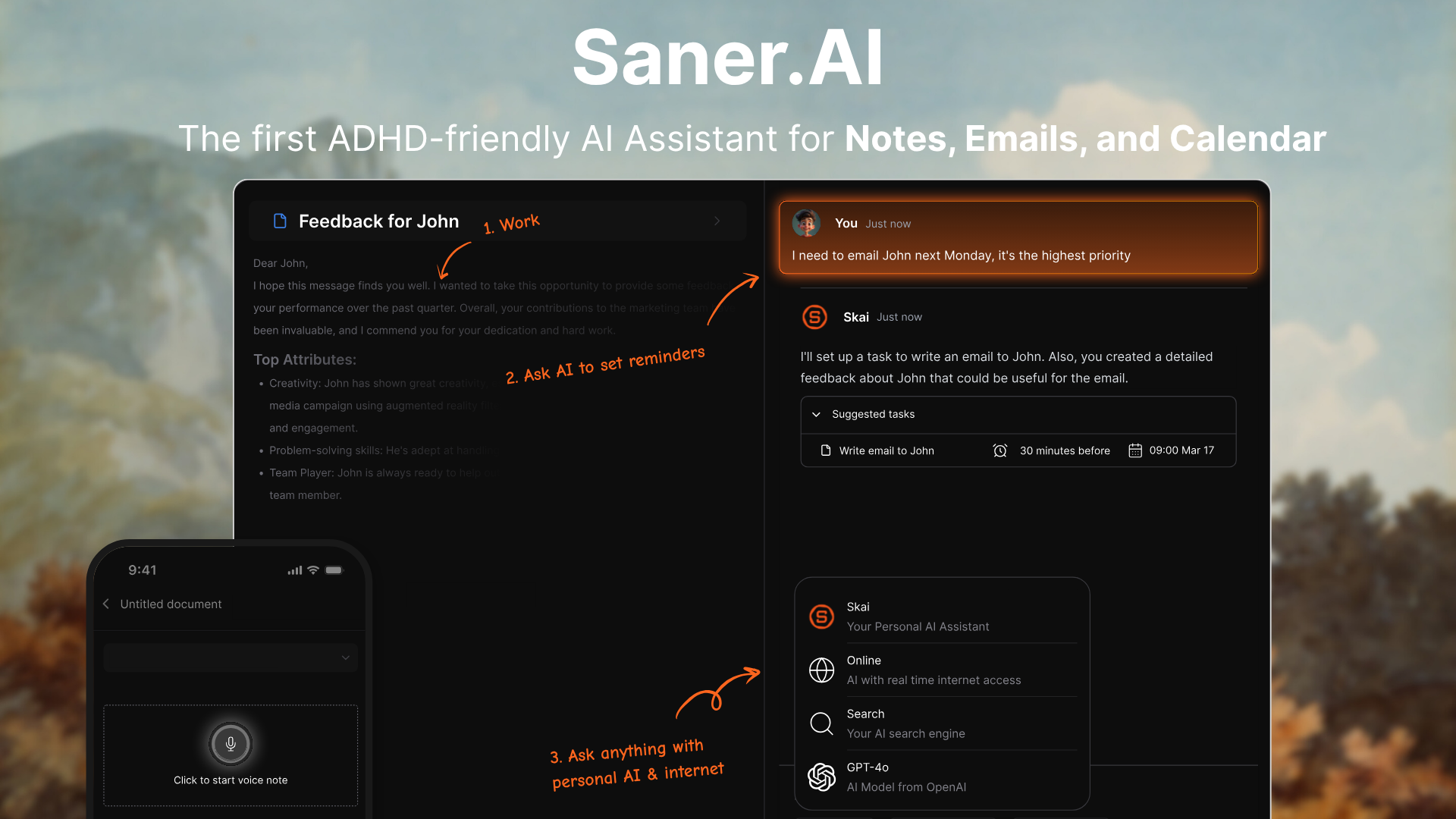
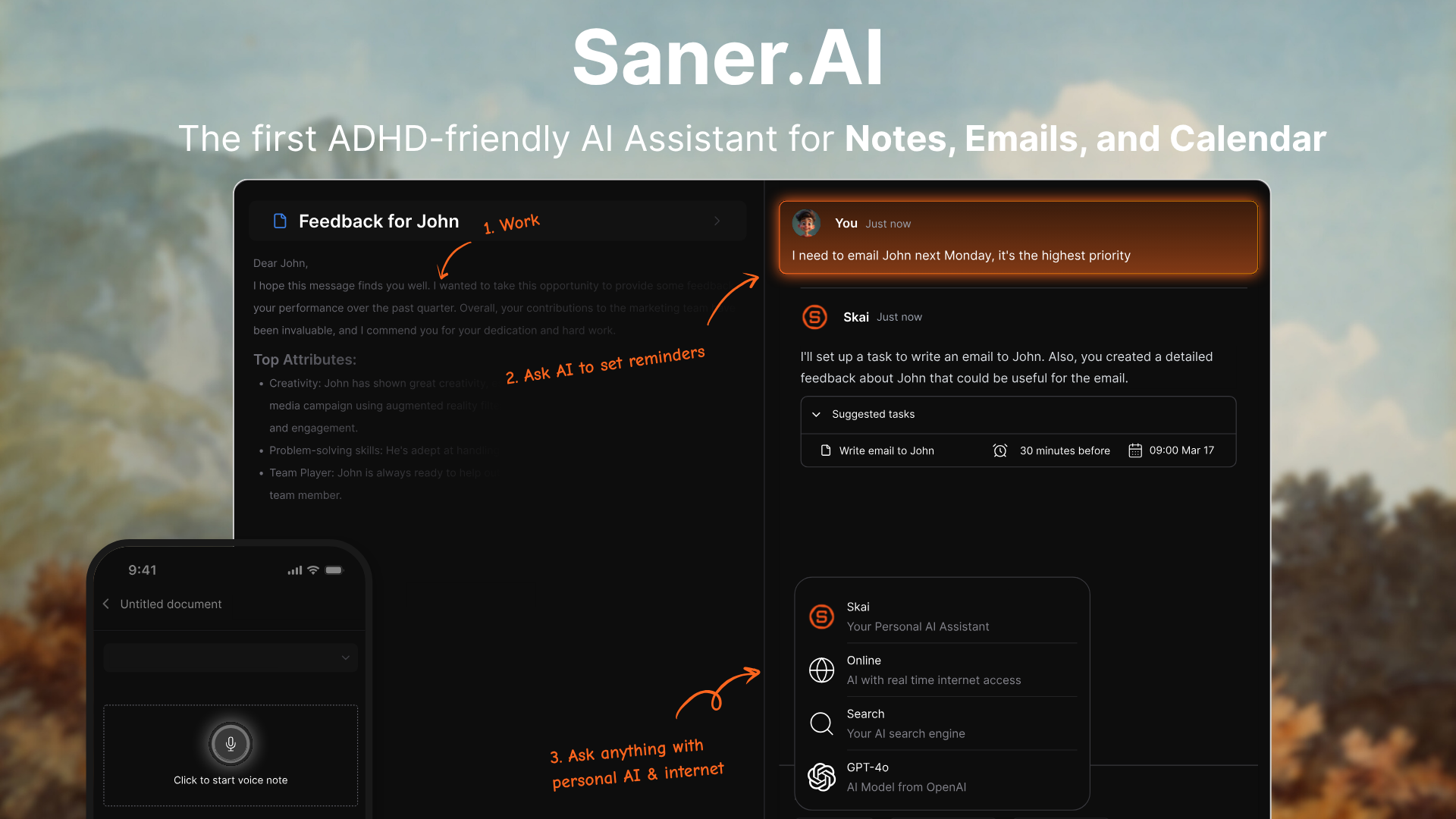
We built Saner.AI because one of our co-founders has ADHD and couldn't find a tool that didn't need its own maintenance plan. It's an AI personal assistant for notes, email, calendar, and tasks, and the whole idea is to take some of that invisible executive function work off your plate. It won't cure burnout. What it can do is carry part of the load while you recover.
- Brain dump, then walk away
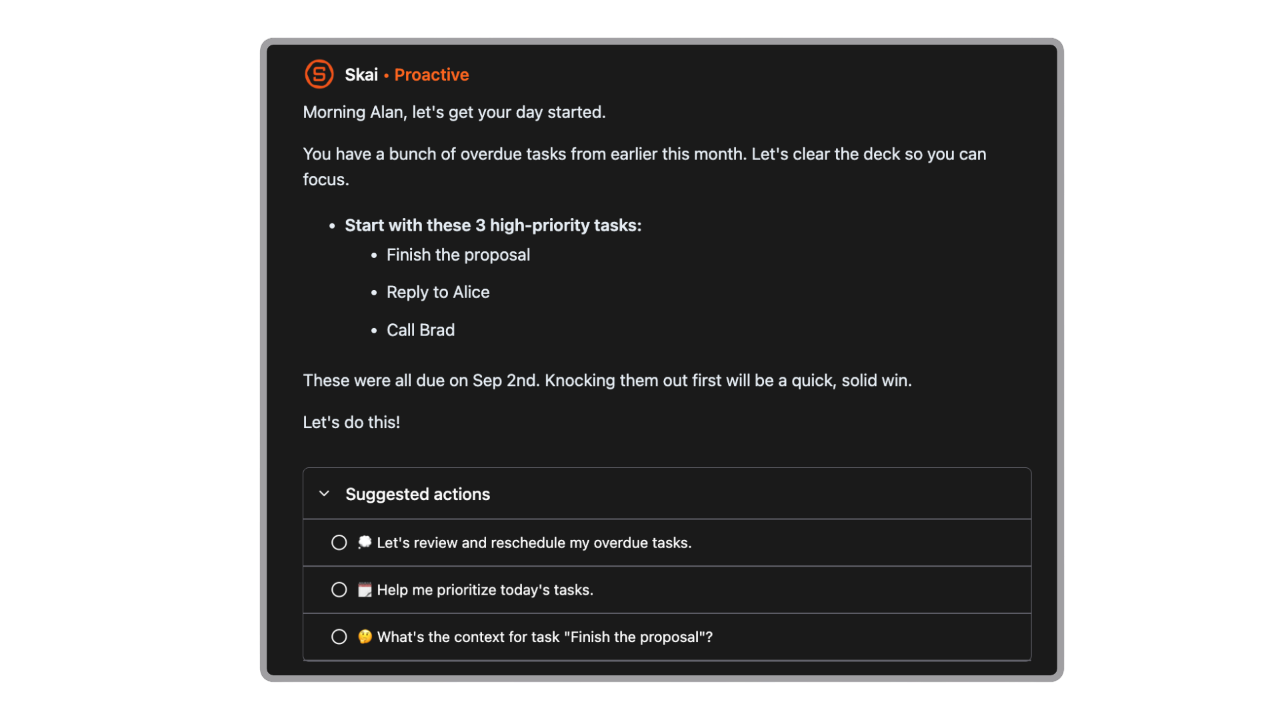
When your head is full, type or speak everything into Saner, messy and unsorted. Skai, the built-in assistant, turns that dump into tasks, reminders, or notes.
- Let the plan come to you
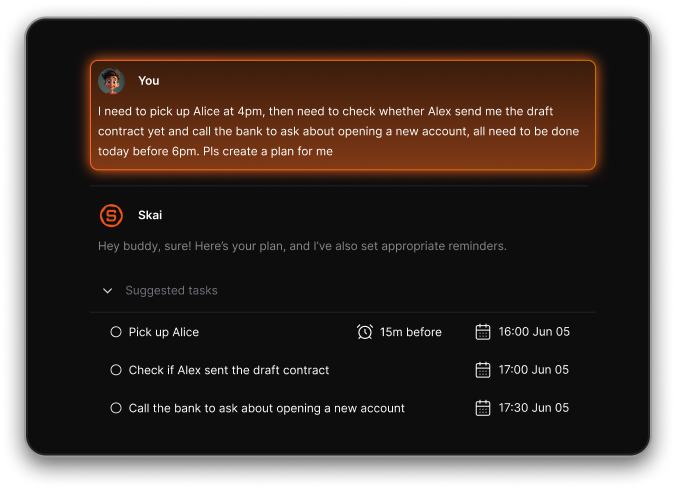
With Skai Proactive, it checks your calendar, overdue tasks, and recent notes each morning (or at a time you pick) and sends a short summary of what needs attention. You react to a plan instead of building one from scratch.
- Stop digging through tabs
Skai can turn emails into tasks and search across everything in plain language, so "what did Linh say about the Q4 budget?" works even if you don't remember where it was.

- Reminders that don't feel like nagging
Notifications can be snoozed, completed, or archived right from the card, and on mobile, Live Activities keep your current focus task on the lock screen.
What Saner.AI won't do
- It isn't a diagnosis, a therapist, or a replacement for ADHD treatment, and if your burnout looks like depression, an app is the wrong first step. Also, connecting your email and calendar means sharing personal data.
There's a free plan, and paid plans start at around $8 a month
When to get professional help
Tools and routines help, but some things need a professional. Book an appointment with a doctor, psychiatrist, or psychologist if:
- the exhaustion has lasted more than a few weeks, and rest isn't touching it
- you've lost interest in almost everything, not just work
- you suspect ADHD but have never been assessed
- your current treatment used to work and doesn't anymore
- you're leaning on alcohol, other substances, or all-nighters to get through
It can help to bring notes. Write down what you've noticed, when it started, and what makes it better or worse (a brain dump in any notes app works fine for this). ADDA also suggests bringing a trusted friend to the appointment if walking in alone feels like too much.
👉 You may like this post on how to improve Productivity for adults with ADHD
FAQ about ADHD burnout
Is ADHD burnout a real diagnosis?
No. ADHD burnout isn't a formal medical diagnosis or an official ADHD symptom. It's a term adults with ADHD use for long-term exhaustion from managing their symptoms. The WHO recognizes burnout only as a work-related phenomenon, not a medical condition. The exhaustion is still real, and research links ADHD to higher job burnout.
What does ADHD burnout feel like?
Most people describe it as an empty tank. Simple tasks like replying to an email or cooking dinner feel impossible, focus gets worse than usual, and irritability, guilt, and procrastination all go up. Physical signs like headaches, poor sleep, and getting sick more often are common too.
How long does ADHD burnout last?
It varies. ADDA says it can last from a few days to several months. It tends to stick around, or come back, when the things causing it (unmanaged symptoms, masking, poor sleep, too much on your plate) stay the same.
How is ADHD burnout different from depression?
Burnout is usually tied to specific situations and often eases with rest and a lighter load. Depression tends to affect every part of life, including things you used to enjoy, and doesn't lift much with rest. They can happen together, so if low mood lasts two weeks or more, see a professional.
Can an AI assistant help with ADHD burnout?
It can help with part of it. An AI assistant like Saner.AI can take over planning, capturing, and remembering, which are the executive function tasks that drain ADHD brains fastest. It can't treat ADHD, depression, or anxiety, so use it alongside proper care, not instead of it.
How do I prevent ADHD burnout from coming back?
Treat the underlying ADHD, keep your daily task list short, get information out of your head and into a trusted system, protect your sleep, and find at least one place where you don't have to mask. Watching for your own early warning signs, like rising irritability or a growing pile of avoided tasks, gives you time to ease off before you crash.
Sources
- ADDA Editorial Team. ADHD Burnout: Cycle, Symptoms, and Causes. Attention Deficit Disorder Association, updated September 2026.
- World Health Organization. Burn-out an "occupational phenomenon": International Classification of Diseases. 28 May 2019.
- Staley BS, et al. ADHD Diagnosis, Treatment, and Telehealth Use in Adults. MMWR 2024;73:890–895. CDC.
- Turjeman-Levi Y, Itzchakov G, Engel-Yeger B. Executive function deficits mediate the relationship between employees' ADHD and job burnout. AIMS Public Health, 2024;11(1):294–314.
- Soler-Gutiérrez AM, Pérez-González JC, Mayas J. Evidence of emotion dysregulation as a core symptom of adult ADHD: A systematic review. PLOS ONE, 2023;18(1):e0280131.
- Simon Fraser University. Adults with ADHD may pay high price to mask traits and fit in. June 2026 (study in Research in Neurodiversity).
- HealthDay. ADHD "masking" may help people blend in but harms mental health. 8 June 2026.
- Bijlenga D, et al. The circadian rhythm in adult ADHD: current state of affairs. Expert Review of Neurotherapeutics, 2013;13(10):1107–16.
- Koutsimani P, Montgomery A, Georganta K. The relationship between burnout, depression, and anxiety: A systematic review and meta-analysis. Frontiers in Psychology, 2019;10:284.
- Hamatani S, et al. Components of cognitive–behavioural therapy for mitigating core symptoms in ADHD: a systematic review and network meta-analysis. BMJ Mental Health, 2024;27(1).
- Simply Psychology. Effectiveness of CBT for ADHD core and emotional symptoms (summary of a 2023 meta-analysis of 28 studies).
Stay on top of your work and life effortlessly