
ADHD Waiting Mode: What is it and how to deal with it?

Quick answer: what is ADHD waiting mode?
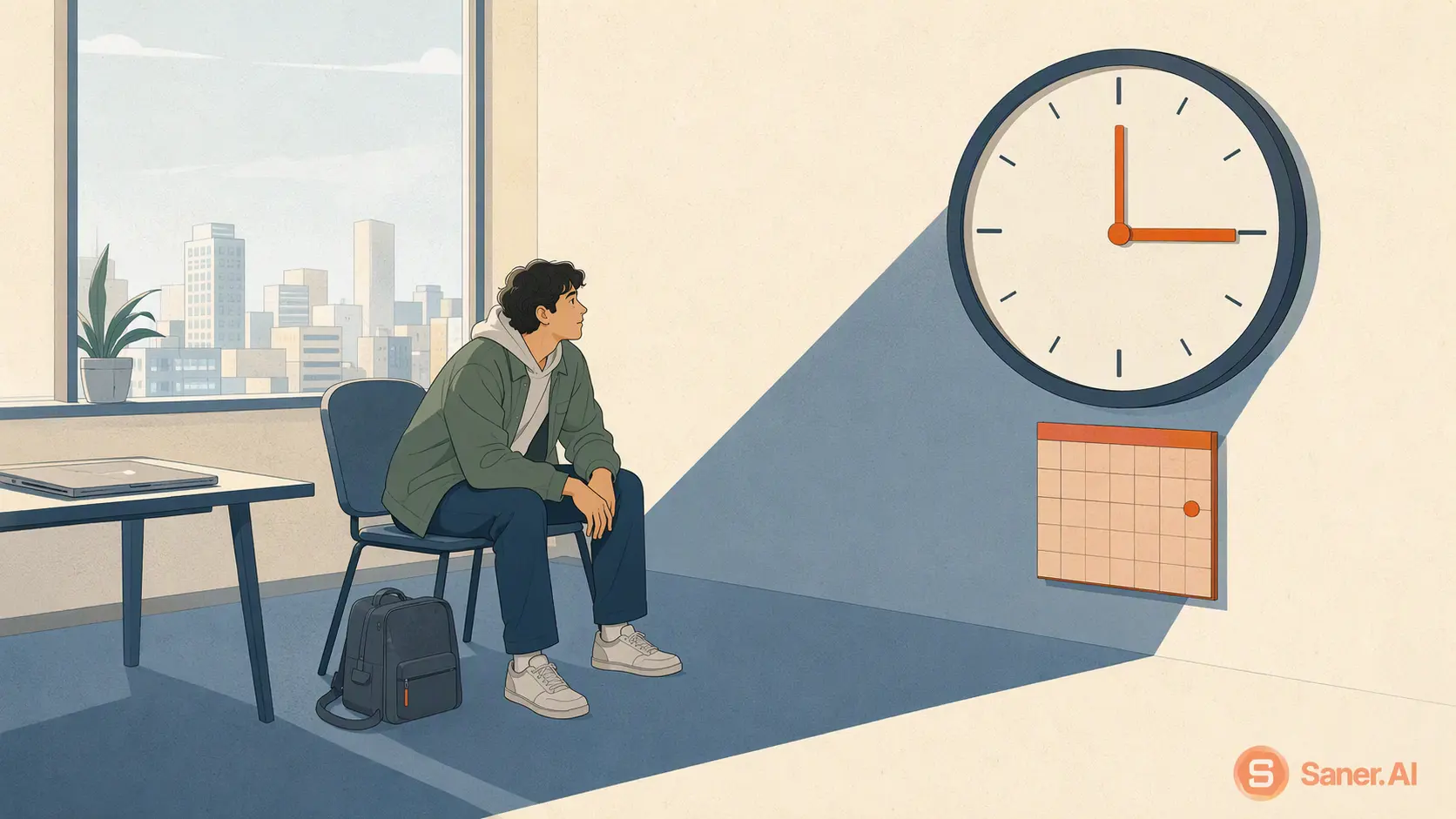
Here's the scene. You have an appointment at 3 p.m. It's 9 a.m., you have six free hours and a decent to-do list, and you fully intend to use them. Then it's 2:15. You've checked the time maybe 40 times, opened your inbox without replying to anything, and the only thing you've finished is a cold coffee.
If that's you, you're far from alone. About 6% of U.S. adults, roughly 15.5 million people, had a current ADHD diagnosis in 2023, and waiting mode is something a lot of them describe in almost the same words.
ADHD waiting mode is the stuck, restless state you fall into before a scheduled event, when you can't start anything else because part of your brain is busy guarding the appointment.
It's not a clinical diagnosis, and no study has examined it directly yet. It does overlap with things researchers have measured in ADHD: a less reliable sense of time, high rates of anxiety, and the way unfinished plans keep tugging at your attention.
Below I'll walk through why it happens, what the science does and doesn't say, and the strategies worth trying first
What waiting mode feels like

Waiting mode is the sense that your day is "on hold" until a fixed event arrives, even when that event is hours away. Healthline describes it as feeling unable to start other tasks when something is scheduled later that day, and notes that people with ADHD describe it in strikingly similar ways.
The trigger doesn't have to be big. People report it before:
- a doctor's or therapy appointment
- a sales call, interview, or 1:1 with their manager
- a flight, a train, or a friend picking them up
- a delivery window ("between 12 and 4" is basically a day-eater)
- a Zoom meeting at an awkward time, like 11:30
Why ADHD waiting mode happens: what the research suggests
1. Your internal clock is less reliable
- A 2021 meta-analysis in the Journal of the American Academy of Child and Adolescent Psychiatry pooled 55 studies on timing and found deficits across every timing task tested, including estimating and producing time intervals. The authors read the pattern as a sign of an internal clock that runs fast.
- Psychologist Christian Mette, told Psychiatry & Behavioral Health Learning Network that adult ADHD treatment should address time perception but often doesn't.
If you can't trust your sense of how long 40 minutes feels, staying near the clock starts to look like the safe choice.
2. Anxiety is often part of the picture

In the U.S. National Comorbidity Survey Replication, 47% of adults with ADHD had an anxiety disorder in the previous 12 months. A 2025 review in Frontiers in Psychiatry puts it more broadly: about 70% of adults with ADHD live with at least one other mental health condition.
So the low hum of "don't miss it, don't be late, what will I say" isn't imaginary. For many ADHD adults, it sits right on top of the timing problem.
3. Unfinished plans keep pinging you
In a series of experiments, psychologists E.J. Masicampo and Roy Baumeister found that unfinished goals caused intrusive thoughts and worse performance on unrelated tasks. When participants wrote a specific plan for that goal, the interference disappeared, even though they hadn't done the task yet.
An appointment is an open loop with a timestamp. If your brain doesn't trust that the plan is handled (when to leave, what to bring, what to say), it keeps checking. That checking is what waiting mode feels like from the inside.
Signs you're stuck in waiting mode
You might be in waiting mode if a few of these show up on appointment days:
- You check the clock every few minutes, even though you have hours left.
- You start tasks and abandon them after a couple of minutes because "there isn't really time."
- You do low-value busywork (tidying a drawer, scrolling) instead of the thing you planned.
- You feel restless and tired at the same time.
- You arrive early, sometimes very early, because waiting at home felt worse.
- You avoid booking anything mid-day, because one 2 p.m. call wipes out the whole day.
- Afterward, you feel guilty about the "wasted" hours, which makes the next appointment day feel heavier.
7 ways to get out of ADHD waiting mode
1. Write the worry down for 10 minutes
In a study published in Science, students who spent 10 minutes writing about their worries right before a high-stakes exam scored higher than students who didn't, and the effect was strongest for the most anxious students. Lead researcher Sian Beilock said the exercise "leveled the playing field." The idea is that worry takes up working memory you need for other things, and writing it down frees some of that space.
Try it before an appointment:
- Set a timer for 10 minutes.
- Write everything that's looping: what you're nervous about, what you need to bring, what you'll say, what could go wrong. Braindump.
- Don't organize it. Messy is fine.
2. Turn the appointment into a specific plan
Remember the Masicampo and Baumeister finding? The thought-loops stopped once people wrote a concrete plan, and the effect held mainly for people who meant to follow through. So close the loop on paper. Write down:
- your leave-by time (not the appointment time)
- what you need to bring
- the one or two things you want to get out of the appointment
If-then plans are worth a special mention. In lab studies, children with ADHD who made if-then plans improved their response inhibition to the level of children without ADHD.
3. Hand the clock to something outside your head

- Set two alarms: a "start wrapping up" alarm 20 to 30 minutes before you leave, and a "leave now" alarm.
- Use alarms that need an action to dismiss, or put your phone across the room.
- Ask someone with a steadier sense of time to text you, especially if they're coming with you.
- Keep a visible countdown (a lock-screen timer or widget) so you don't have to keep checking.
Once the clock is guarded by something else, a lot of the background tension drops.
4. Pick a task with a built-in ending
The stop-planning problem goes away if the task already has a natural end. Good candidates are things that take 15 to 45 minutes and are done when they're done: replying to five emails, a load of laundry, outlining one blog post, a short walk.
5. Notice it, name it, and let it pass

Sometimes just saying "oh, this is waiting mode" takes a bit of the shame out of it. Mindfulness practice builds that habit. In a randomized trial of 120 adults with ADHD, adding mindfulness-based cognitive therapy to usual care improved clinician-rated ADHD symptoms compared with usual care alone, with benefits still visible six months later. Reviewers have flagged limits in the design, so think of it as one helpful tool, not a cure.
6. Book appointments early when you can
This is the most boring tip and maybe the most effective. If a 3 p.m. slot ruins your whole day, Healthline suggests scheduling things as early in the day as you can, so there's less runway to get stuck on. Some people also batch appointments onto one "errand day" and protect the rest of the week.
7. Go early and wait there
If you're going to wait anyway, wait somewhere useful. Leave with plenty of buffer, bring a small, portable task (reading, voice notes, a short draft on your phone), and do it near the appointment. Being physically close removes the "will I be late?" worry, and the task fills the gap. I'll admit this feels a bit like giving in, but it often works better than fighting the waiting at home.
How Saner.AI can help you with "waiting mode"
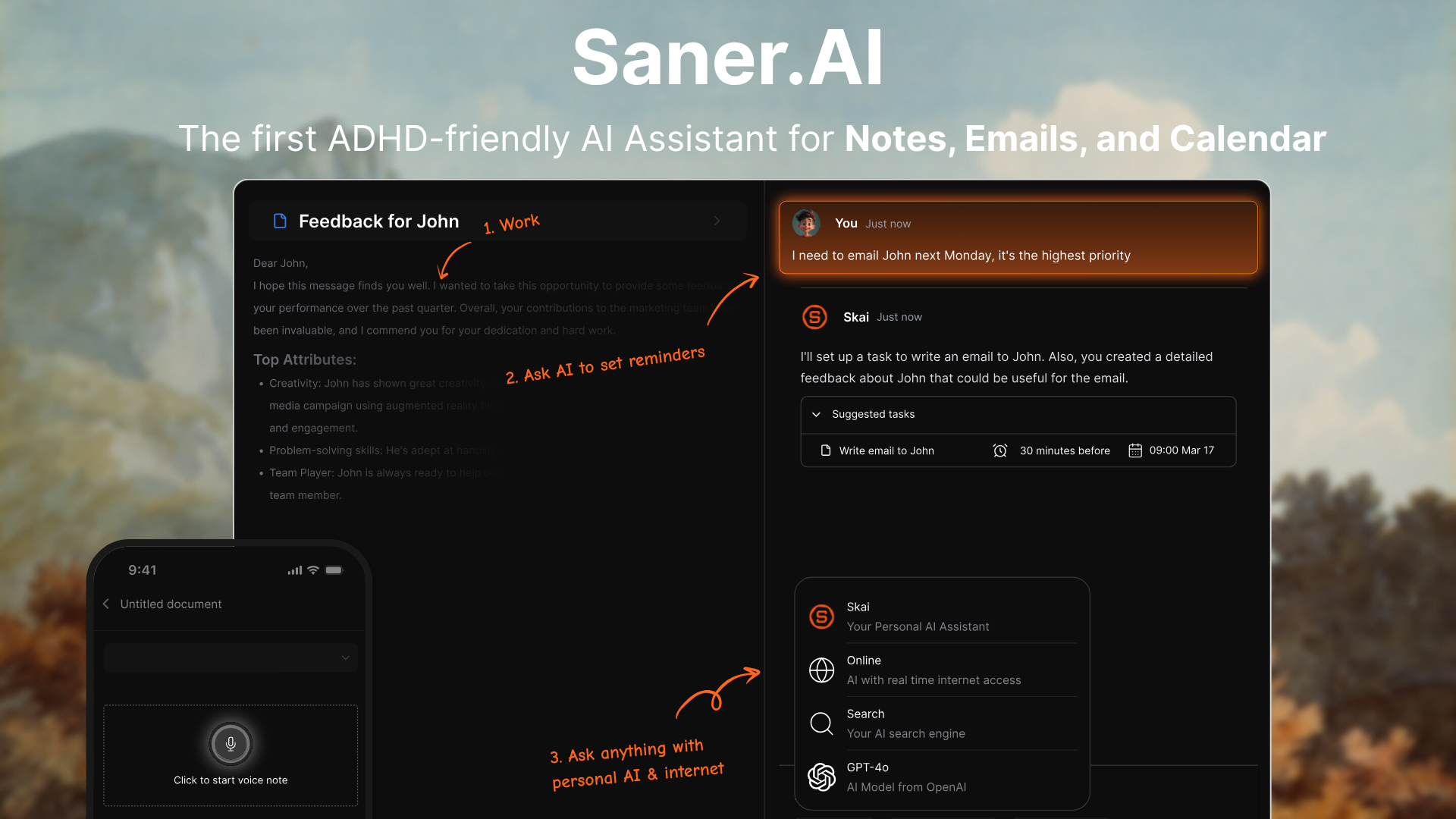
Most of the strategies above have the same shape: get the loop out of your head, make a concrete plan, and let something else watch the clock. Saner.AI is an AI personal assistant built for people with ADHD that puts notes, tasks, email, and calendar in one place, and you talk to it in plain language through its assistant, Skai.
Here's how it maps onto a waiting-mode day.
- Dump the pre-appointment noise in one message
Open Saner and type (or say) everything that's looping, unedited. With Smart Add, Skai can save that as a note, turn the actionable bits into tasks, and file them into related notes or folders. That's strategy 1 and 2 in one move
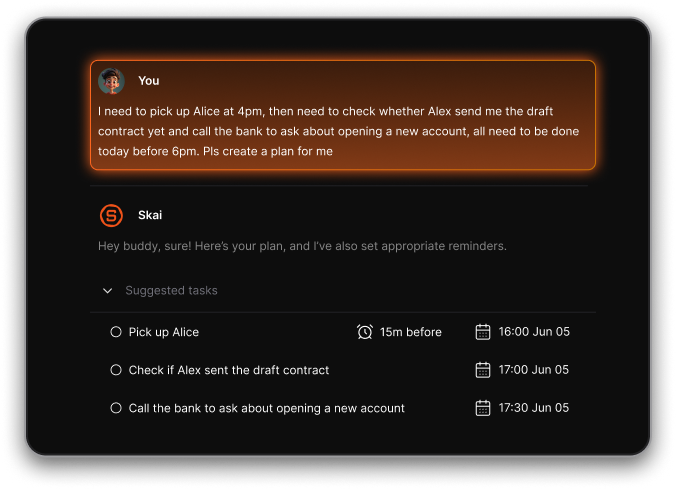
- Get a plan before the day gets away from you
Skai Proactive scans your calendar, overdue tasks, and recent notes each morning (or at a time you pick) and gives you a summary of what needs attention. On an appointment day, that means you see the 3 p.m. event next to the two or three things that realistically fit before it, instead of staring at the whole list.
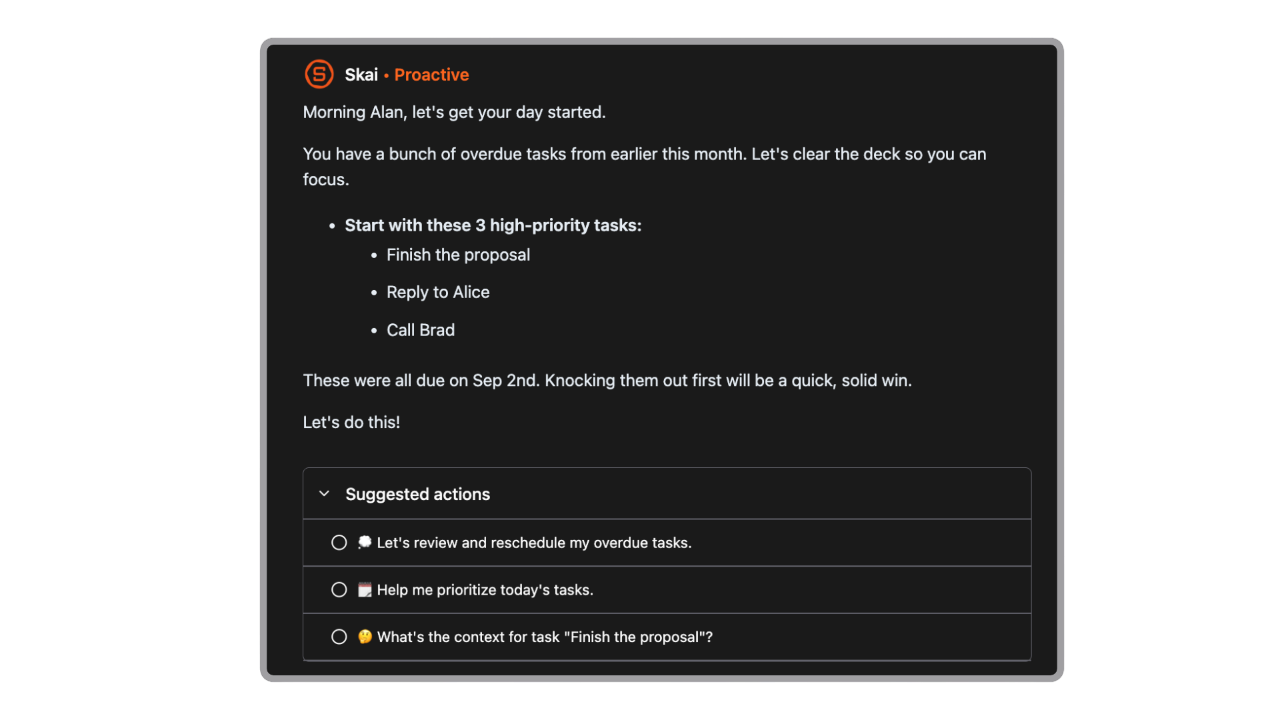
- Stop worrying about what's slipping elsewhere
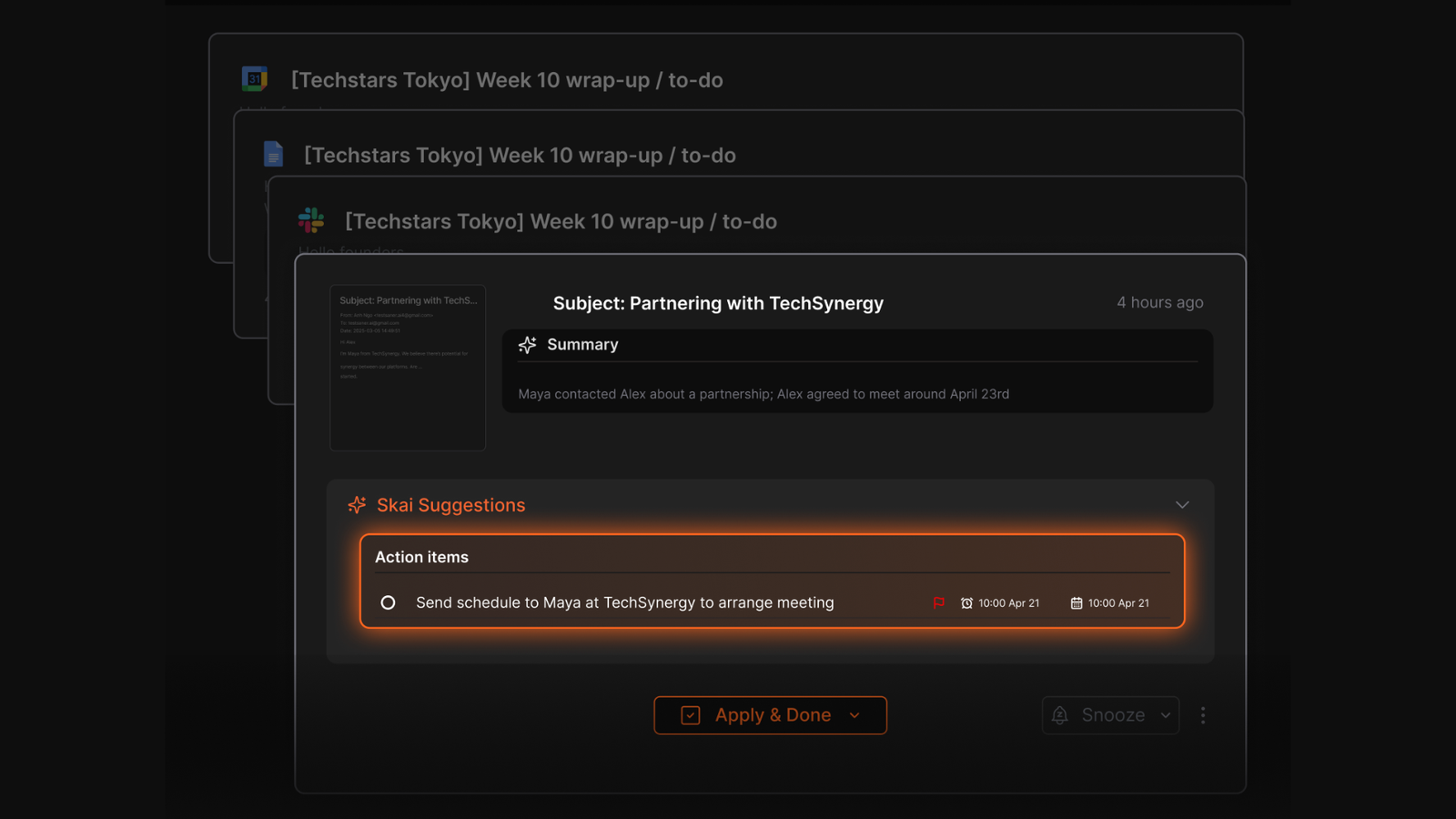
Part of waiting mode is a vague sense that something else is falling through the cracks. Saner can pull action items out of your email and connect Gmail, Outlook, Google Calendar, Google Drive, and Slack, so follow-ups surface on their own. That's one less thing to hold while you wait.
- See how much time you really have
You can give tasks a duration and see them as blocks on your calendar, right next to the appointment. That makes the gap visible: "I have 3 hours and 40 minutes, and this task takes 45."
- Let reminders do the clock-watching
Set your leave-by reminder in plain language ("remind me at 2:20 to leave for the dentist") and snooze or mark it done right from the notification. On mobile, Live Activities keep your focus task on the lock screen, so you don't have to open anything to know where you are.
Pricing plan
- Free plan
- Paid plans start at $8 a month for Starter and $16 a month for Standard, billed yearly.
When it might be more than waiting mode
An occasional stuck morning before a big meeting is normal. It's worth talking to a doctor, psychologist, or ADHD specialist if:
- it happens most days, or before small events like a quick phone call
- the worry feels hard to control, or shows up as a racing heart, stomach trouble, or poor sleep
- you're turning down jobs, appointments, or plans to avoid the waiting
- You suspect ADHD but have never been assessed
You wouldn't be unusual. The CDC found that more than half of U.S. adults with ADHD were diagnosed at 18 or older, and about a third received no treatment in the past year. Treating anxiety and ADHD together can change how appointment days feel, and that's a conversation for a clinician.
FAQ about ADHD waiting mode
Is waiting mode an official ADHD symptom?
No. It isn't in any diagnostic manual, and there's no research on waiting mode specifically. It's a name the ADHD community uses for a common experience that likely draws on timing difficulties, anxiety, and executive function challenges.
Do people without ADHD get waiting mode?
Yes, sometimes, especially before stressful events. People with ADHD, autism, anxiety, or depression tend to report it more often and for longer stretches.
Why can't I start anything if I have hours left?
Starting a task before an appointment means also planning when to stop, and an unreliable sense of time makes that stop point feel risky. Add background worry about the appointment, and doing nothing can feel like the safest option, even though it rarely feels good.
What's the fastest way to break out of waiting mode?
Write a quick plan with your leave-by time, set two alarms you can't ignore, then pick one task that's done in under 45 minutes. Getting the clock out of your head is usually what loosens things.
Can an app really help with waiting mode?
It can help with the parts that rely on memory and planning: capturing worries, turning them into tasks, showing how much time you have, and reminding you when to leave. Saner.AI does those in one place. An app won't treat underlying anxiety or ADHD, so if waiting mode is affecting your work or relationships, talk to a professional too.
👉 You may like this post on how to improve Productivity for adults with ADHD
Sources
- Staley et al., ADHD Diagnosis, Treatment, and Telehealth Use in Adults, CDC MMWR, Oct 2024
- Marx et al., Meta-analysis: Altered Perceptual Timing Abilities in ADHD, JAACAP, 2021
- Mette, Time Perception in Adult ADHD: Findings from a Decade, a Review, IJERPH, 2023
- Adult ADHD Treatment Should Address Time Perception, Expert Says, HMP Global Learning Network
- Hsu, Benikos & Sonuga-Barke, Spontaneous activity in the waiting brain, Developmental Cognitive Neuroscience, 2015
- Managing ADHD in Children, Adolescents, and Adults With Comorbid Anxiety in Primary Care (NCS-R data), Primary Care Companion to the Journal of Clinical Psychiatry
- Adult ADHD and comorbid anxiety and depressive disorders: a review, Frontiers in Psychiatry, 2025
- Masicampo & Baumeister, Consider it done! Plan making can eliminate the cognitive effects of unfulfilled goals, Journal of Personality and Social Psychology, 2011
- Ramirez & Beilock, Writing About Testing Worries Boosts Exam Performance, Science, 2011 (University of Chicago release via ScienceDaily)
- Gawrilow & Gollwitzer, Implementation intentions facilitate response inhibition in ADHD children, Cognitive Therapy and Research, 2008
- Janssen et al., Mindfulness-based cognitive therapy v. treatment as usual in adults with ADHD, Psychological Medicine, 2019
- ADHD Waiting Mode, Healthline