AI and ADHD Statistics: How ADHD Adults Are Using AI in 2026

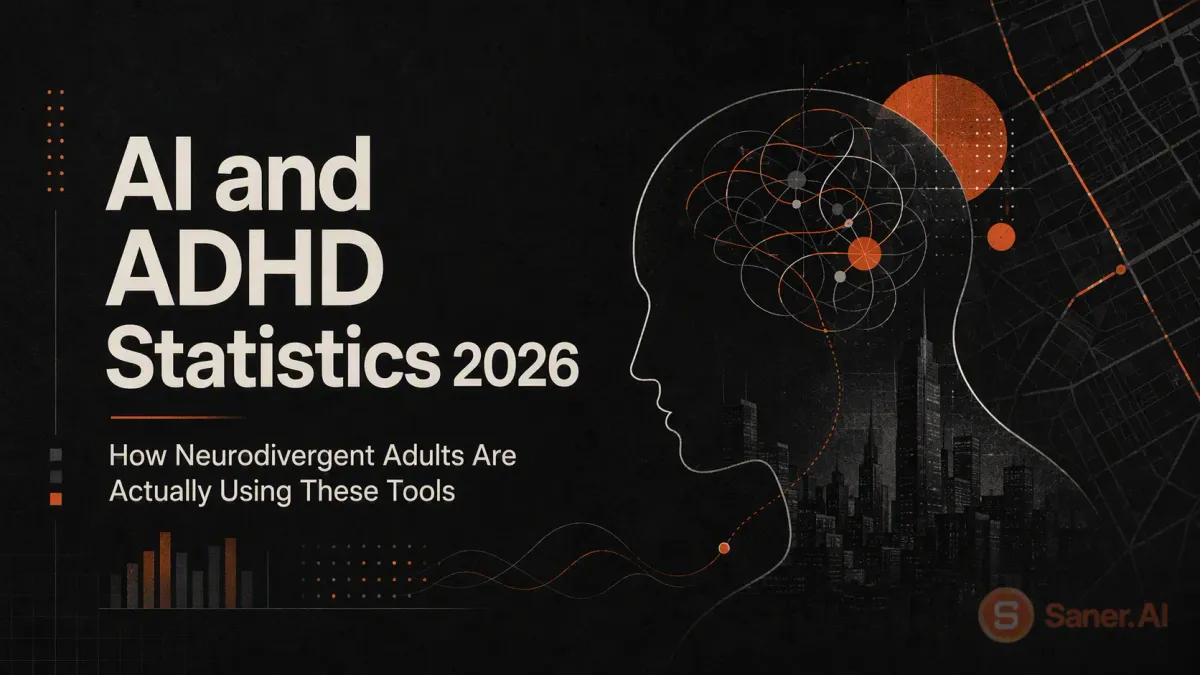
78% of neurodivergent employees now use AI at work, 6.0% of U.S. adults have a current ADHD diagnosis, and 34.7% of disabled students using generative AI for writing cite ADHD or neurodivergence - yet researchers are also finding potential drawbacks. Below is what the data actually says on both sides.
Key AI and ADHD statistics
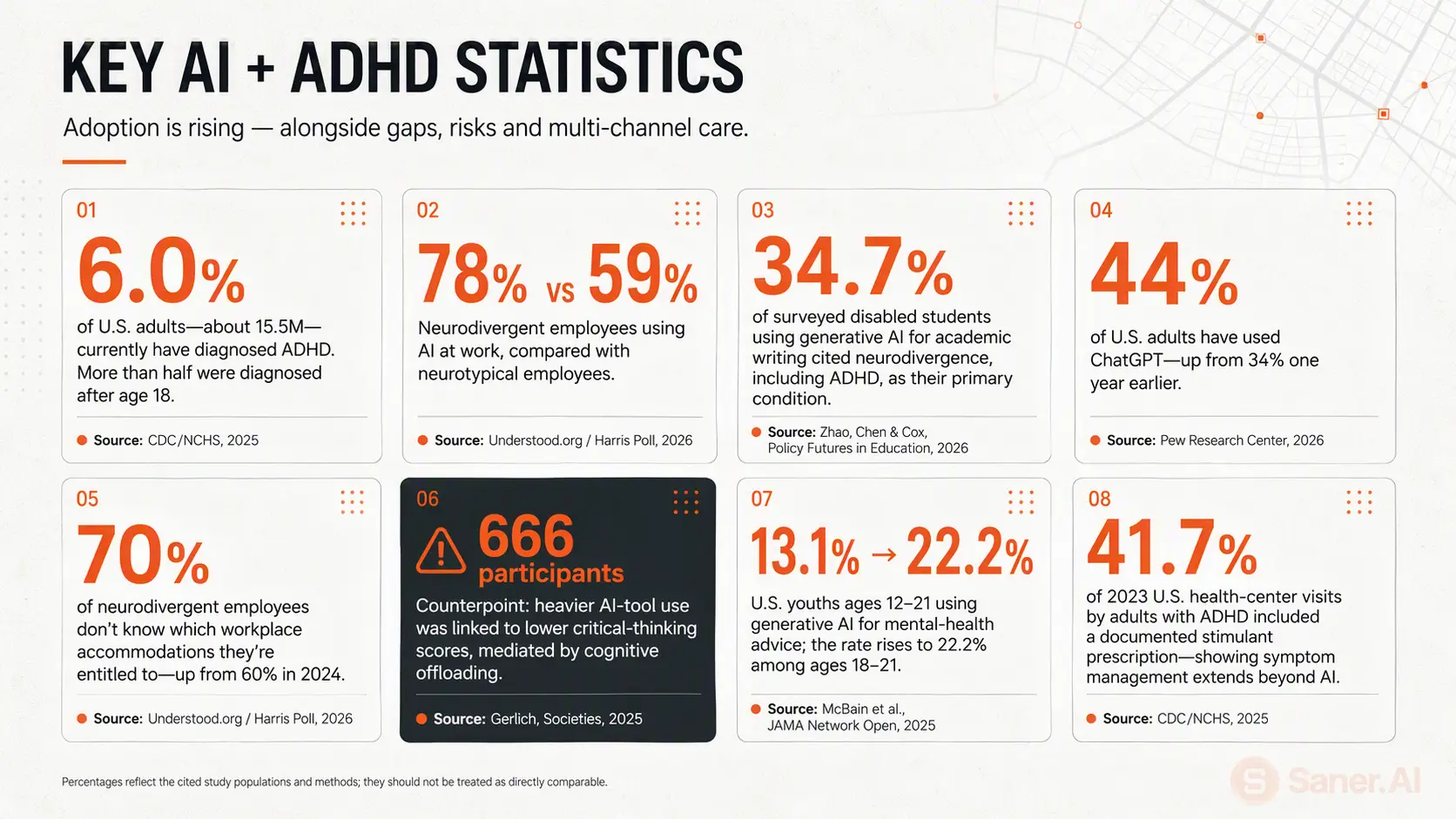
- 6.0% of U.S. adults (about 15.5 million people) currently have a diagnosed ADHD, and more than half were diagnosed after age 18 (CDC/NCHS, 2025)
- 78% of neurodivergent employees say they use AI tools at work, compared with 59% of neurotypical employees (Understood.org/Harris Poll, 2026)
- 34.7% of surveyed disabled students using generative AI for academic writing cited neurodivergence, including ADHD, as their primary condition (Zhao, Chen & Cox, Policy Futures in Education, 2026)
- 44% of U.S. adults now report having used ChatGPT, up from 34% just a year earlier (Pew Research Center, 2026)
- 70% of neurodivergent employees say they have no idea what workplace accommodations they're entitled to — up from 60% in 2024, even as AI use climbs (Understood.org/Harris Poll, 2026)
- Counterpoint: in a peer-reviewed study of 666 people, heavier AI tool use was linked to measurably lower critical-thinking scores, mediated by cognitive offloading (Gerlich, Societies, 2025)
- 13.1% of U.S. youths aged 12–21 report using generative AI for mental health advice, rising to 22.2% among 18–21-year-olds — general-population data relevant given ADHD's high anxiety comorbidity (McBain et al., JAMA Network Open, 2025)
- 41.7% of U.S. health center visits by adults with ADHD included a documented stimulant prescription in 2023, underscoring how many ADHD adults are managing symptoms through multiple channels at once, not AI alone (CDC/NCHS, 2025)
Table of contents
2. How are ADHD adults actually using AI day to day?
3. Is AI closing the ADHD workplace and education gap?
4. AI adoption across different populations
5. When does AI use backfire for ADHD brains?
6. What these statistics mean for ADHD adults choosing AI tools
7. Quotable AI and ADHD statistics
8. FAQ
9. Sources
1) How many people have ADHD, and how many are turning to AI?
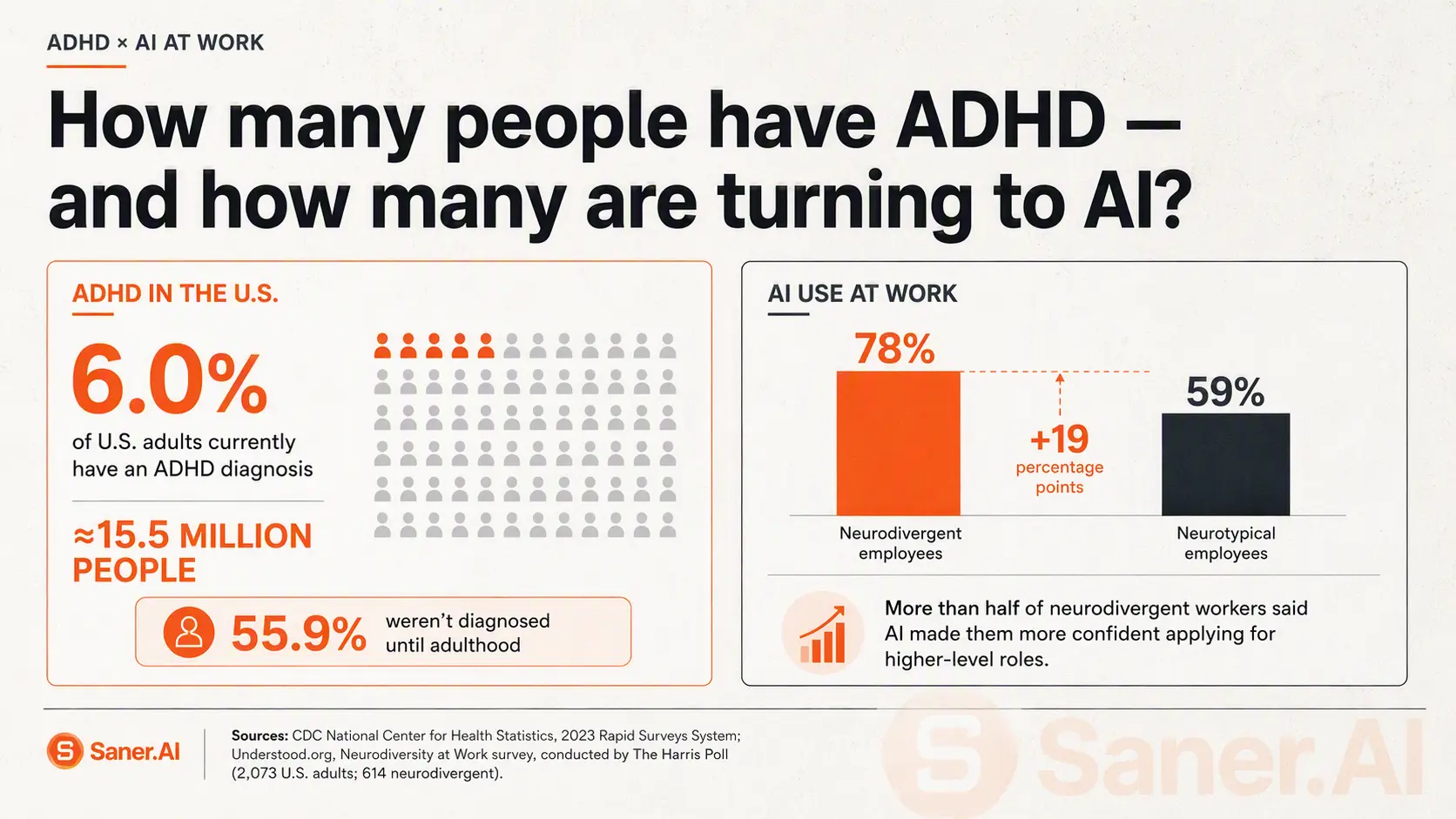
How common is ADHD among U.S. adults in 2026?
- Among children, CDC data shows boys are diagnosed at roughly double the rate of girls (13% vs. 7%), a gap researchers link partly to underrecognized presentation in girls rather than lower actual prevalence.
- 41.7% of their health center visits included a documented stimulant prescription, and 40.1% involved a co-diagnosis of a non-mental-health chronic condition, most commonly overweight or obesity.
For most adults with ADHD, AI tools are entering a life that already includes medication, therapy, or other supports, not replacing them.
How many neurodivergent adults are using AI tools right now?
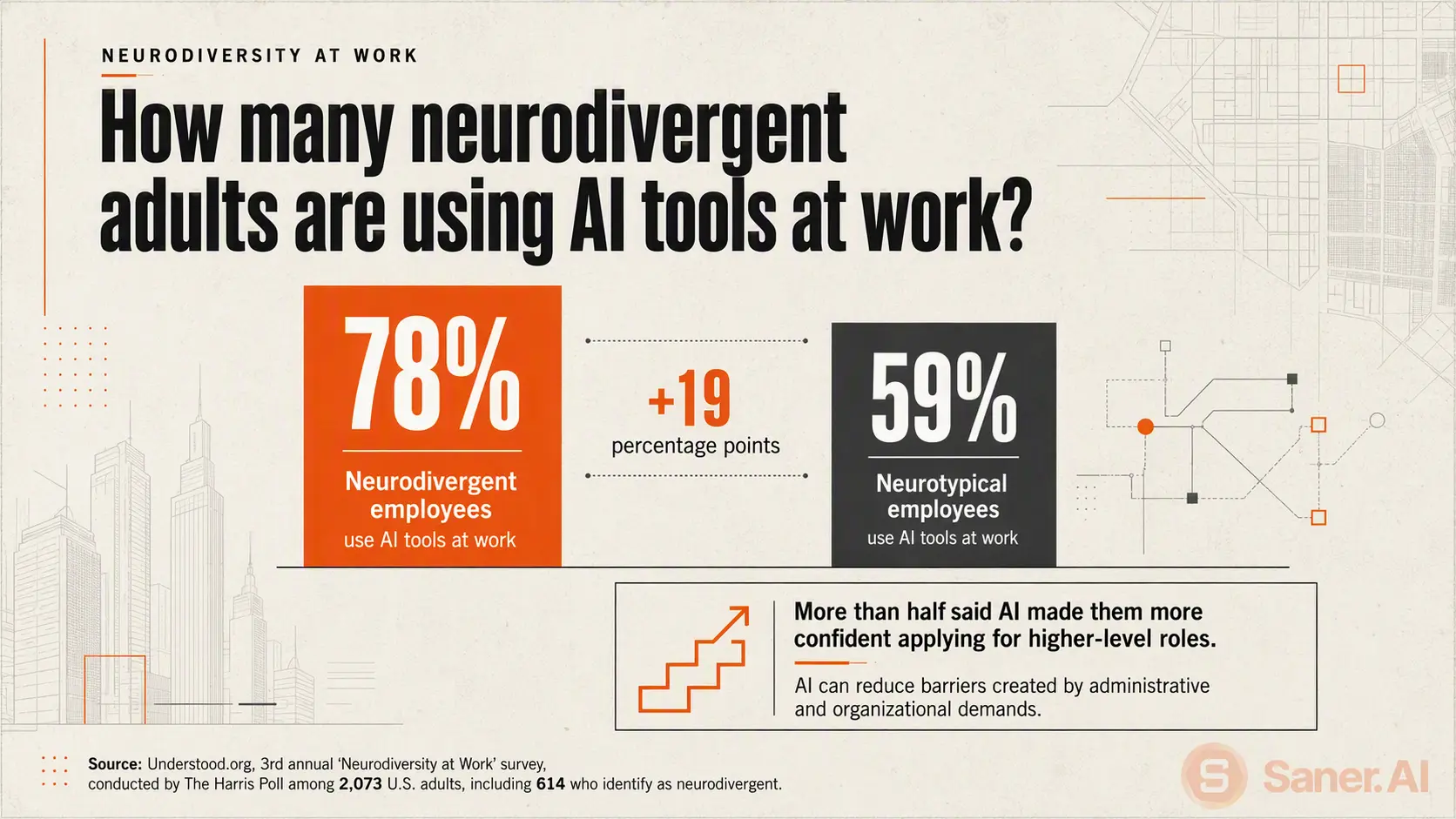
- Understood.org's third annual "Neurodiversity at Work" survey, conducted by the Harris Poll among 2,073 U.S. adults (614 of whom identify as neurodivergent), found that 78% of neurodivergent employees say they use AI tools at work, compared with 59% of neurotypical employees.
More than half of neurodivergent workers said AI tools made them more confident applying for higher-level roles they'd previously felt shut out of due to administrative or organizational demands.
- It's worth being precise about what this survey measures: "neurodivergent" here includes ADHD, autism, dyslexia, and other conditions together, not ADHD in isolation.
2) How are ADHD adults actually using AI day to day?
What tasks are ADHD adults offloading to AI?
- A seven-day diary study and interview study of 13 adults with ADHD, presented at the 2025 Australian Conference on Human-Computer Interaction, found participants using ChatGPT to bridge communication gaps between neurotypical and neurodivergent perspectives and to support both executive function and emotional regulation.
- CHADD's National Resource Center: people using AI to break large projects into smaller steps, draft difficult emails, and reduce the mental load of holding multiple tasks in working memory at once.
Does AI genuinely support executive function, or is this anecdote?
A 2025 study published in BMC Psychology tested whether ChatGPT could help design individualized executive-function rehabilitation plans for people with ADHD across different age groups:
- The AI-generated plans scored well on internal coherence and comprehensiveness — covering multiple executive functions with both practical and metacognitive strategies
- It showed more variability in adaptability and accuracy, meaning the plans weren't reliably tailored to real individual differences without expert review.
3) AI adoption across different populations
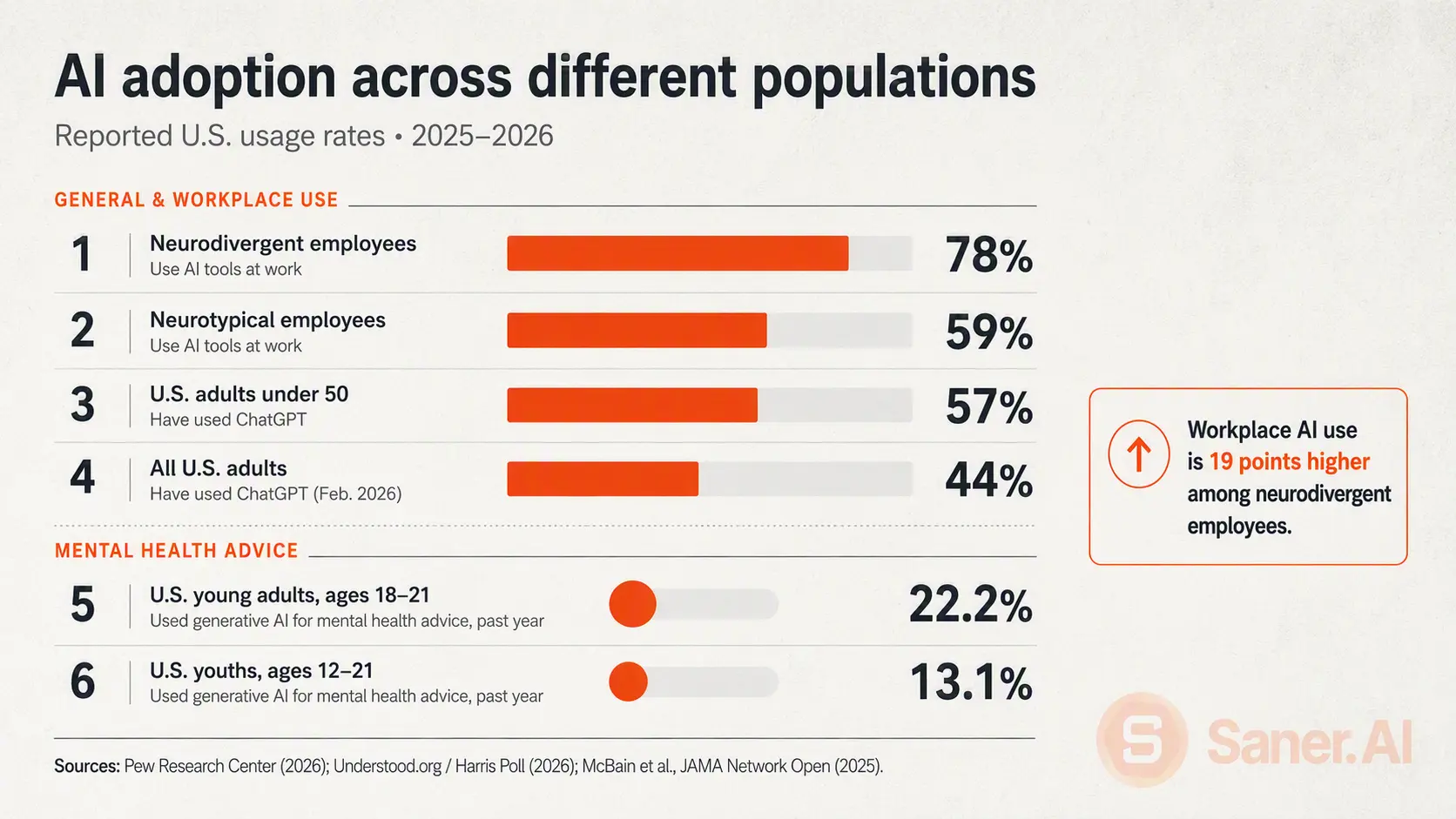
4) Is AI closing the ADHD workplace and education gap?
How does AI use differ between neurodivergent and neurotypical employees?
People are reaching for a tool they can use privately, on their own terms, rather than going through a process that still feels stigmatized.
How are ADHD students using AI for academic writing?
- A 2026 study in Policy Futures in Education by researchers at the University of Sheffield surveyed 124 disabled students about their use of generative AI in academic writing: Neurodivergent conditions, including ADHD, were the most commonly cited category, reported by 34.7% (43 of 124) of respondents, ahead of specific learning difficulties like dyslexia (29%) and autism-spectrum conditions (21.8%).
- The AI's ability to explain complex material more accessibly, help them express ideas they struggled to put into words, and support planning and structuring a piece of writing before starting it.
5) When does AI backfire for ADHD brains?
Does relying on AI weaken critical thinking?
- A 2025 peer-reviewed study published in Societies surveyed and interviewed 666 people across a range of ages and education levels and found that: the more people delegated thinking tasks to AI, the less they engaged in the kind of reflective reasoning that keeps critical-thinking skills sharp.
- Younger participants showed both higher AI dependence and lower critical-thinking scores; higher educational attainment appeared to buffer the effect somewhat (this study wasn't conducted on an ADHD sample specifically).
Is AI safe for ADHD-related emotional or mental health support?
- The JAMA Network Open study referenced above found that among the 13.1% of surveyed youths using generative AI for mental health advice, 92.7% found it somewhat or very helpful — a notably high satisfaction rate.
- However, there are currently few standardized benchmarks for evaluating the quality of mental health advice AI chatbots give, and limited transparency into how the underlying models were trained to handle sensitive disclosures.
Where does the risk actually sit?
- Edge Foundation draws explicitly in its own guidance for ADHD adults: AI is most useful as a scaffold, something that reinforces a person's own systems, and becomes a liability when it functions as a substitute for them — replacing rather than supporting judgment, routine, and human connection.
- Using AI itself can become a new form of unproductive avoidance, where organizing and optimizing with the tool replaces actually doing the task.
6) What these statistics mean for ADHD adults choosing AI tools
- Adoption is real, and it's outpacing formal support systems.
- Neurodivergent adults are adopting AI faster than neurotypical adults across both the workplace and higher education, and they're doing it largely with general-purpose tools that weren't built with ADHD in mind.
- People are having to personalize ChatGPT themselves, building their own prompts and workflows from scratch, because nothing was designed around their actual difficulty starting tasks or holding multiple steps in mind.
That gap between general-purpose adoption and purpose-built design is worth naming plainly: it's a large part of why tools built specifically around ADHD-friendly structure exist at all — the same task-breakdown and externalized-memory benefits people are already finding in ChatGPT, without requiring each person to reinvent that scaffolding from zero every time.
That's what we have in mind when building Saner.AI, a tool specifically for ADHD people to help manage their work and personal life without setting up anything.
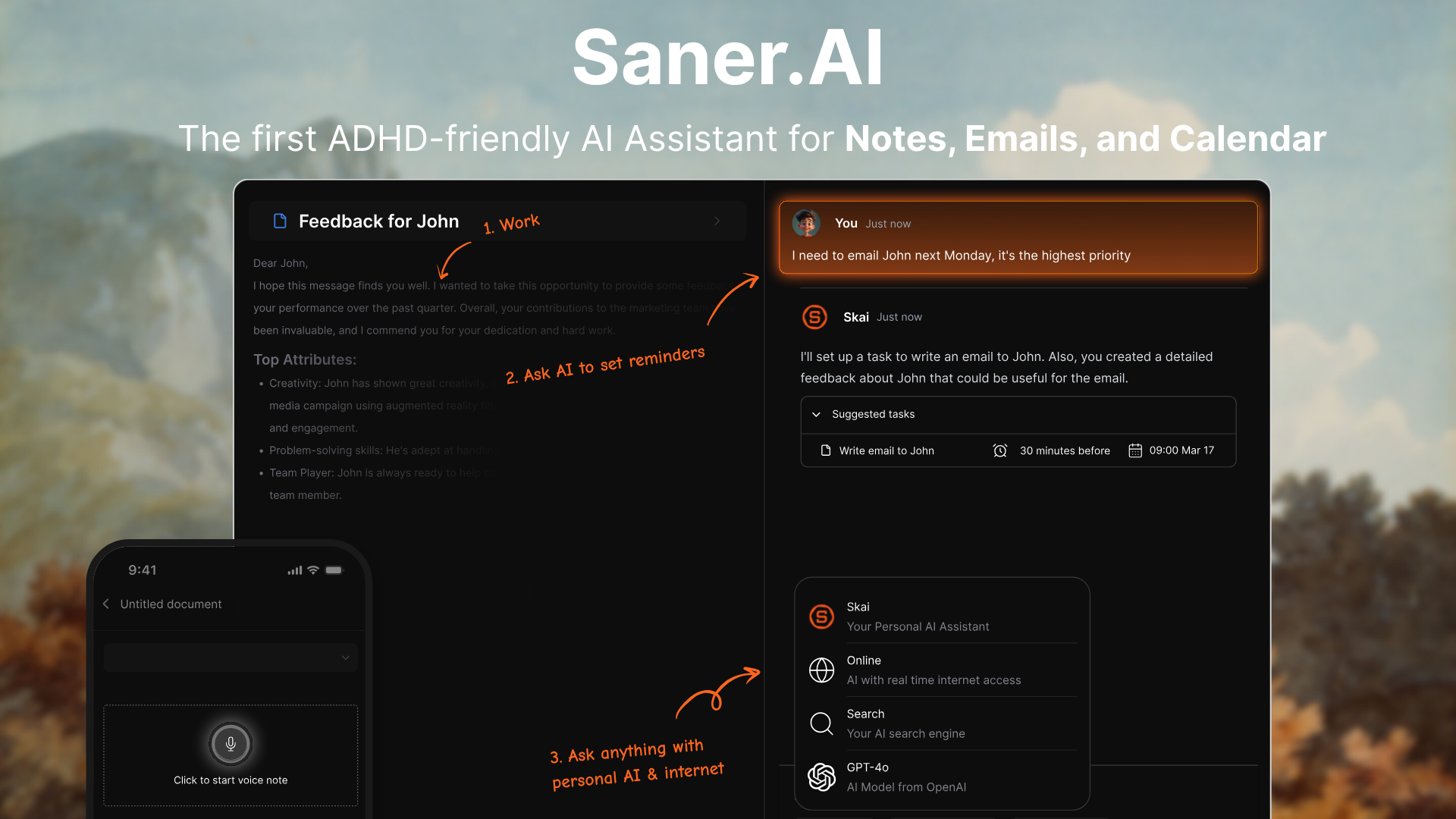
Stay on top of your work and life effortlessly
👉 You may like this post on how to improve Productivity for adults with ADHD
- The offloading risk is real, and it's not a reason to avoid AI — it's a reason to use it deliberately.
- AI should reinforce a person's own systems, not replace the parts of thinking they actually want to keep exercising.
- The students in the Sheffield study who chose to avoid AI for some tasks weren't being AI-skeptics for its own sake — they were protecting specific reasoning skills they didn't want to lose, which is a distinction worth respecting rather than flattening into "more AI use is always better."
- The accommodation gap hasn't closed, and AI is filling part of it quietly.
- With 70% of neurodivergent employees unclear on what accommodations they're entitled to and stigma around asking still high, it makes sense that AI adoption is a form of support people can access privately, without a disclosure conversation.
- It also means the underlying structural gap in workplace accommodation systems is being papered over rather than fixed.
Quotable AI and ADHD statistics
- According to CDC/NCHS data brief #543 (2025), 6.0% of U.S. adults — approximately 15.5 million people — currently have a diagnosed ADHD, and 55.9% of them were diagnosed after age 18. (CDC)
- Understood.org and the Harris Poll's 2026 "Neurodiversity at Work" survey found that 78% of neurodivergent employees use AI tools at work, compared with 59% of neurotypical employees. (Understood.org)
- A 2026 University of Sheffield study in Policy Futures in Education found that 34.7% of surveyed disabled students using generative AI for academic writing cited neurodivergence, including ADHD, as their primary condition. (Zhao, Chen & Cox, 2026)
- Pew Research Center's 2026 "Americans and AI" survey found 44% of U.S. adults have used ChatGPT, up from 34% one year earlier. (Pew Research Center)
- A 2025 peer-reviewed study of 666 participants published in Societies found a significant negative correlation between frequent AI tool use and critical-thinking ability, mediated by cognitive offloading. (Gerlich, 2025)
- 70% of neurodivergent employees say they don't know what workplace accommodations they're entitled to, up from 60% in 2024. (Understood.org, 2026)
- Among U.S. youths aged 12–21 who use generative AI for mental health advice, 92.7% report finding it somewhat or very helpful, per a 2025 JAMA Network Open study. (McBain et al., 2025)
- 41.7% of U.S. health center visits by adults with ADHD in 2023 included a documented stimulant prescription. (CDC/NCHS, 2025)
FAQ
1. How many adults have ADHD in the U.S.?
As of the latest CDC/NCHS data, 6.0% of U.S. adults — about 15.5 million people — currently have a diagnosed ADHD, and more than half were diagnosed in adulthood rather than childhood. (CDC)
2. Do more neurodivergent people use AI than neurotypical people?
Yes. Understood.org's 2026 survey found 78% of neurodivergent employees use AI tools at work compared with 59% of neurotypical employees, a 19-point gap. The survey covers neurodivergence broadly (ADHD, autism, dyslexia, and more), not ADHD alone. (Understood.org)
3. Does ChatGPT actually help with ADHD executive function?
Community and diary-study evidence consistently describes AI easing executive-function tasks like breaking down projects and drafting communication. Clinical research is earlier-stage: a 2025 BMC Psychology study found AI-generated executive-function plans scored well on comprehensiveness but showed variable accuracy and adaptability without expert review, positioning it as a complement to clinical support rather than a replacement. (BMC Psychology)
4. Can AI replace ADHD coaching or therapy?
No evidence in this research base supports that. The BMC Psychology study frames AI as a complementary aid for clinicians, not a substitute, and the Edge Foundation explicitly recommends AI reinforce existing supports like coaching, therapy, and routines rather than replace them. (Edge Foundation)
5. Is it safe to use AI chatbots for ADHD-related emotional support?
Satisfaction is high — 92.7% of young people using generative AI for mental health advice found it helpful in one 2025 study — but researchers note there are currently few standardized benchmarks for evaluating the quality of AI-generated mental health advice, which is a real gap given how many ADHD adults also manage anxiety or mood symptoms. (JAMA Network Open, 2025)
6. Does using AI tools weaken critical thinking?
A 2025 peer-reviewed study of 666 people found a significant negative correlation between frequent AI use and critical-thinking scores, mediated by cognitive offloading — heavier, less deliberate AI use was linked to weaker reflective reasoning. This wasn't an ADHD-specific study, but the mechanism is relevant to any population offloading tasks heavily to AI. (Gerlich, Societies, 2025)
7. How are ADHD students using AI in college?
A 2026 study of 124 disabled students found neurodivergent conditions, including ADHD, were the most commonly cited category among AI users (34.7%), primarily for explaining complex material, helping express ideas, and structuring writing before starting. Some students also deliberately avoided AI for certain tasks to protect their own reasoning skills. (Zhao, Chen & Cox, 2026)
8. What percentage of neurodivergent employees feel more confident applying for jobs because of AI?
Understood.org's 2026 survey found more than half of neurodivergent workers said AI tools made them more confident applying for higher-level roles that previously felt inaccessible due to administrative or organizational demands. (Understood.org)
Sources
- Ashman JJ, Santo L, Peters ZJ, Okeyode T, Gidali D. Visits to Health Centers by Adults With Attention-Deficit/Hyperactivity Disorder: United States, 2023. NCHS Data Brief No. 543. National Center for Health Statistics, December 18, 2025. https://www.cdc.gov/nchs/data/databriefs/db543.pdf
- CHADD National Resource Center on ADHD. General Prevalence of ADHD in Adults. Citing Staley et al. (2024), NCHS Rapid Surveys System, and Kessler et al. (2006), American Journal of Psychiatry. https://chadd.org/about-adhd/general-prevalence-adults/
- Centers for Disease Control and Prevention. Data on ADHD in Children. https://www.cdc.gov/adhd/data/index.html
- Understood.org, in partnership with The Harris Poll. Neurodiversity at Work Survey 2026. Conducted March 19–23, 2026, among 2,073 U.S. adults (614 identifying as neurodivergent). https://www.understood.org/en/press-releases/neurodiversity-at-work-survey-reveals-persistent-stigma-and-role-for-ai-in-the-workplace
- Pew Research Center. Americans and AI 2026: Chatbots, Smart Devices and Views on Impact. Survey of 5,119 U.S. adults, conducted February 17–23, 2026. Published June 17, 2026. https://www.pewresearch.org/internet/2026/06/17/americans-and-ai-2026-chatbots-smart-devices-and-views-on-impact/
- Pinto A, Quilter E, Vasikaran J, Koerner S, Chimonas T, Nielsen E, Marshall P, O'Hara K. "A little bit of a life raft" – Exploring the Use and Experiences of ChatGPT as a Support Tool among Adults with ADHD. Proceedings of the 37th Australian Conference on Human-Computer Interaction, 2025. https://dl.acm.org/doi/10.1145/3764687.3764713
- [Author(s) not individually attributed in available excerpt]. Exploring AI-assisted design of executive function rehabilitation programs for individuals with ADHD: a mixed-methods evaluation of prompts and ChatGPT outputs. BMC Psychology, 2025. https://pmc.ncbi.nlm.nih.gov/articles/PMC12784522/
- Zhao X, Chen X, Cox A. Exploring the affordances of generative AI in academic writing for students with disabilities: A bottom-up approach to inform GenAI policies. Policy Futures in Education, 2026;24(1):59–81. https://journals.sagepub.com/doi/10.1177/14782103251395436
- Gerlich M. AI Tools in Society: Impacts on Cognitive Offloading and the Future of Critical Thinking. Societies, 2025;15(1):6. https://doi.org/10.3390/soc15010006 (Correction published: Societies 2025;15(9):252 — verify before use)
- McBain RK, Bozick R, Diliberti M, et al. Use of Generative AI for Mental Health Advice Among US Adolescents and Young Adults. JAMA Network Open, 2025;8(11):e2542281. https://jamanetwork.com/journals/jamanetworkopen/fullarticle/2841067
- Edge Foundation. Beyond Productivity Hacks: AI as Cognitive Support for ADHD Adults. https://edgefoundation.org/beyond-productivity-hacks-ai-as-cognitive-support-for-adhd-adults/
- CHADD National Resource Center on ADHD. Harnessing Artificial Intelligence to Live Better with ADHD. https://chadd.org/attention-article/harnessing-artificial-intelligence-to-live-better-with-adhd/