AI Note-Taking Statistics 2026: Adoption, Accuracy, and Trust Gap

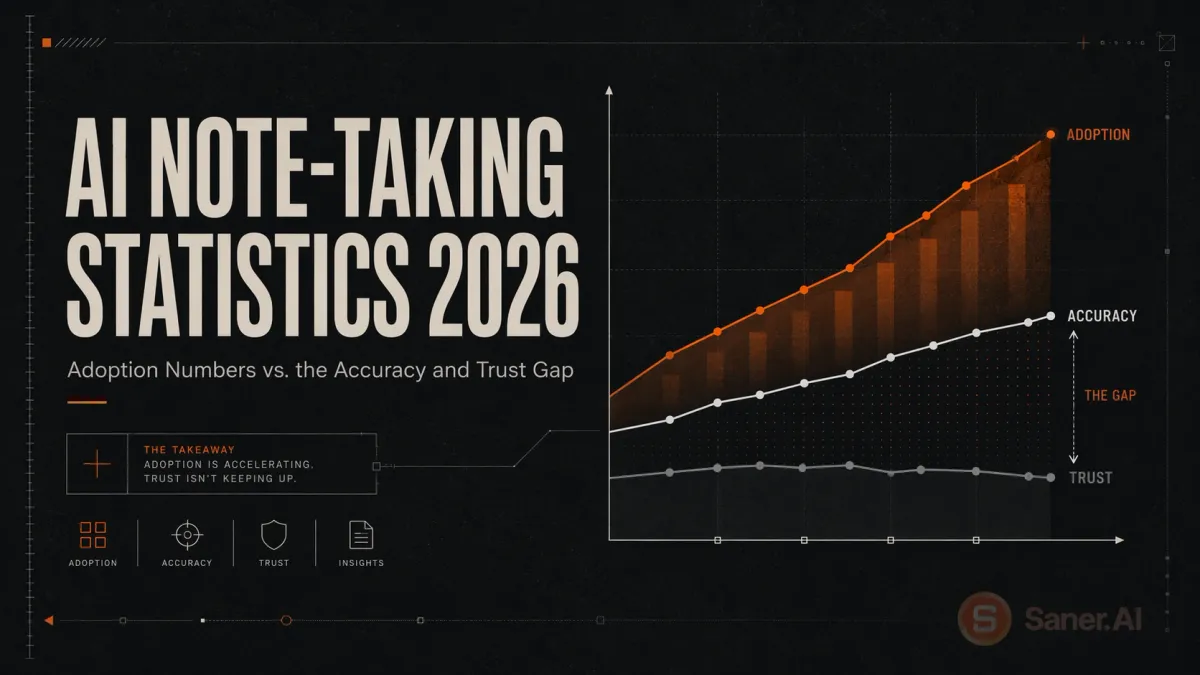
Three out of four professionals now say an AI note-taker sits in on their work meetings. Here is what you need to know about the AI Note-taking market:
Key AI note-taking statistics
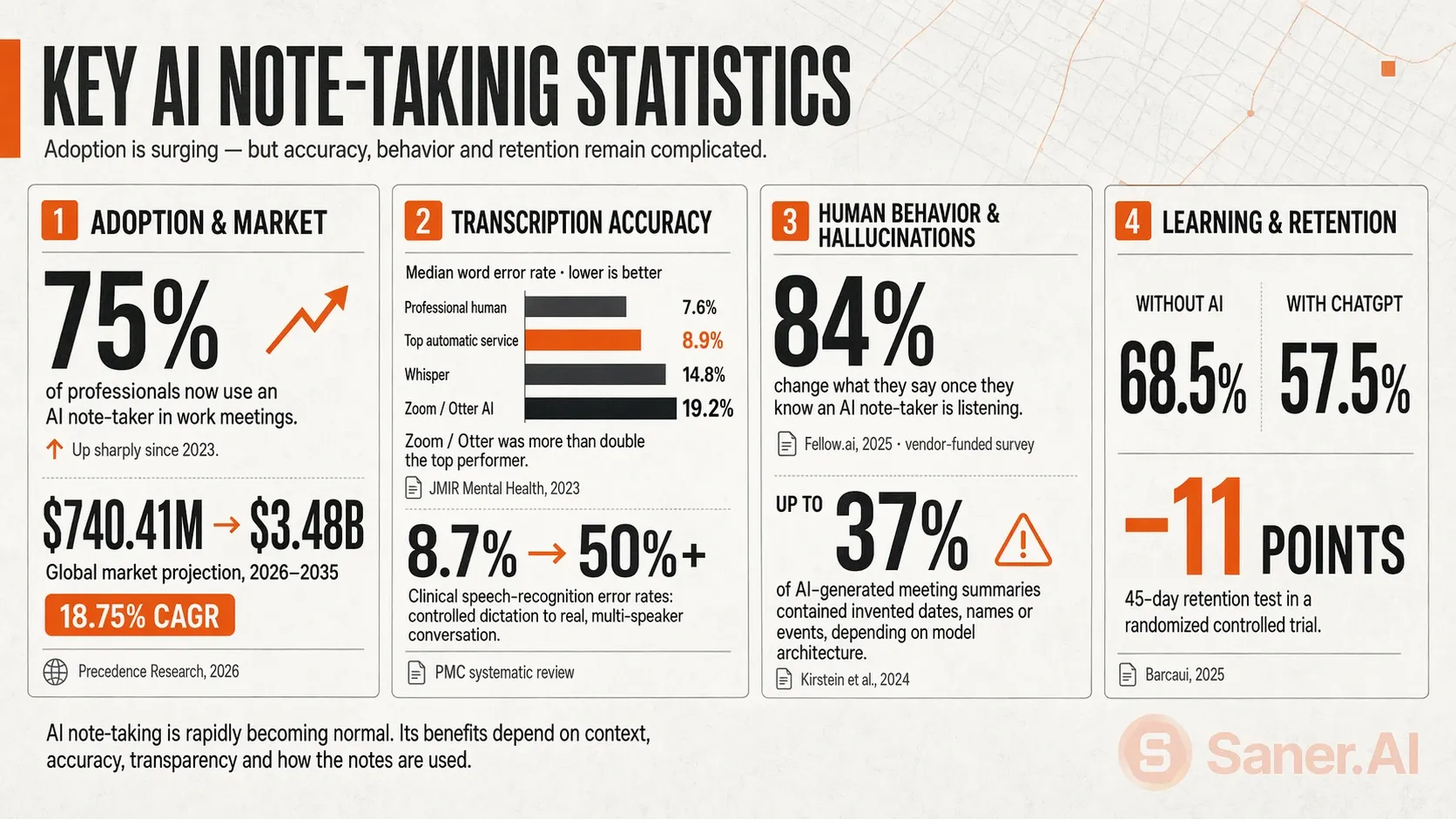
- 75% of professionals now use an AI note-taker in their work meetings — a figure that has climbed sharply since 2023. (Fellow.ai, 2025 — vendor-funded survey; see notes below)
- The global AI note-taking market is projected to grow from $740.41 million in 2026 to roughly $3.48 billion by 2035, an 18.75% compound annual growth rate. (Precedence Research, 2026)
- In peer-reviewed testing, the best-performing automatic transcription service posted an 8.9% median word error rate — nearly matching professional human transcription at 7.6%. (JMIR Mental Health, 2023)
- The same study found Zoom's built-in Otter AI transcription produced a 19.2% median word error rate — more than double the top performer and over a full percentage point higher than Whisper's 14.8%. (JMIR Mental Health, 2023)
- A systematic review of AI speech recognition in clinical settings found word error rates ranging from 8.7% in controlled dictation to over 50% in real conversational, multi-speaker audio. (PMC systematic review)
- 84% of AI note-taker users say they change what they say once they know the tool is listening. (Fellow.ai, 2025 — vendor-funded survey)
- Hallucinated content — invented dates, names, or events that were never said — appeared in up to 37% of AI-generated meeting summaries, depending on the model architecture tested. (Kirstein et al., 2024)
- In a randomized controlled trial, students who used ChatGPT as a study aid scored 11 points lower on a 45-day retention test than students who studied without AI assistance (57.5% vs. 68.5% correct). (Barcaui, 2025)
Table of contents
- How fast is AI note-taking adoption actually moving?
- How accurate is AI meeting transcription, really?
- Word error rates by service: a comparison
- Does relying on an AI note-taker change how people behave — or think?
- Where does AI note-taking fail or backfire?
- What these statistics mean for teams adopting AI note-takers
- Quotable AI note-taking statistics
- FAQ
- Sources
1) How fast is AI note-taking adoption actually moving?
How many professionals use an AI note-taker at work?
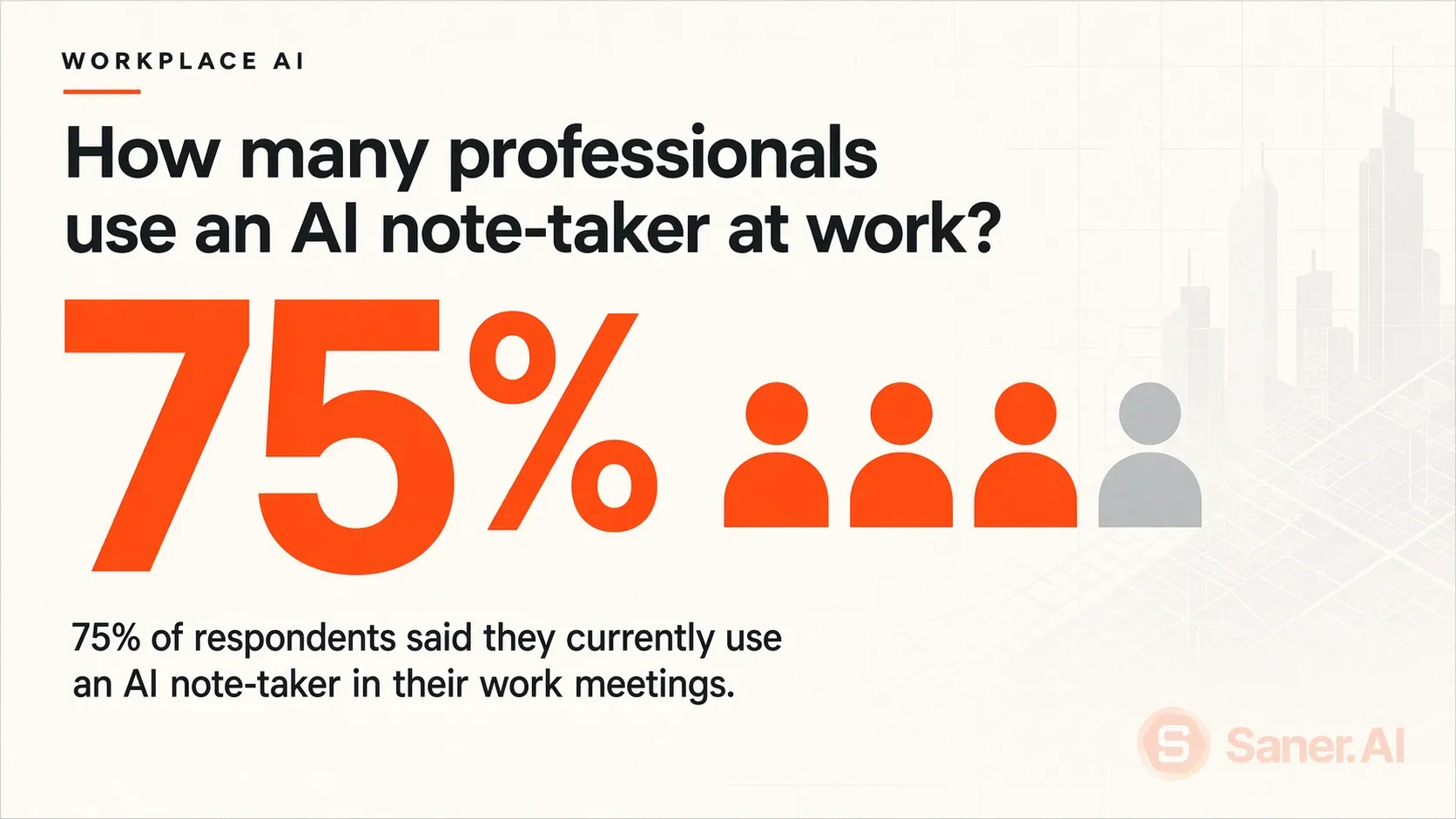
The most-cited figure in this category comes from Fellow.ai's 2025 survey of professionals across IT, operations, and business leadership: 75% of respondents said they currently use an AI note-taker in their work meetings, up sharply from a much smaller base just two years earlier. It's worth flagging plainly that Fellow is itself a commercial AI note-taking company, so this number should be read as a vendor-commissioned survey rather than an independent academic study
Independent government data paints a more conservative but directionally consistent picture. The Federal Reserve's ongoing monitoring of AI adoption across the US economy found that overall business AI adoption stood at about 18% of firms by the end of 2025, with over 20% of firms expecting to adopt AI in some business function during the first half of 2026 (Federal Reserve, 2026). That figure covers all AI use across all business functions, not note-taking specifically, so it's a much broader denominator than Fellow's meeting-focused sample — but it's a useful check on how far ahead of official firm-level statistics the "everyone's already doing this" narrative tends to run.
How big is the AI note-taking market, and how fast is it growing?
Precedence Research, an industry market-sizing firm, puts the global AI note-taking market at $623.5 million in 2025, crossing $740.41 million in 2026, and reaching approximately $3.48 billion by 2035 — an 18.75% compound annual growth rate over that period (Precedence Research, 2026). By offering, software held the largest share of the market in 2025; by application, education was the largest single segment, with corporate and healthcare use cases following behind.
That figure specifically covers standalone note-taking software. A related but broader category — AI meeting assistants generally, which includes agenda-setting and CRM-integration tools bundled with transcription — is sized separately by the same firm at $1.20 billion in 2025, heading toward $6.28 billion by 2035 (Precedence Research, 2026). The two numbers aren't in conflict; they're measuring different-sized boxes.
2) How accurate is AI meeting transcription, really?
What word error rate do leading AI note-takers achieve in practice?
The cleanest independent answer comes from a 2023 peer-reviewed pilot study published in JMIR Mental Health, which compared three automatic speech recognition (ASR) services — Amazon Transcribe, Zoom's Otter AI live transcription, and OpenAI's Whisper — against professional human transcription across 65 recorded interviews (JMIR Mental Health, 2023). The results, measured as median word error rate (WER):
- Amazon Transcribe: 8.9% median WER
- Whisper: 14.8% median WER
- Zoom-Otter AI: 19.2% median WER
- Rev (human transcription): 7.6% median WER
The gap between the best automatic service and professional human transcription was statistically significant but small — 8.9% versus 7.6%. The gap between the worst automatic service tested (Otter AI, one of the most widely deployed meeting transcription engines on the market) and human transcription was more than two and a half times larger.
Does that accuracy hold up outside a clean recording studio?
Not consistently. A systematic review of AI-based speech recognition in clinical documentation — pooling published studies through February 2025 — found reported word error rates ranging from 8.7% in controlled dictation settings to more than 50% in conversational or multi-speaker scenarios, with F1 accuracy scores spanning from 0.416 to 0.856 depending on the setting (PMC systematic review).
The review's authors noted that time-efficiency and user-satisfaction gains showed up consistently across studies even as accuracy varied — a reminder that "faster" and "more accurate" are not the same claim, and vendor marketing sometimes blurs the two.
The pattern across both studies is consistent: the accuracy numbers marketed by AI note-taking vendors (often "95%+ accuracy" or similar) tend to describe best-case conditions — clean audio, a single speaker, minimal crosstalk. Real meetings routinely violate all three of those conditions.
Word error rates by service: a comparison
| Transcription service | Median WER | Setting | Source |
|---|---|---|---|
| Rev (human transcription) | 7.6% | Recorded clinical interviews | JMIR Mental Health, 2023 |
| Amazon Transcribe | 8.9% | Recorded clinical interviews | JMIR Mental Health, 2023 |
| Whisper (OpenAI) | 14.8% | Recorded clinical interviews | JMIR Mental Health, 2023 |
| Zoom-Otter AI | 19.2% | Recorded clinical interviews | JMIR Mental Health, 2023 |
| AI speech recognition (pooled range) | 8.7%–50%+ | Controlled dictation to multi-speaker conversation | PMC systematic review |
3) Does relying on an AI note-taker change how people behave, or think?
Do people change what they say when an AI note-taker is listening?
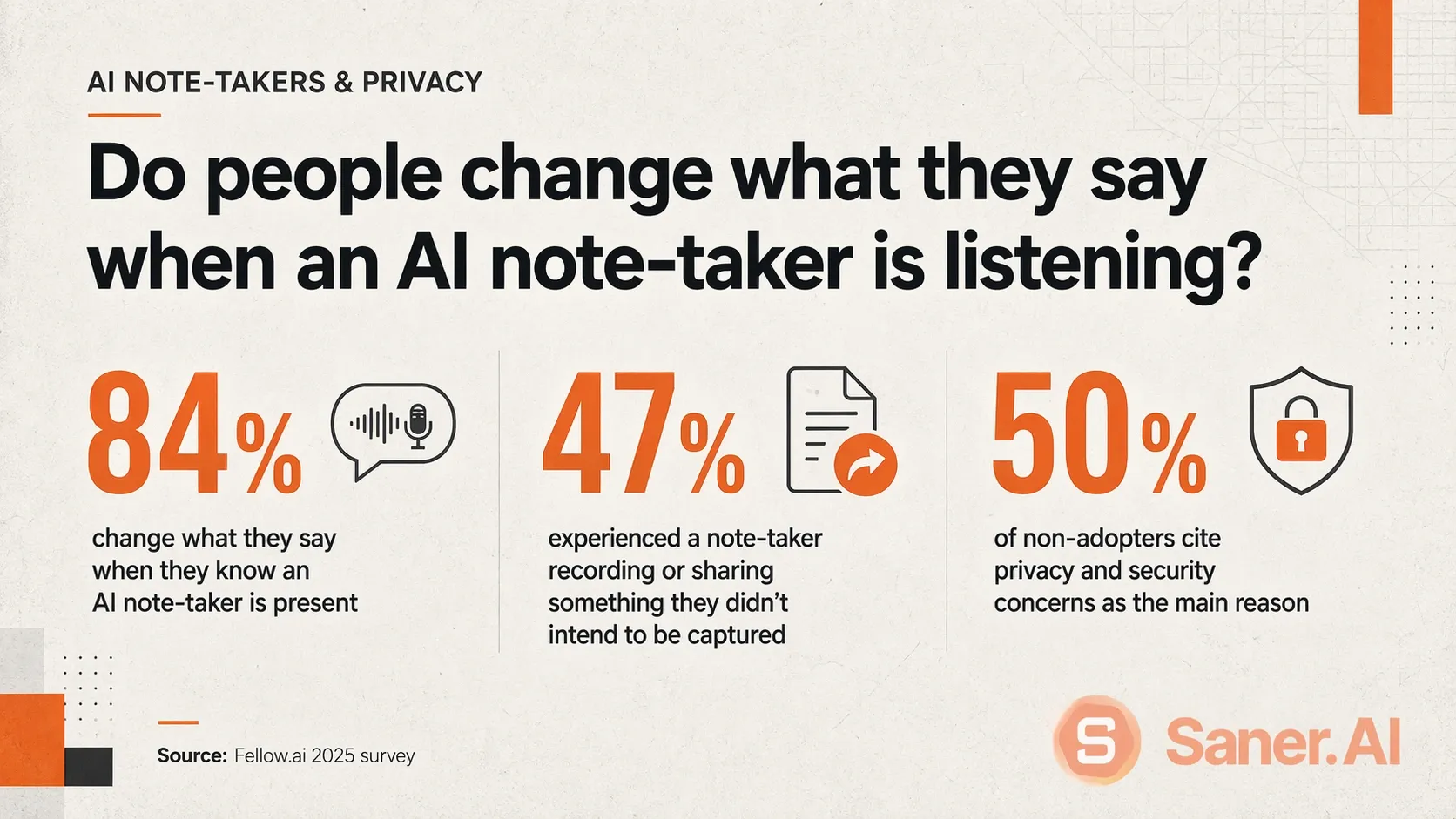
Yes, according to the same Fellow.ai 2025 survey cited above (again, a vendor-funded study, worth reading with that context): 84% of respondents said they change what they say when they know an AI note-taker is present, and 47% said they'd experienced a note-taker recording or sharing something they didn't intend to be captured. Among people who haven't adopted an AI note-taker, 50% cited privacy and security concerns as the main reason.
This is a useful data point because it complicates the adoption headline. A tool that 75% of people use, but that a plurality of users say measurably changes their communication behavior, isn't simply "adopted" in the way that word usually implies — it's adopted and adjusted around.
Does letting AI take your notes weaken your memory of the meeting?
This is where the evidence gets more speculative, and it's worth being upfront about that. There isn't yet a large, direct study measuring memory retention specifically for AI meeting note-takers. What does exist is a body of cognitive-offloading research that studies the same underlying mechanism — delegating a memory or attention task to an external tool — in adjacent contexts, and the findings there are consistent enough to be worth taking seriously as a plausible extension.
A 2021 study published in the Quarterly Journal of Experimental Psychology found that cognitive offloading produces a measurable trade-off: it accelerates immediate task performance but leaves weaker memory traces for the offloaded information (Grinschgl et al., 2021). Critically, the same research found this effect wasn't inevitable — participants who offloaded with an explicit goal of still forming a memory largely counteracted the effect, while those who offloaded passively did not.
A more recent randomized controlled trial adds a sharper, more current data point from an adjacent domain. In a 2025 study of 120 undergraduates, students who used ChatGPT as a study aid scored 57.5% correct on a surprise retention test 45 days later, versus 68.5% for students who studied without AI assistance — an 11-point gap with a moderate effect size (Cohen's d = 0.68) (Barcaui, 2025).
This study is about AI-assisted studying, not meeting note-taking specifically, so it's an analogy rather than direct evidence — but the underlying mechanism (offloading effortful processing to an AI tool weakens the memory trace that effort would otherwise have built) is the same one cognitive-offloading researchers have been documenting for over a decade.
4) Where does AI note-taking fail or backfire?
Three separate failure modes show up across the research, and they don't get equal airtime in vendor marketing.
Accuracy degrades exactly where meetings actually happen. The controlled-condition WER numbers vendors advertise (often 95%+) describe clean, single-speaker audio. The moment a meeting involves crosstalk, accents, domain jargon, or more than one or two speakers — which describes most real meetings — the peer-reviewed data shows error rates climbing into the high teens and, in some conversational settings, past 50%. The accuracy claim and the real-world condition are frequently mismatched.
Summaries hallucinate, and current metrics don't reliably catch it. A 2024 peer-reviewed evaluation of meeting summarization models found hallucinated content — invented dates, names, or events not present in the source meeting — in 14% to 37% of AI-generated summaries, depending on the model architecture (Kirstein et al., 2024). The same research found that standard automatic quality metrics (the kind vendors might cite to claim "high accuracy") frequently failed to penalize hallucinated content at all, and in some cases scored hallucinated summaries higher. This is a distinct failure mode from transcription word-error rate: even a transcript with a low WER can feed a summarization step that invents an action item nobody agreed to.
The behavioral and memory costs are real but boundary-conditioned, not universal. The 84% figure on behavior change and the cognitive-offloading research on memory both point toward genuine costs — but neither is a blanket argument against AI note-taking. The offloading research specifically found that memory loss was avoidable when the offloading was paired with an explicit intention to also retain the information, not just record it.
5) What these statistics mean for teams adopting AI note-takers
Adoption has outrun verification. Three-quarters of professionals using a tool is a strong signal of utility, but it isn't evidence of accuracy — and the peer-reviewed testing above suggests a meaningful portion of that adopted user base is working from transcripts and summaries with double-digit error rates they haven't independently checked.
The 84% behavior-change figure is a second, quieter cost beyond the raw error rate. Even a perfectly accurate AI note-taker changes a meeting if participants are speaking more guardedly because of it. Teams evaluating these tools tend to focus entirely on transcription quality and miss this half of the ledger — the tool can be accurate and still alter what gets said in the room.
The offloading research points toward a specific, practical fix rather than a wholesale rejection of the category: pair capture with active review, not passive storage. The cognitive-offloading data is fairly clear that the memory cost of delegation is avoidable when there's still a deliberate step of engaging with the offloaded material, rather than trusting it to sit untouched until needed. This is the same principle behind the growing interest in note tools that treat capture as the first step rather than the last one — where a note or transcript gets reviewed, connected to related material, and turned into a task rather than filed away and forgotten.
Saner.AI's approach of pairing quick capture with an AI-assisted synthesis layer is one example of a tool built around that active-review principle.
FAQ
1. How accurate are AI note-takers in real meetings?
Peer-reviewed testing puts leading automatic transcription services at roughly 9% to 19% median word error rate under controlled conditions, with error rates climbing above 50% in noisy, multi-speaker, real-world conversation (JMIR Mental Health, 2023; PMC systematic review). That's meaningfully higher than the 95%+ figures often used in marketing, which typically describe best-case clean audio.
2. Do AI note-takers ever make up things that weren't said?
Yes. Research evaluating AI-generated meeting summaries found hallucinated content — invented names, dates, or events — in 14% to 37% of summaries depending on the model tested, and found that common automatic quality metrics often failed to flag it (Kirstein et al., 2024).
3. Why do people change their behavior around AI note-takers?
Survey data suggests privacy and permanence are the driving concerns: 84% of users report speaking differently when they know they're being recorded and summarized, and 47% say a note-taker has captured or shared something unintended (Fellow.ai, 2025 — vendor-funded).
4. Does using an AI note-taker weaken your memory of the meeting?
There's no large direct study of this specific question yet. Related cognitive-offloading research shows that delegating a memory task to an external tool measurably weakens retention of the offloaded information — but only when the offloading is passive. When people retain an explicit intent to also remember the material, the effect largely disappears (Grinschgl et al., 2021).
5. How big is the AI note-taking market?
Precedence Research sizes the global AI note-taking market at $740.41 million in 2026, projected to reach approximately $3.48 billion by 2035 — an 18.75% compound annual growth rate (Precedence Research, 2026).
6. What percentage of professionals use an AI note-taker?
A 2025 vendor-funded survey from Fellow.ai puts the figure at 75% of professionals using an AI note-taker in work meetings. Broader, independent government data on overall business AI adoption (not note-taking specifically) puts adoption closer to 18% to 20% of US firms as of late 2025 (Federal Reserve, 2026).
7. Are AI meeting notes more accurate than human transcription?
Not quite, though the gap has narrowed. The best-performing automatic transcription service in peer-reviewed testing posted an 8.9% median word error rate, versus 7.6% for professional human transcription — a small but statistically significant difference favoring humans (JMIR Mental Health, 2023).
8. What's the biggest reason people don't adopt an AI note-taker?
Privacy and security concerns top the list: half of non-adopters surveyed cited this as their main reason for holding back (Fellow.ai, 2025 — vendor-funded).
Sources
- Fellow.ai. (2025). The State of AI Meeting Notetakers 2025: Why Privacy and Security Are Everyone's Priority. fellow.ai/blog/ai-notetaker-statistics — Vendor-funded survey (Fellow is a commercial AI note-taking company).
- Precedence Research. (2026). AI Note Taking Market Size, Share and Trends 2026 to 2035. precedenceresearch.com/ai-note-taking-market
- Precedence Research. (2026). AI in Meeting Assistants Market Size to Hit USD 6.28 Billion by 2035. precedenceresearch.com/ai-in-meeting-assistants-market
- Seyedi, S., Griner, E., Corbin, L., Jiang, Z., Roberts, K., Iacobelli, L., Milloy, A., Boazak, M., Bahrami Rad, A., Abbasi, A., Cotes, R.O., & Clifford, G.D. (2023). Using HIPAA-Compliant Transcription Services for Virtual Psychiatric Interviews: Pilot Comparison Study. JMIR Mental Health, 10, e48517. mental.jmir.org/2023/1/e48517
- (2025). Evaluating the performance of artificial intelligence-based speech recognition for clinical documentation: a systematic review. PMC. pmc.ncbi.nlm.nih.gov/articles/PMC12220090
- Grinschgl, S., Papenmeier, F., & Meyerhoff, H.S. (2021). Consequences of cognitive offloading: Boosting performance but diminishing memory. Quarterly Journal of Experimental Psychology, 74(9), 1477–1496. pmc.ncbi.nlm.nih.gov/articles/PMC8358584
- Barcaui, A. (2025). ChatGPT as a cognitive crutch: Evidence from a randomized controlled trial on knowledge retention. Social Sciences & Humanities Open, 12, 102287. sciencedirect.com/science/article/pii/S2590291125010186
- Kirstein, F., Wahle, J.P., Ruas, T., & Gipp, B. (2024). What's under the hood: Investigating Automatic Metrics on Meeting Summarization. Findings of the Association for Computational Linguistics: EMNLP 2024. arxiv.org/abs/2404.11124
- Federal Reserve Board. (2026). Monitoring AI Adoption in the US Economy. FEDS Notes. federalreserve.gov