
Digital Overwhelm Statistics in 2026


Ask a knowledge worker what's wearing them down, and the answer is rarely one thing. It's the ping during a meeting, the tab you forgot you opened, the inbox that refilled while you were in a Slack thread.
The statistics below trace that feeling to its sources: how much of the modern workday goes to managing digital noise rather than doing the work itself, and, more usefully, which fixes people reach for are backed by evidence and which are folklore that happens to sound plausible.
Key digital overwhelm statistics
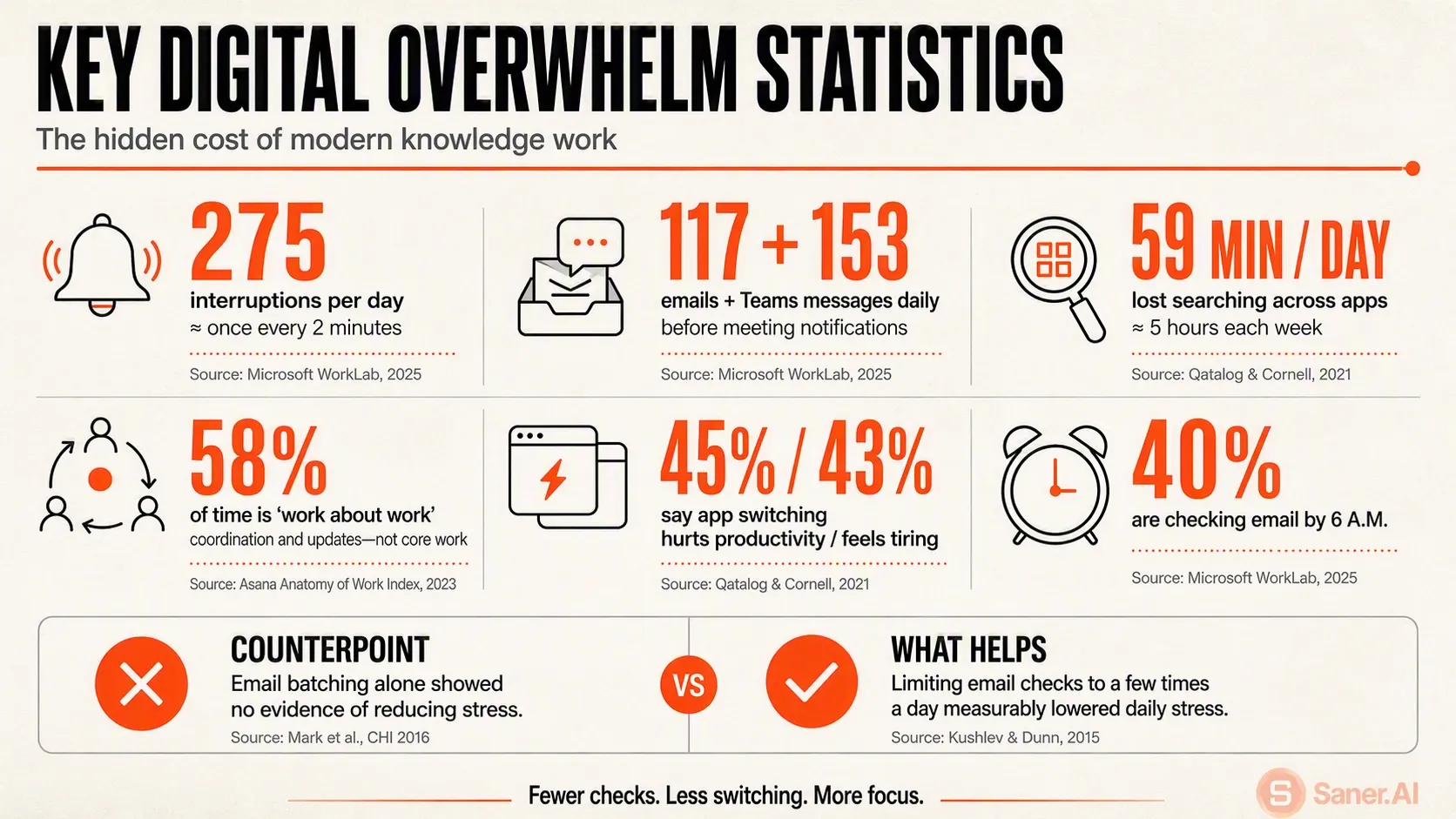
- Knowledge workers are interrupted roughly 275 times a day during core work hours, about once every two minutes. (Microsoft WorkLab, 2025)
- The average worker receives 117 emails and 153 Teams messages every workday, before a single meeting notification arrives. (Microsoft WorkLab, 2025)
- People lose 59 minutes a day just searching for information trapped inside different apps and tools, close to 5 hours a week. (Qatalog & Cornell University's Ellis Idea Lab, 2021)
- 58% of the average knowledge worker's time goes to "work about work", coordinating and updating, rather than the job they were hired to do. (Asana Anatomy of Work Index, 2023)
- 45% of workers say switching between apps makes them less productive, and 43% call it genuinely tiring. (Qatalog & Cornell, 2021)
- 40% of employees are already reviewing email by 6 a.m. (Microsoft WorkLab, 2025)
- Counterpoint: despite years of productivity advice, researchers found no evidence that batching email reduces stress. (Mark et al., CHI 2016)
- What does help: limiting email checks to a few times a day measurably lowered daily stress in a controlled two-week study. (Kushlev & Dunn, 2015)
Table of contents
- How overloaded is the average knowledge worker's day?
- Where does the overwhelm actually come from?
- Interruption channels compared
- Do the popular fixes for digital overwhelm actually work?
- What these statistics mean for knowledge workers
- Quotable digital overwhelm statistics
- FAQ
- Sources
1) How overloaded is the average knowledge worker's day?
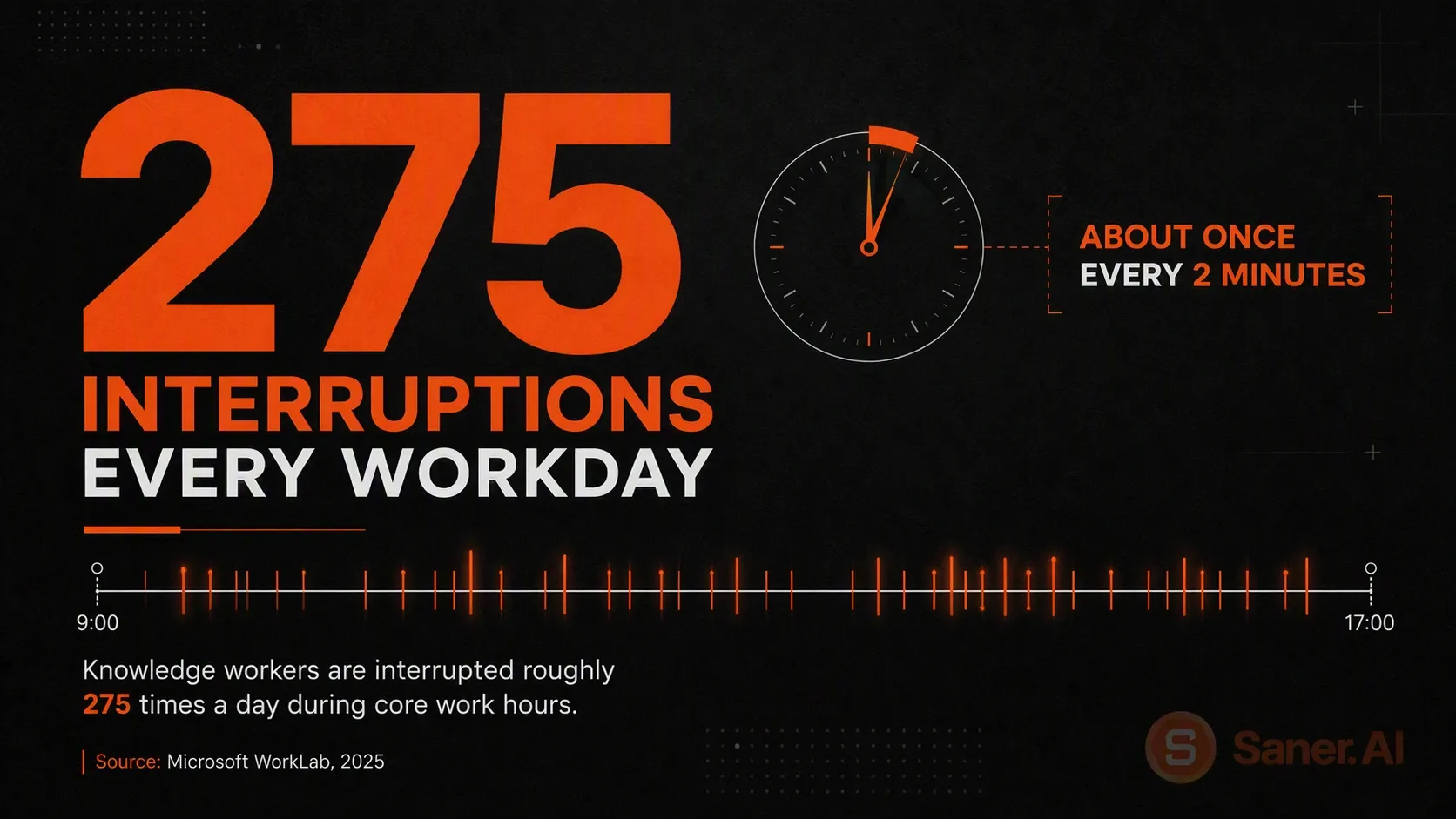
How many times a day is the average worker interrupted?
- 275 times, according to Microsoft's 2025 WorkLab telemetry analysis, drawn from anonymized Microsoft 365 usage data through mid-February 2025 and a companion survey of 31,000 workers across 31 countries.
How many emails and messages does the average worker receive daily?
- The same Microsoft WorkLab dataset puts the average at 117 emails and 153 Teams messages per workday.
- Forty percent of people online at 6 a.m. are already reviewing their inbox for the day ahead, and meetings scheduled after 8 p.m. have risen 16% year over year.
- Mass emails sent to 20 or more recipients are up 7% over the past year, while one-on-one email threads are down 5%, a shift toward broadcast-style communication that puts more messages in front of more people without necessarily making any single message more relevant to its recipient.
What percentage of the workday goes to "work about work"?
- 58%, according to Asana's 2023 Anatomy of Work Global Index, which surveyed more than 9,600 knowledge workers across six countries.
To be clear, Asana sells work management software, and a finding that coordination overhead is high and worth solving serves its commercial interest. The figure is included here because it is self-reported by the survey's own respondents rather than inferred, and because the direction of the finding (a majority of time spent on coordination rather than execution) is corroborated independently by the search-and-switching data below.
2)Interruption channels compared
| Channel | Daily volume | Measured cost | Source |
|---|---|---|---|
| All interruptions combined (meetings, email, chat) | ~275 per day | Fragments the workday into pieces roughly two minutes apart | Microsoft WorkLab (2025) |
| 117 messages/day | Longer daily email duration linked to higher physiological stress and lower self-rated productivity | Mark et al., CHI (2016) | |
| Chat/Teams messages | 153 messages/day | 43% describe channel-driven switching as very tiring | Qatalog & Cornell (2021) |
| App and tool switching | ~36 min/day switching; ~9.5 min recovery per switch | 45% report reduced productivity from switching | Qatalog & Cornell (2021) |
| Information search across tools | 59 min/day (~5 hrs/week) | 69% say finding information is time-consuming | Qatalog & Cornell (2021) |
3)Where does the overwhelm actually come from?
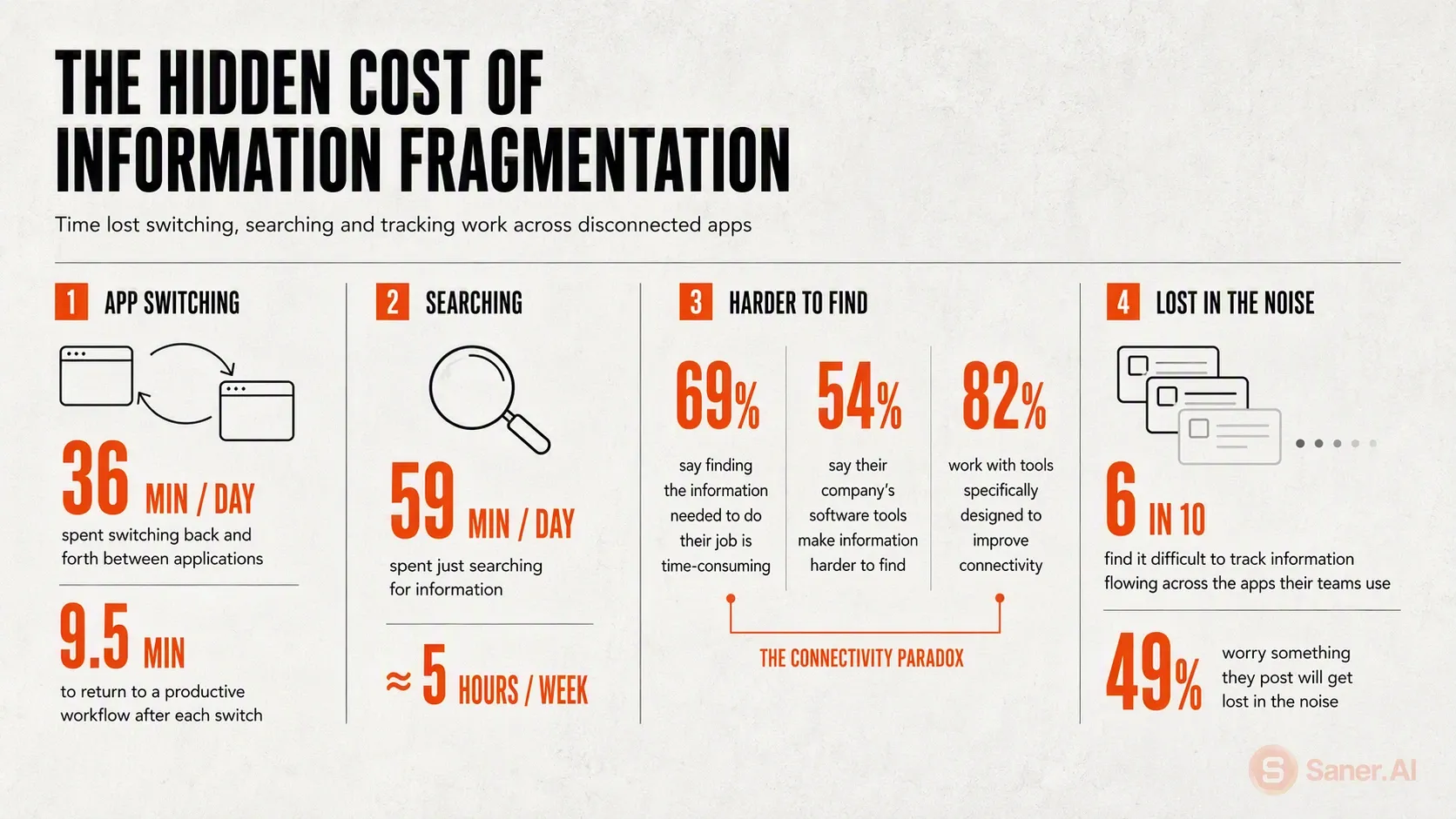
How much time is lost switching between apps and tools?
Qatalog and Cornell University's Ellis Idea Lab ran three surveys of 1,000 participants each for their 2021 Workgeist Report, using a Gallup-poll-style methodology with US and UK remote workers.
- People spend an average of 36 minutes a day switching back and forth between applications, and take roughly 9.5 minutes on average to return to a productive workflow after each switch.
- Forty-three percent said they spend too much time switching between online tools, 45% said this switching makes them less productive, and 43% described it as genuinely tiring.
For a deeper look at what constant tool switching does to focus, output, and cognitive load specifically, our Context Switching Statistics breakdown goes further into the mechanism.
How much time do workers spend just searching for information?
- 59 minutes a day, or close to 5 hours a week, according to the same Workgeist Report.
- 69% of respondents said finding the information needed to do their job is time-consuming, and 54% said their company's software tools actually make information harder to find, despite 82% reporting that they work with tools specifically designed to improve connectivity.
- About six in ten said it is difficult to keep track of information flowing across the various applications their teams use, and 49% said they worry that something they post will get lost in the resulting noise.
The pattern here is not that workers lack tools. It is that each additional tool creates a new place information can hide, and the cognitive tax of remembering where something lives has quietly become a job requirement in its own right.
Does constant email checking actually hurt productivity?
- The longer a participant's daily email duration, the lower their self-assessed productivity and the higher their measured physiological stress (via heart rate variability) for that day. (CHI '16)
- Participants who checked email primarily on their own initiative, rather than reacting to notifications, reported higher productivity at high email volumes than those who let notifications drive their checking.
- The researchers suggest this may come down to agency: choosing when to interrupt yourself is a fundamentally different cognitive event than being interrupted.
4)Do the popular fixes for digital overwhelm actually work?
Batching email does not reduce stress, despite the claim's popularity.
- The same 2016 CHI study found some support for batching improving productivity at high email volumes, but explicitly found no evidence that batching reduces stress, despite how frequently that claim circulates in popular productivity advice.
Reducing check frequency, as opposed to batching, does appear to help.
- Kushlev and Dunn's 2015 study suggests it is the number of times a person engages with email, not whether those engagements are clustered together, that drives the stress effect.
Notification-batching interventions work, but the benefit fades without upkeep.
- Notification management is not a setting you configure once, it is closer to a habit that decays without reinforcement. (Journal of Occupational Health)
A worker's own digital confidence and mindfulness may matter more than any notification setting.
- Employees with higher trait mindfulness were better protected against nearly every measured "dark side" effect of digital work, including stress, overload, and compulsive checking, except anxiety, which was better predicted by a worker's confidence with the technology itself. Notably, mindfulness outperformed digital confidence as a protective factor across most outcomes. (PLOS ONE)
Taken together, these four findings reconcile an apparent contradiction: notification settings can help, but only temporarily and only for certain outcomes, while the more durable protection seems to come from how often a person engages with digital demands and the internal resources they bring to that engagement, not from the specific technical configuration of their alerts.
5) What these statistics mean for knowledge workers
1. The overload is additive, not singular.
- No single channel accounts for Microsoft's 275 daily interruptions; email, chat, and meetings each contribute their own volume, and none of them shrank as the others grew.
- This is why single-channel fixes, muting Slack but leaving email untouched, tend to produce only partial relief. The research points toward interruption load as a property of the whole system a person works inside, not any one app within it.
2. The fixes people reach for first are not always the ones the evidence supports.
- Batching, the most commonly recommended notification strategy, shows no measured stress benefit on its own.
- What does show a benefit, reducing how often email gets checked at all, is a harder habit to sustain, which may explain why the less effective but easier-to-adopt advice (batch your notifications) has spread further than the better-supported one.
3. Consolidation, not willpower, is what the underlying data actually points toward.
- The Workgeist researchers' own recommendation, after finding that 59 minutes a day disappears into searching across fragmented tools, was to integrate scattered applications into a single work hub rather than adding another point solution.
- Asana's finding that 58% of time goes to coordination overhead tells the same story from a different angle: the problem compounds specifically when notes, tasks, and communication live in separate places that all have to be checked, cross-referenced, and kept in sync by hand.
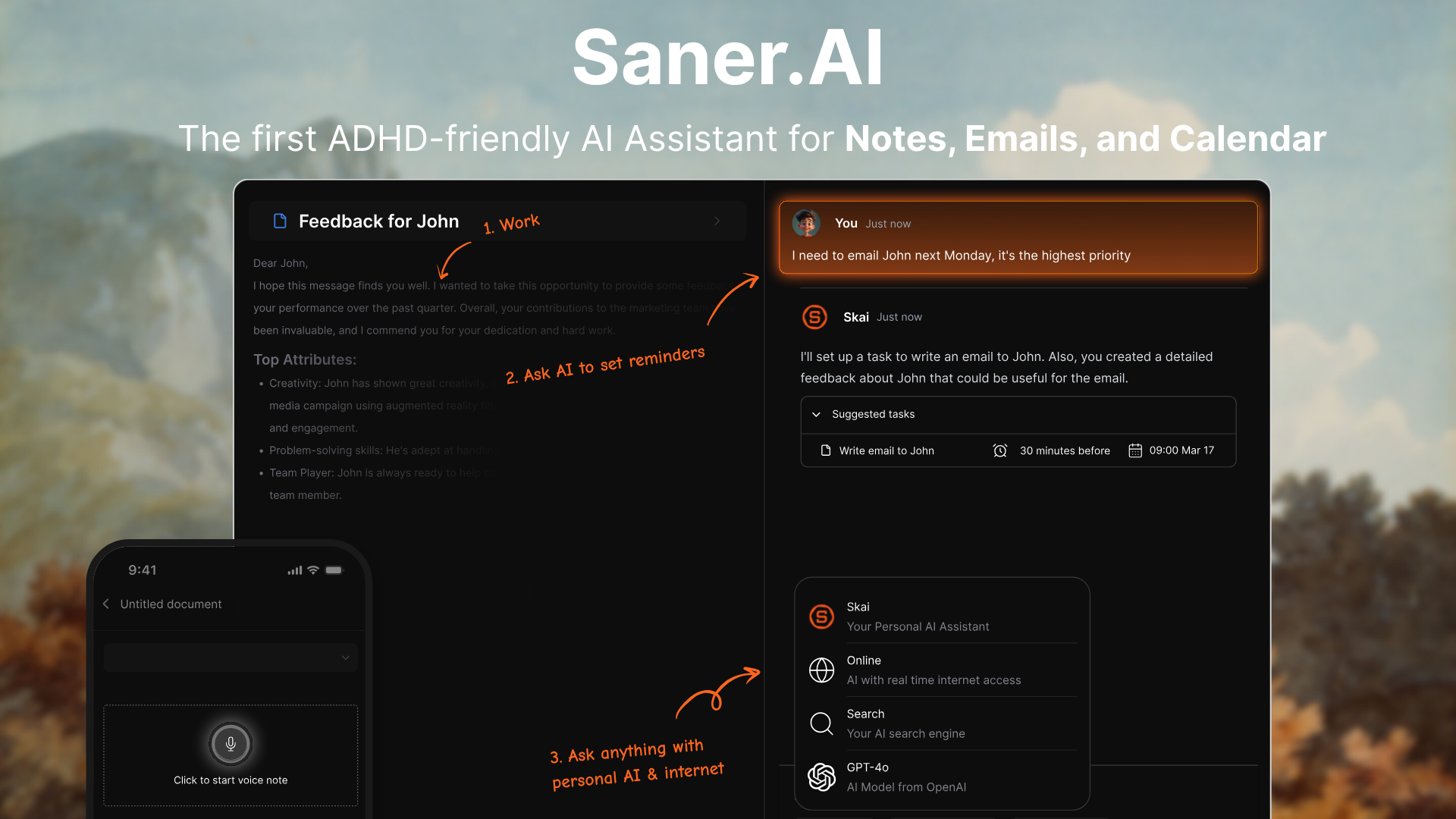
That's the same logic behind consolidating notes, tasks, and an AI assistant into a single workspace like Saner.AI rather than solving fragmentation by adding one more app to an already fragmented stack.
Stay on top of your work and life effortlessly
Quotable digital overwhelm statistics
- According to Microsoft's 2025 Work Trend Index, the average knowledge worker is interrupted 275 times per workday, roughly once every two minutes. (Microsoft WorkLab)
- Microsoft's 2025 telemetry data shows the average employee receives 117 emails and 153 Teams messages every workday. (Microsoft WorkLab)
- Qatalog and Cornell University's Ellis Idea Lab found in 2021 that knowledge workers lose 59 minutes a day searching for information trapped across different apps. (Workgeist Report)
- The same 2021 Qatalog and Cornell study found that workers take an average of 9.5 minutes to return to productive work after switching between digital apps. (Workgeist Report)
- Asana's 2023 Anatomy of Work Index found that knowledge workers spend 58% of their time on "work about work" rather than skilled or strategic tasks. (Asana, 2023)
- A 2016 Microsoft Research and UC Irvine study published at CHI found no evidence that batching email reduces workplace stress, despite the popularity of the advice. (Mark et al., CHI 2016)
- A 2015 University of British Columbia study in Computers in Human Behavior found that limiting email checks to three times a day significantly reduced participants' daily stress. (Kushlev & Dunn, 2015)
- A 2024 University of Nottingham study in PLOS ONE found that trait mindfulness protected workers against nearly every measured "dark side" effect of digital work, including stress, overload, and compulsive use. (Marsh et al., 2024)
FAQ
Does turning off notifications actually reduce stress?
Partially, and not permanently. A Journal of Occupational Health study found a notification-batching intervention lowered stress and improved heart rate variability, but the benefits faded once the intervention stopped. A separate 2016 study found no stress benefit from batching specifically. The more consistent finding is that reducing how often you check, not just clustering when you check, is what correlates with lower stress.
How much time do employees lose to digital overwhelm every day?
The two most directly measured figures are 59 minutes a day spent searching for information across apps and roughly 36 minutes a day spent switching between them, both from the Qatalog and Cornell Workgeist Report. Combined with 275 daily interruptions from meetings, email, and chat (Microsoft WorkLab), the workday adds up to significantly more coordination overhead than most people would estimate if asked directly.
What is "work about work"?
It's Asana's term for time spent coordinating work rather than doing it: chasing status updates, attending meetings about progress, and switching between the tools used to track projects. Asana's 2023 Anatomy of Work Index put this at 58% of the average knowledge worker's time.
Is digital overwhelm the same thing as burnout?
No. Digital overwhelm describes a specific mechanism, too many interruptions, tools, and information sources competing for attention, while burnout is a broader state of chronic exhaustion that can have many contributing causes beyond technology. Digital overwhelm can be a contributing factor to burnout, but the statistics above measure interruption volume and switching cost specifically, not clinical burnout outcomes.
How many notifications does the average worker get per day?
Microsoft's telemetry-based figure is 275 interruptions per workday from combined meetings, emails, and chat messages, which breaks down further into 117 emails and 153 Teams messages specifically. (Microsoft WorkLab, 2025)
Does checking email less often really help?
Yes, according to a controlled study that had participants limit checks to three times a day for a week. Daily stress was significantly lower during the limited week than during a week of unrestricted checking, though researchers noted most participants found sticking to the limit genuinely difficult.
Can mindfulness really offset technology overload?
The evidence points that way. A 2024 study of 142 UK workers found that people with higher trait mindfulness were better protected against stress, overload, fear of missing out, and compulsive technology use, outperforming digital confidence as a protective factor for most of those outcomes.
Sources
- Microsoft WorkLab. "Breaking Down the Infinite Workday." Work Trend Index Special Report, 2025. https://www.microsoft.com/en-us/worklab/work-trend-index/breaking-down-infinite-workday
- Qatalog & Cornell University's Ellis Idea Lab. "Workgeist Report '21." 2021. https://assets.qatalog.com/language.work/qatalog-2021-workgeist-report.pdf
- Mark, G., Iqbal, S. T., Czerwinski, M., Johns, P., & Sano, A. "Email Duration, Batching and Self-interruption: Patterns of Email Use on Productivity and Stress." Proceedings of CHI 2016. https://www.microsoft.com/en-us/research/wp-content/uploads/2016/06/Email20Duration20Camera20Ready20submission3-1.pdf
- Kushlev, K., & Dunn, E. W. "Checking Email Less Frequently Reduces Stress." Computers in Human Behavior, 43, 220-228, 2015. https://www.sciencedirect.com/science/article/abs/pii/S0747563214005810
- "Effects of Task Interruptions Caused by Notifications from Communication Applications on Strain and Performance." Journal of Occupational Health, 2023/2024. https://academic.oup.com/joh/article/65/1/e12408/7479297
- Marsh, E., Perez Vallejos, E., & Spence, A. "Mindfully and Confidently Digital: A Mixed Methods Study on Personal Resources to Mitigate the Dark Side of Digital Working." PLOS ONE, 19(2), e0295631, 2024. https://journals.plos.org/plosone/article?id=10.1371%2Fjournal.pone.0295631
- Asana. "Anatomy of Work Global Index 2023." 2023. https://www.businesswire.com/news/home/20230308005268/en/Asana-Anatomy-of-Work-Global-Index-2023-Smart-Collaboration-and-Clear-Goals-integral-to-creating-positive-business-opportunities