
Information Overload Statistics 2026: What The Digital Noise Actually Costs


"Information overload" gets thrown around so often it's started to feel like a vibe instead of a measurable thing. It isn't. Researchers have been clocking exactly how much information knowledge workers process, how often they get pulled away from it, and how long it takes to recover - for two decades now.
The picture that emerges from that research is more specific, and more useful, than the usual "we're all so busy" narrative: overload has a shape, a cost, and, importantly, a set of conditions under which it doesn't apply. That last part rarely makes it into the listicles.
Key information overload statistics
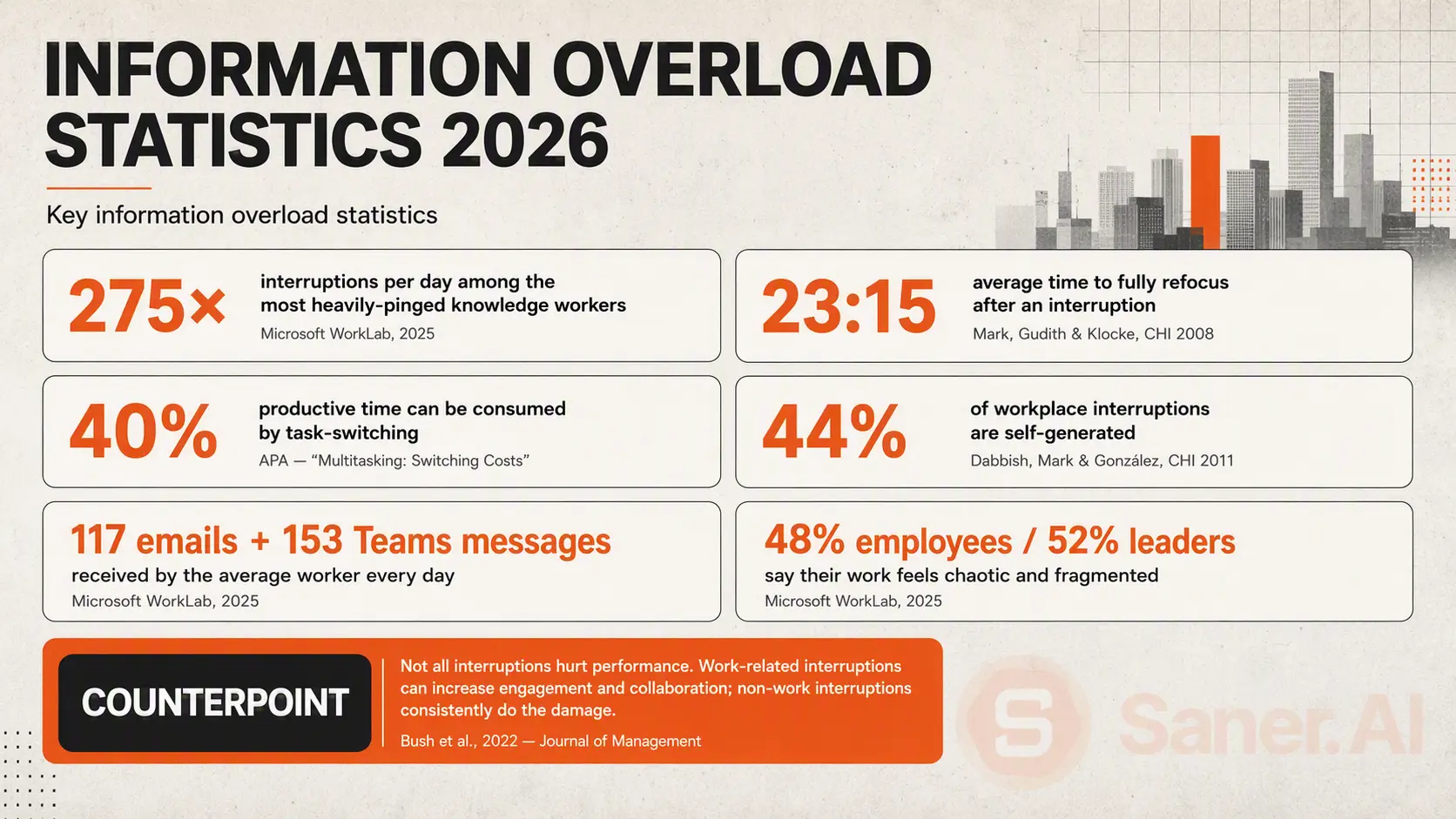
- The average knowledge worker is interrupted every 2 minutes during core work hours — about 275 times a day among the most heavily-pinged users. (Microsoft WorkLab, 2025)
- It takes an average of 23 minutes and 15 seconds to fully refocus after an interruption. (Mark, Gudith & Klocke, CHI 2008)
- Task-switching can consume up to 40% of a person's productive time. (APA, "Multitasking: Switching costs")
- 44% of workplace interruptions are self-generated, not externally triggered. (Dabbish, Mark & González, CHI 2011)
- The average worker receives 117 emails and 153 Teams messages every day. (Microsoft WorkLab, 2025)
- 48% of employees and 52% of leaders say their work feels chaotic and fragmented. (Microsoft WorkLab, 2025)
- Counterpoint: not all interruptions hurt performance. Work-related interruptions were shown to increase engagement and collaboration — it's non-work interruptions that consistently do the damage. (Bush et al., 2022, Journal of Management)
| Metric | Figure | Source | Study type |
|---|---|---|---|
| Interruption frequency (core hours) | Every 2 minutes / 275 per day | Microsoft WorkLab, 2025 | Product telemetry, 31,000-person survey |
| Recovery time after interruption | 23 min 15 sec | Mark, Gudith & Klocke, CHI 2008 | Direct observation |
| Productive time lost to switching costs | Up to 40% | APA / Rubinstein, Meyer & Evans, 2001 | Peer-reviewed lab experiments |
| Interruptions that are self-generated | 44% | Dabbish, Mark & González, CHI 2011 | 889 hours of observed behavior |
| Employees who say work feels chaotic/fragmented | 48% (52% of leaders) | Microsoft WorkLab, 2025 | 31,000-person global survey |
| Engagement effect of work-related intrusions | Increased engagement & collaboration | Bush et al., 2022, Journal of Management | Experimental + experience-sampling study |
1) How much information are knowledge workers actually processing?
Microsoft's Work Trend Index Special Report analyzed aggregated, anonymized signals from Microsoft 365 alongside a 31,000-person survey of knowledge workers across 31 markets, and the numbers describe a workday with almost no unstructured space left in it:
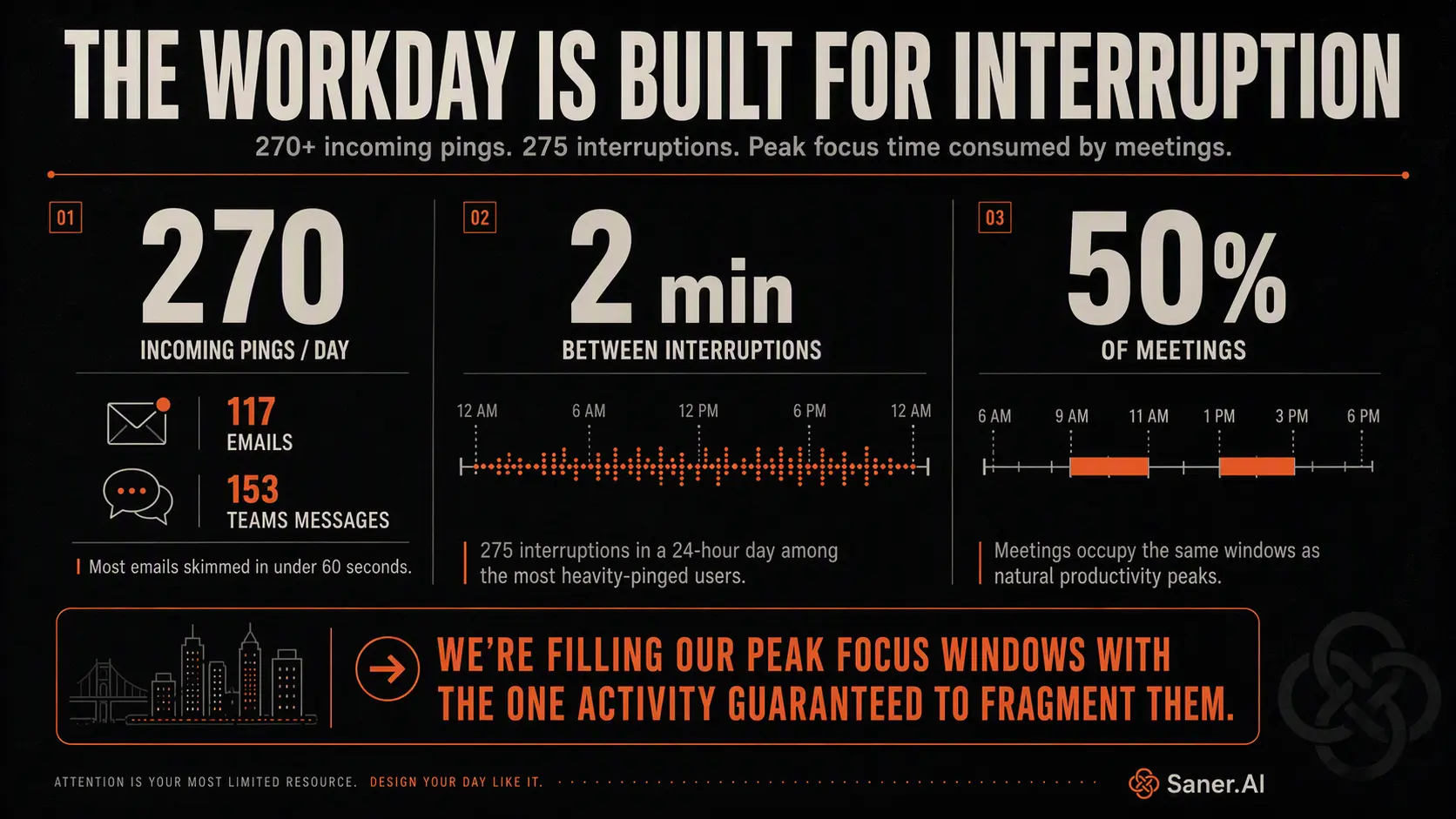
- The average knowledge worker receives 117 emails per day, most skimmed in under 60 seconds, and 153 Microsoft Teams messages per day — 270 incoming pings before you even count meetings.
- Microsoft's telemetry shows employees are interrupted by a meeting, email, or chat every 2 minutes during core work hours, which works out to 275 interruptions in a 24-hour day among the most heavily-pinged users.
- Half of all meetings fall between 9–11 a.m. and 1–3 p.m. — the exact windows when circadian research shows most people hit their natural productivity peak. Instead of protecting that time for focused work, organizations are filling it with the one activity guaranteed to fragment it.
2) What does constant task-switching cost the brain?
Volume alone doesn't explain why overload feels so draining - the recovery cost does.
- Published in her peer-reviewed CHI 2008 paper The Cost of Interrupted Work: More Speed and Stress, the recovery cost was 23 minutes and 15 seconds on average - and workers didn't return directly to the original task, they typically passed through two other tasks first.
- Switching to a new task while the previous one was still unfinished left part of the brain's attention "stuck" on the first task, measurably degrading performance on the second.
- The effect was strongest when the interrupted task had been left incomplete — meaning the common advice to "just switch and come back later" is precisely the pattern that produces the worst outcomes.
3) How much of information overload is actually self-inflicted?
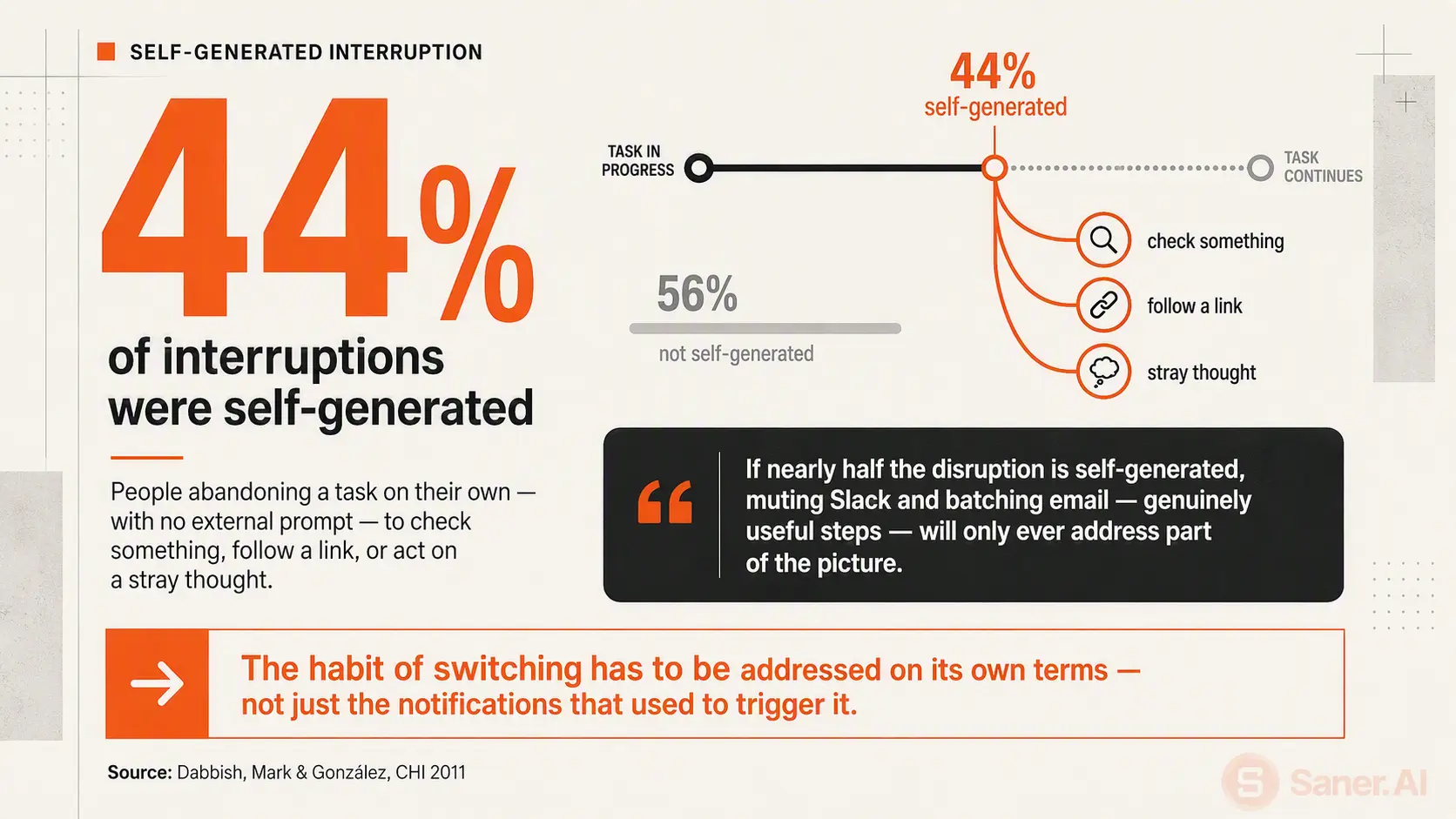
- 44% of interruptions were self-generated — people abandoning a task on their own, with no external prompt, to check something, follow a link, or act on a stray thought. (Dabbish, Mark & González, CHI 2011)
- If nearly half the disruption is self-generated, then muting Slack and batching email - genuinely useful steps - will only ever address part of the picture. The habit of switching has to be addressed on its own terms, not just the notifications that used to trigger it.
4) When does interruption fail to hurt performance?
- Work-related intrusions increased both employee engagement and collaboration with the people who initiated them. It was specifically non-work-related interruptions — small talk about sports, weather, weekend plans — that carried the negative effects on focus and mood. (Bush et al., 2022, Journal of Management)
- Interruption frequency and perceived workload is mediated by how the interruption is perceived and moderated by task complexity — meaning the same interruption rate can feel like background noise in simple work and genuine overload in complex, high-stakes work. (Rick, Brandl, Mertens & Nitsch, 2024, WORK)
Put together, these findings draw a boundary condition around everything in the sections above: the damage isn't a fixed property of "an interruption" - it depends on who initiated it, whether it relates to the work at hand, and how demanding the interrupted task already was.
5) What does chronic overload cost in wellbeing and output?
- 48% of employees and 52% of leaders say their work feels chaotic and fragmented — leaders, who typically face the most external interruptions, report it even more than the people they manage. One in three employees said the pace of work over the past five years has made it impossible to keep up. (Microsoft WorkLab, 2025)
- Nearly a third of active workers are back checking email by 10 p.m., and close to 20% of employees are checking email before noon on Saturdays and Sundays, suggesting the boundary between "workday" and "day" has largely dissolved for a meaningful share of the workforce. (Microsoft WorkLab, 2025)
6) What these statistics mean for knowledge workers and the tools they use
- The volume problem and the fragmentation problem are separate, and only one of them is solvable by working harder.
- Microsoft's telemetry shows the sheer quantity of incoming information — 117 emails, 153 chat messages, a ping every two minutes - but Mark's and Leroy's research shows the real cost isn't the volume itself; it's the switching that volume forces.
=> Two hundred and seventy daily pings wouldn't be nearly as damaging if they arrived in one place and one rhythm; the damage compounds because they arrive scattered across inbox, chat, calendar, and a half-dozen other surfaces, each with its own context to reload.
- Self-interruption means the fix can't only be about managing other people's demands on your attention.
- Reducing the number of places a person has to check reduces both the external pings and the self-generated urge to check "just in case," because there's less scattered across more surfaces to feel anxious about missing.
It's part of the logic behind consolidating the sprawl of email, calendar, and chat into a single working surface rather than adding another standalone tool to the pile - which is the direction platforms like Saner.AI have taken, treating fragmentation itself as the thing to design against, rather than adding one more app that competes for the same fractured attention.
Stay on top of your work and life effortlessly
- Not all interruptions are the problem — and treating them as uniformly bad leads to the wrong fixes.
- The evidence points toward a more specific target: protect focus time from irrelevant noise and administrative sprawl, not from the colleague who's actually collaborating with you on the task at hand.
7) Quotable information overload statistics
- According to Microsoft's 2025 Work Trend Index Special Report, the average knowledge worker is interrupted by a meeting, email, or chat every 2 minutes during core work hours. (Microsoft WorkLab)
- Gloria Mark's peer-reviewed 2008 study found it takes an average of 23 minutes and 15 seconds to fully return to a task after an interruption. (Mark, Gudith & Klocke, CHI 2008)
- The American Psychological Association's research summary states that switching costs from frequent task-switching can consume up to 40% of a person's productive time. (APA)
- Sophie Leroy's 2009 study in Organizational Behavior and Human Decision Processes found that "attention residue" from an unfinished task measurably degrades performance on the next task. (Leroy, 2009)
- A CHI 2011 study analyzing 889 hours of observed behavior found that 44% of workplace interruptions are self-generated, not externally triggered. (Dabbish, Mark & González, CHI 2011)
- Microsoft's 2025 Work Trend Index found that 48% of employees and 52% of leaders say their work feels chaotic and fragmented. (Microsoft WorkLab)
- A 2022 study in the Journal of Management found that work-related interruptions increased both employee engagement and collaboration, contradicting the assumption that all interruptions harm performance. (Bush et al., 2022)
- Microsoft telemetry shows PowerPoint edits spike 122% in the final 10 minutes before a meeting, evidence of preparation time being squeezed out of the workday. (Microsoft WorkLab)
8) FAQ
How many times a day is the average knowledge worker interrupted?
Based on Microsoft 365 telemetry among the most heavily-pinged users, the average is roughly every 2 minutes during an 8-hour core workday, totaling about 275 interruptions across a full 24-hour day when after-hours activity is included. (Microsoft WorkLab, 2025)
How long does it actually take to refocus after a distraction?
Gloria Mark's peer-reviewed research found an average of 23 minutes and 15 seconds to return to full focus on a complex task, with people typically completing two other tasks before circling back to the original one. (Mark, Gudith & Klocke, CHI 2008)
Is multitasking actually possible, or is it always task-switching?
The peer-reviewed research on "multitasking" almost universally describes rapid task-switching rather than true simultaneous processing, and the American Psychological Association notes this switching carries a measurable cost — up to 40% of productive time lost to the mental overhead of loading and unloading task rules. (APA)
What percentage of interruptions are self-caused rather than external?
Around 44%, according to a peer-reviewed study that analyzed 889 hours of observed workplace behavior across three organizations. (Dabbish, Mark & González, CHI 2011)
Do all interruptions hurt productivity?
No. A 2022 study in the Journal of Management found work-related interruptions increased engagement and collaboration, while only non-work-related interruptions consistently harmed focus and mood — the type of interruption matters more than the raw count. (Bush et al., 2022)
What is attention residue?
Attention residue is the portion of cognitive attention that remains on a previous task after switching to a new one, particularly when the first task was left unfinished. It was identified and named by Sophie Leroy in a 2009 peer-reviewed study, which found it measurably reduces performance on the task a person switches to. (Leroy, 2009)
Does complexity of the task change how much interruptions hurt?
Yes. A 2024 diary study of 492 office workers found that more complex primary tasks strengthen the relationship between interruption frequency and perceived overload, meaning the same interruption rate is more disruptive during demanding work than during routine work. (Rick, Brandl, Mertens & Nitsch, 2024)
How many emails and chat messages does the average worker get per day?
Microsoft's 2025 telemetry puts the average at 117 emails and 153 Teams messages per day — roughly 270 incoming items before meetings are even counted. (Microsoft WorkLab, 2025)
Sources
- Microsoft WorkLab. (2025). Breaking Down the Infinite Workday (Work Trend Index Special Report). microsoft.com/en-us/worklab
- Mark, G., Gudith, D., & Klocke, U. (2008). The Cost of Interrupted Work: More Speed and Stress. Proceedings of the SIGCHI Conference on Human Factors in Computing Systems (CHI '08). ics.uci.edu/~gmark/chi08-mark.pdf
- Dabbish, L., Mark, G., & González, V. M. (2011). Why Do I Keep Interrupting Myself? Environment, Habit and Self-Interruption. Proceedings of the SIGCHI Conference on Human Factors in Computing Systems (CHI '11). dl.acm.org/doi/10.1145/1978942.1979405
- American Psychological Association. Multitasking: Switching costs. apa.org/topics/research/multitasking
- Rubinstein, J. S., Meyer, D. E., & Evans, J. E. (2001). Executive Control of Cognitive Processes in Task Switching. Journal of Experimental Psychology: Human Perception and Performance, 27(4). Covered in APA Monitor, October 2001.
- Leroy, S. (2009). Why is it so hard to do my work? The challenge of attention residue when switching between work tasks. Organizational Behavior and Human Decision Processes, 109(2), 168–181. doi.org/10.1016/j.obhdp.2009.04.002
- Rick, V. B., Brandl, C., Mertens, A., & Nitsch, V. (2024). Work interruptions of office workers: The influence of the complexity of primary work tasks on the perception of interruptions. WORK, 77(3). doi.org/10.3233/WOR-220684
- Bush, J. T., Baer, M. D., Welsh, D. T., Outlaw, R., Garud, N., & Sessions, H. (2022). To What Do I Owe This Visit? The Drawbacks and Benefits of In-Role and Non-Role Intrusions. Journal of Management, 48(7), 1888–1917. doi.org/10.1177/01492063211015288