
ADHD at Work Statistics 2026: Productivity, Cost, and Accommodation Data

The data below spans two decades of workplace research, from a WHO-backed survey of 7,000+ workers in ten countries to a 2026 government accommodation-cost report
Key ADHD workplace statistics
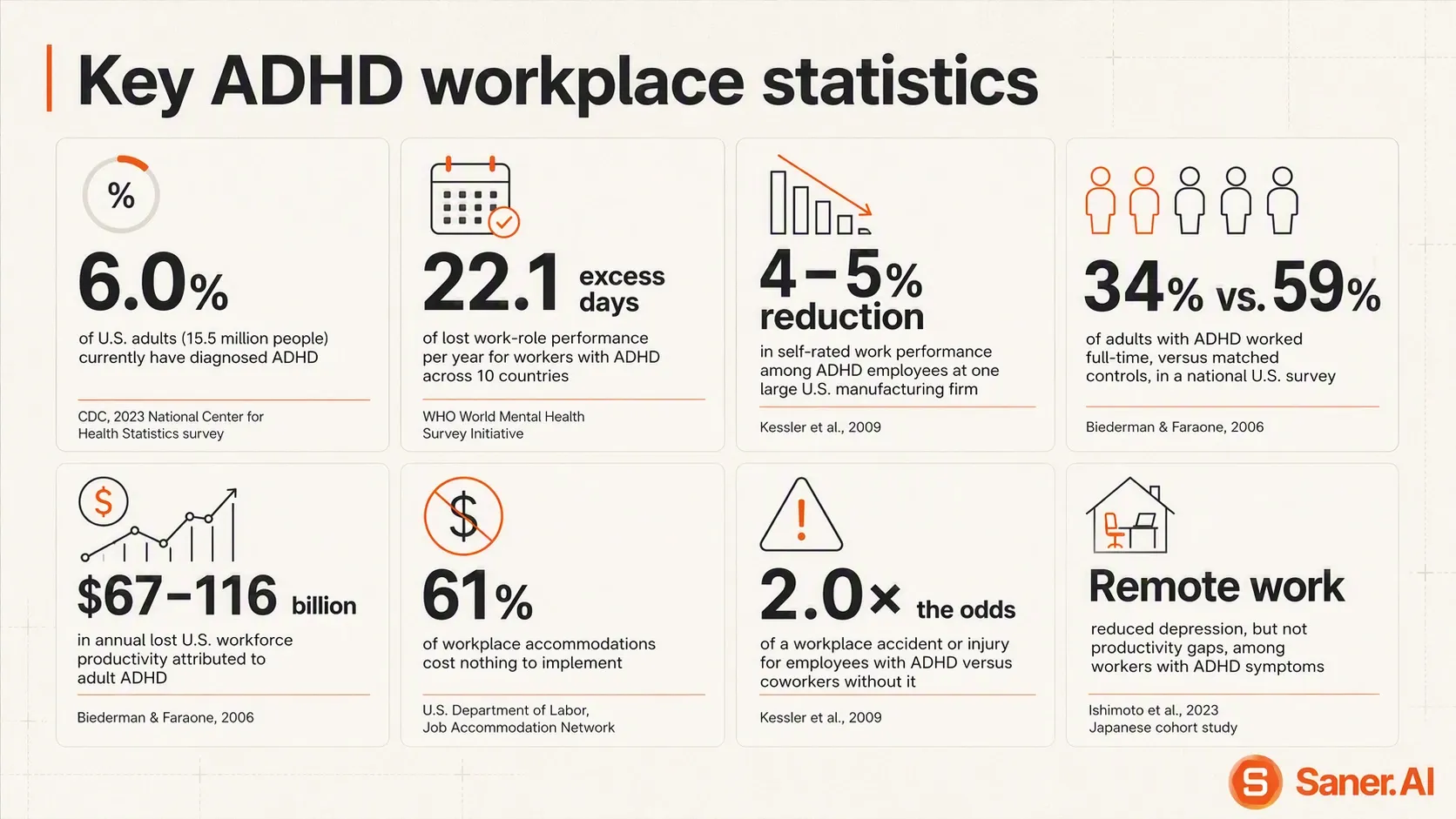
- 6.0% of U.S. adults (15.5 million people) currently have a diagnosed ADHD, per the CDC's 2023 National Center for Health Statistics survey
- 22.1 excess days of lost work-role performance per year for workers with ADHD, found across 10 countries by the WHO World Mental Health Survey Initiative
- 4-5% reduction in self-rated work performance among ADHD employees at one large U.S. manufacturing firm, per Kessler et al., 2009
- 34% of adults with ADHD worked full-time, versus 59% of matched controls, in a national U.S. survey (Biederman & Faraone, 2006)
- $67-116 billion a year in lost U.S. workforce productivity attributed to adult ADHD (Biederman & Faraone, 2006)
- 61% of workplace accommodations cost nothing to implement, per the U.S. Department of Labor's Job Accommodation Network
- 2.0x the odds of a workplace accident or injury for employees with ADHD versus coworkers without it (Kessler et al., 2009)
- Remote work reduced depression, but not productivity gaps, in workers with ADHD symptoms, per a 2023 Japanese cohort study (Ishimoto et al.)
Table of contents
- How common is ADHD among working adults?
- How does ADHD affect performance, attendance, and safety at work?
- What does ADHD cost in income and career advancement?
- Do workplace accommodations for ADHD actually work?
- Does remote work fix ADHD's productivity problems?
- What these statistics mean for ADHD professionals and the people who manage them
- Quotable ADHD workplace statistics
- FAQ
- Sources
1) How common is ADHD among working adults?
How many adults in the U.S. workforce have ADHD?
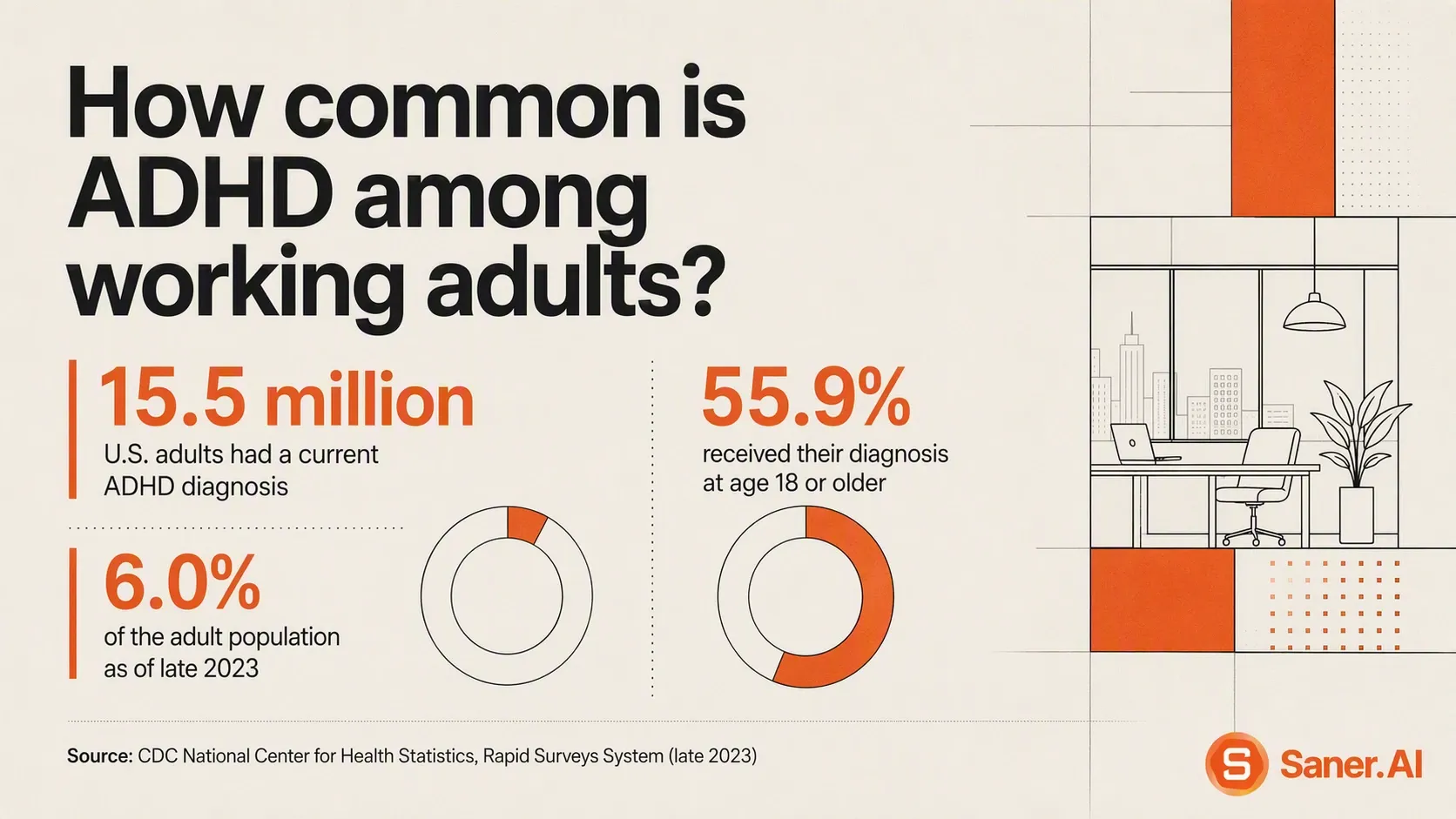
- That figure covers all diagnosed adults, not only those employed, but it sets the scale: ADHD is not a rare condition quietly affecting a handful of employees. It is common enough that most mid-sized organizations employ dozens of people to manage it, whether anyone at work knows.
- Roughly half of that group, about 55.9%, received their diagnosis at age 18 or older, per the same CDC survey -> a large share of employees are discovering their ADHD mid-career, often after years of attributing their struggles to a personality flaw rather than a treatable neurological condition.
What percentage of the workforce specifically meets ADHD criteria?
- The WHO World Mental Health Survey Initiative, which screened 7,075 employed adults across 10 countries, found an average of 3.5% of workers met DSM-IV criteria for adult ADHD, with a range of 1.3% to 4.9% depending on the country.
- A separate survey of one large U.S. manufacturing firm (Kessler et al., 2009) found a current prevalence of 1.9% among more than 4,000 respondents.
The gap between these numbers and the CDC's 6.0% reflects different screening methods and populations, not disagreement about the underlying condition.
Whichever figure a given organization is closest to, the workforce implication is the same: ADHD is present on most teams of meaningful size.
2) How does ADHD affect performance, attendance, and safety at work?
Does ADHD actually reduce work performance?
Yes, measurably.
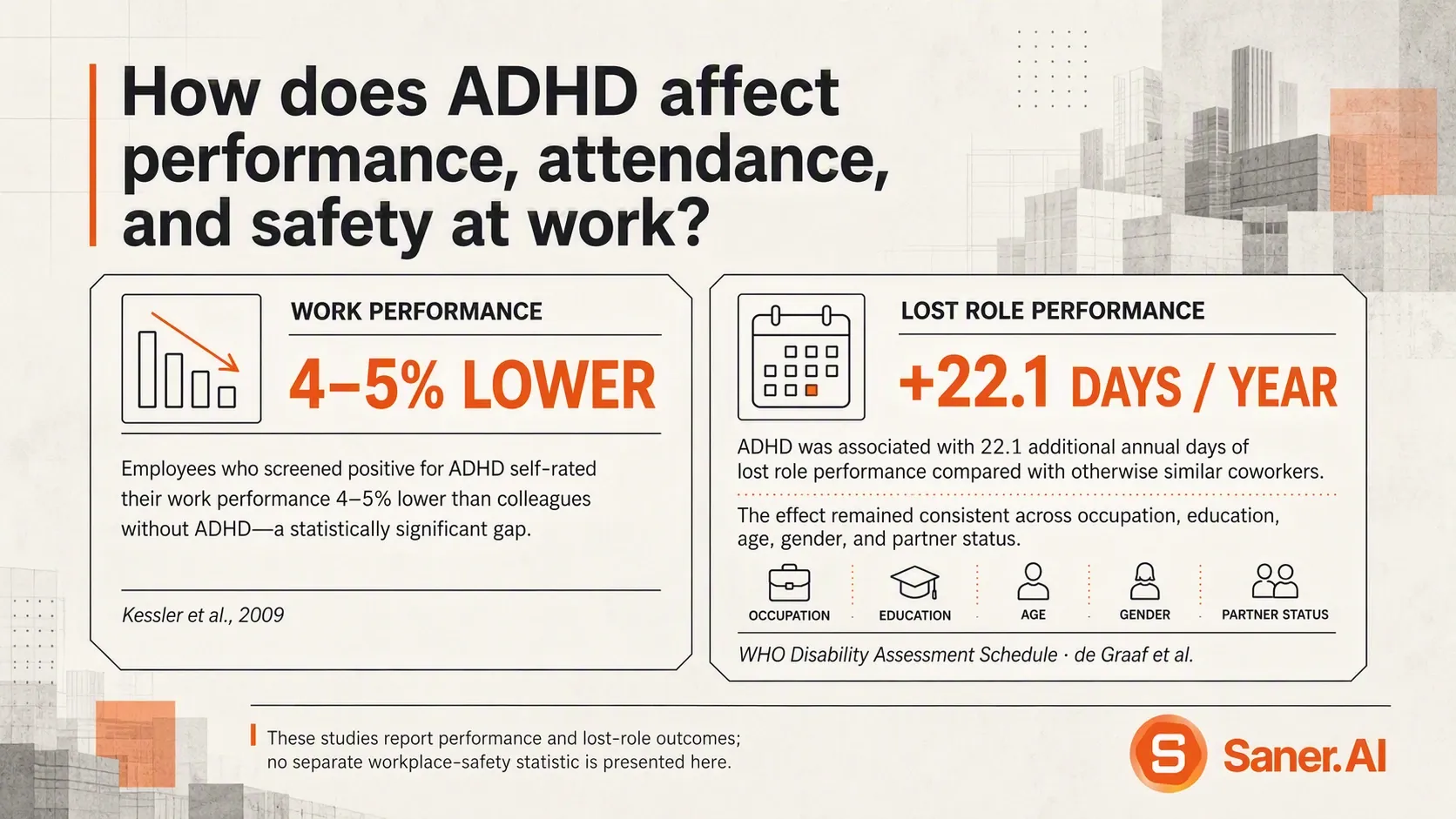
- In the manufacturing-firm study, employees who screened positive for ADHD self-rated their work performance 4-5% lower than colleagues without ADHD, a statistically significant gap (Kessler et al., 2009).
- Separately, the WHO survey found ADHD was associated with 22.1 additional annual days of lost role performance compared to otherwise similar coworkers, measured using the WHO Disability Assessment Schedule.
- Notably, de Graaf and colleagues found this effect held steady across occupation, education level, age, gender, and partner status, meaning it wasn't explained away by any single demographic factor.
How much does ADHD increase sickness absence and workplace accidents?
- The manufacturing-firm data breaks this out precisely: employees with ADHD had 2.1 times the odds of sickness absence and 2.0 times the odds of a workplace accident or injury, compared to employees without ADHD (Kessler et al., 2009).
- The same researchers calculated a human-capital cost of $4,336 per affected worker per year just from lost performance, not counting the unmonetized costs of the accidents themselves.
Are people with ADHD more likely to be fired or quit their jobs?
- A 2021 peer-reviewed synthesis in the Journal of Neural Transmission restates findings from Murphy and Barkley's 1996 study that adults with ADHD had a 200% increased risk of quitting a job and a 66% increased risk of being fired, compared to typically developing peers.
3) What does ADHD cost in income and career advancement?
Does ADHD affect employment rates and income?
Substantially.
- In a national U.S. survey of 500 adults with ADHD and 501 matched controls, only 34% of the ADHD group worked full-time, compared with 59% of controls (Biederman & Faraone, 2006).
- The same study found average household incomes were significantly lower for adults with ADHD across nearly every age group studied, regardless of academic achievement, with the sole exception of the 18-24 age bracket, where careers hadn't yet diverged.
What is the total economic cost of ADHD in the workplace?
- Biederman and Faraone extrapolated their income-gap findings to the full working-age population and estimated ADHD costs the U.S. economy between $67 billion and $116 billion annually in lost workforce productivity.
- That range is wide, reflecting the uncertainty of extrapolating from survey data to a national economy, but even the low end represents a substantial, largely invisible drag on GDP.
4) Do workplace accommodations for ADHD actually work?
How much do ADHD workplace accommodations typically cost?
Far less than most employers assume.
- The U.S. Department of Labor's Job Accommodation Network, which has tracked employer-reported accommodation costs since 2004, found that of 1,425 employers who shared cost data between 2019 and 2024, 61% (872 employers) said the accommodation cost nothing at all to implement.
- The remainder typically involved one-time costs with a median of $300. JAN's ADHD-specific guidance recommends common accommodations like quiet workspaces, written instructions, task-chunking, and flexible deadlines, none of which require significant capital outlay.
Are workplace accommodations effective once they're in place?
Generally, yes.
- In DOL's prior published effectiveness breakdown (data collected 2019-2022), of over 1,300 employers who rated the accommodations they'd implemented, 68.4% called them "very" or "extremely" effective, while only 13% rated them ineffective.
5) Does remote work fix ADHD's productivity problems?
A 2023 cohort study of Japanese workers (Ishimoto et al., published in Neuropsychiatric Disease and Treatment) examined undiagnosed workers screening positive for ADHD symptoms during the COVID-19 pandemic.
- In other words: working from home can genuinely help an ADHD employee's mental health without doing anything measurable for their output, because the underlying executive-function gap (planning, initiating tasks, tracking time) doesn't disappear just because the walls around it changed.
There's a second, quieter barrier that limits how much any accommodation can help: many employees never ask.
- A cross-sectional study of Dutch workers examining mental-illness disclosure at work found that while 82.4% expected mostly positive outcomes from disclosing, a majority also anticipated real costs: 68.4% expected disclosure to hurt their chances of a contract renewal, and 57% expected it to reduce their odds of promotion.
- Accommodations that cost employers nothing and work well, per the JAN data above, still only help the people who feel safe enough to request them.
6) What these statistics mean for ADHD professionals and their managers
- The performance gap is real, specific, and largely about time and attention, not effort.
Across three independent, decades-apart studies, the effect size lands in a narrow, consistent range: a mid-single-digit percentage drop in self-rated performance, roughly three weeks of excess lost productive days a year, and doubled odds of absence or accident.
These aren't stories about people who don't care about their jobs. They're the predictable output of executive-function differences running headfirst into a workday still designed around sustained, linear attention.
- Cheap accommodations work; the problem is more often access than cost.
The DOL's own data undercuts the most common employer objection to accommodating ADHD: cost. Most fixes are free, and the ones that aren't cost a few hundred dollars.
The real friction, per the Dutch disclosure data, is that employees have to weigh an uncertain trade-off between getting help and being seen differently at work, and a majority expect that trade-off to have a real downside for their career.
- Flexibility alone doesn't close the gap; the right tools for the underlying task might.
The Ishimoto finding is the most counterintuitive one here, and arguably the most useful: remote work made ADHD workers feel better without making them measurably more productive, because it removed office noise but didn't replace the external structure (calendars, reminders, task decomposition) that a traditional office scaffolds for free.
That's the specific gap that tools built around externalized memory and structure, rather than raw flexibility, are positioned to close.
It's also the design premise behind Saner.AI, which was built to hold the calendars, notes, tasks, and reminders that ADHD brains struggle to hold internally, so structure doesn't depend on an employee's working memory on any given day.
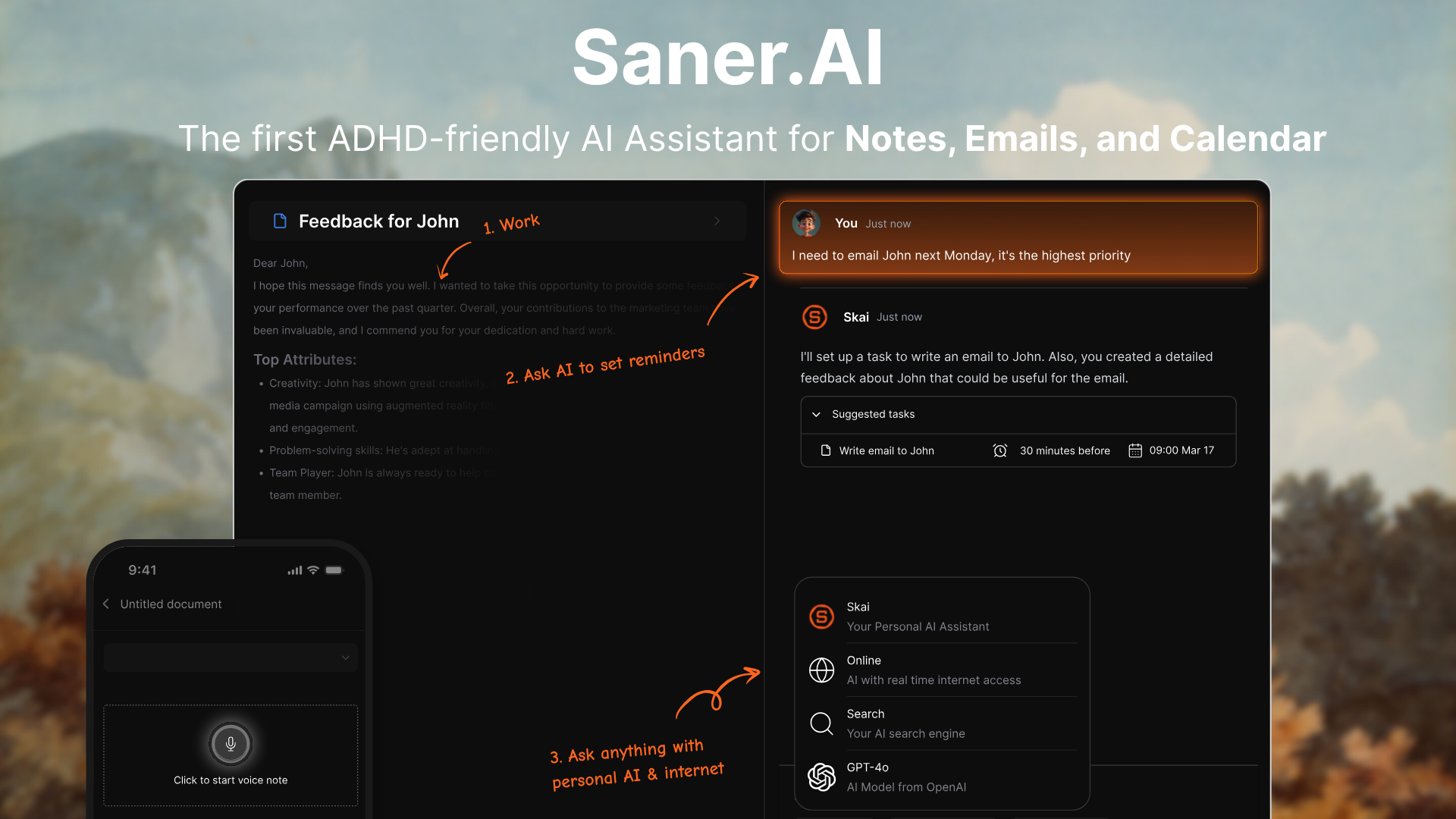
Stay on top of your work and life effortlessly
👉 You may like this post on how to improve Productivity for adults with ADHD
Quotable ADHD workplace statistics
- According to the CDC's 2023 National Center for Health Statistics survey, 15.5 million U.S. adults (6.0%) currently have a diagnosed ADHD. (CDC)
- The WHO World Mental Health Survey Initiative (2008) found employees with ADHD lose an average of 22.1 more workdays of role performance per year than similar coworkers without ADHD. (de Graaf et al., Occupational and Environmental Medicine)
- A 2009 survey of a large U.S. manufacturing firm found ADHD was associated with a 4-5% reduction in self-rated work performance. (Kessler et al., Psychological Medicine)
- Employees with ADHD in that manufacturing-firm study had 2.1 times the odds of sickness absence and 2.0 times the odds of a workplace accident. (Kessler et al., Psychological Medicine)
- The same study estimated a $4,336 annual human-capital cost per worker with ADHD from lost performance alone. (Kessler et al., Psychological Medicine)
- A 2006 national U.S. survey found only 34% of adults with ADHD worked full-time, compared with 59% of matched controls. (Biederman & Faraone, MedGenMed)
- That survey estimated ADHD costs the U.S. economy between $67 billion and $116 billion a year in lost workforce productivity. (Biederman & Faraone, MedGenMed)
- The U.S. Department of Labor's Job Accommodation Network found 61% of workplace accommodations implemented between 2019 and 2024 cost employers nothing. (Job Accommodation Network / U.S. DOL)
- A 2023 Japanese cohort study found remote work reduced depressive symptoms in workers with ADHD traits but did not significantly improve their measured productivity. (Ishimoto et al., Neuropsychiatric Disease and Treatment)
FAQ
1. How many people at work have ADHD?
Using the CDC's population-wide figure, about 6.0% of U.S. adults, or 15.5 million people, currently have a diagnosed ADHD. Workplace-specific screening studies find a somewhat lower active rate among employed adults, between 1.9% and 3.5% depending on the population and screening method used (CDC; de Graaf et al.).
2. Does ADHD really hurt job performance, or is that a stereotype?
It's measurable, not a stereotype. Independent studies spanning nearly two decades put the performance gap at roughly 4-5% in self-rated output and about 22 excess lost workdays a year, with elevated odds of absence and accidents on top of that (Kessler et al., 2009; de Graaf et al., 2008).
3. How much does ADHD cost employers and the economy?
At the individual level, one study estimated $4,336 in annual lost-performance cost per affected employee (Kessler et al., 2009). Nationally, ADHD's income and productivity effects have been estimated at $67-116 billion a year in the U.S. (Biederman & Faraone, 2006).
4. Are people with ADHD more likely to lose their jobs?
Older research suggests so: a 200% increased risk of quitting and a 66% increased risk of being fired, compared to peers without ADHD, per a 1996 study restated in later peer-reviewed literature. That specific figure is worth treating with some caution given its age and indirect sourcing, but it's broadly consistent with the lower full-time employment rate (34% vs. 59%) found a decade later by Biederman and Faraone.
5. Are ADHD workplace accommodations expensive for employers?
No. U.S. Department of Labor data shows 61% of accommodations cost nothing to implement, and the rest typically cost a median of $300 as a one-time expense (Job Accommodation Network).
6. Do workplace accommodations for ADHD actually work?
Generally yes. In DOL's most recent published effectiveness data, 68.4% of employers who'd implemented an accommodation called it very or extremely effective, versus 13% who called it ineffective.
7. Does working from home help employees with ADHD?
It helps mental health more reliably than it helps productivity. A 2023 study found remote and hybrid work reduced depressive symptoms in workers with ADHD traits, but did not significantly improve their measured work output or quality of life (Ishimoto et al., 2023).
8. Should I disclose my ADHD diagnosis to my employer?
That's a personal decision with real trade-offs on both sides. Research on mental-illness disclosure at work found most people expect a mostly positive outcome from disclosing, but a majority also anticipate it will hurt their chances at a promotion or contract renewal (cross-sectional Dutch worker study). There's no universal right answer; it depends on the workplace, the role, and how much accommodation would actually help.
Sources
- Staley, B.S. et al. (2024). Attention-Deficit/Hyperactivity Disorder Diagnosis, Treatment, and Telehealth Use in Adults — National Center for Health Statistics Rapid Surveys System, United States, October–November 2023. MMWR, 73(40), 890-895. https://www.cdc.gov/mmwr/volumes/73/wr/mm7340a1.htm
- de Graaf, R., Kessler, R.C., Fayyad, J. et al. (2008). The prevalence and effects of adult attention-deficit/hyperactivity disorder (ADHD) on the performance of workers: results from the WHO World Mental Health Survey Initiative. Occupational and Environmental Medicine, 65(12), 835-842. https://pubmed.ncbi.nlm.nih.gov/18505771/
- Kessler, R.C., Lane, M., Stang, P.E., & Van Brunt, D.L. (2009). The prevalence and workplace costs of adult attention deficit hyperactivity disorder in a large manufacturing firm. Psychological Medicine, 39(1), 137-147. https://pubmed.ncbi.nlm.nih.gov/18423074/
- Biederman, J. & Faraone, S.V. (2006). The effects of attention-deficit/hyperactivity disorder on employment and household income. MedGenMed, 8(3), 12. https://www.medscape.com/viewarticle/536264
- U.S. Department of Labor, Job Accommodation Network. Cost and Benefits of Accommodations (data 2019-2024, updated 9/17/2025). https://askjan.org/topics/costs.cfm
- U.S. Department of Labor / Job Accommodation Network. Accommodation and Compliance: Low Cost, High Impact (data 2019-2022, released May 2023), as reported by HealthLeaders Media and the DOL press release.
- Ishimoto, Y., Sotodate, T., Namba, Y., Uenishi, T., Iwasaki, K., & Tomita, H. (2023). Benefits of Working from Home During the COVID-19 Pandemic for Undiagnosed Workers with Attention-Deficit/Hyperactivity Disorder Symptoms. Neuropsychiatric Disease and Treatment, 19, 1607-1621. https://pubmed.ncbi.nlm.nih.gov/37484117/
- Bexkens, A. et al. (2021), restating Murphy, K. & Barkley, R.A. (1996). Attention deficit hyperactivity disorder adults: comorbidities and adaptive impairments. Comprehensive Psychiatry, 37(6), 393-401. Cited via Journal of Neural Transmission synthesis. https://link.springer.com/article/10.1007/s00702-021-02309-z
- Expectations of Mental Illness Disclosure Outcomes in the Work Context: A Cross-Sectional Study Among Dutch Workers. PMC. https://www.ncbi.nlm.nih.gov/pmc/articles/PMC9668951/