
ADHD Productivity Statistics 2026: Prevalence, Workplace Cost, and What Actually Helps

In this article, we will pull data from CDC data briefs, WHO-affiliated workplace surveys, and randomized controlled trials of digital interventions to answer: what does the evidence actually say about why ADHD makes productivity harder, and which interventions have data behind them
Key ADHD productivity statistics
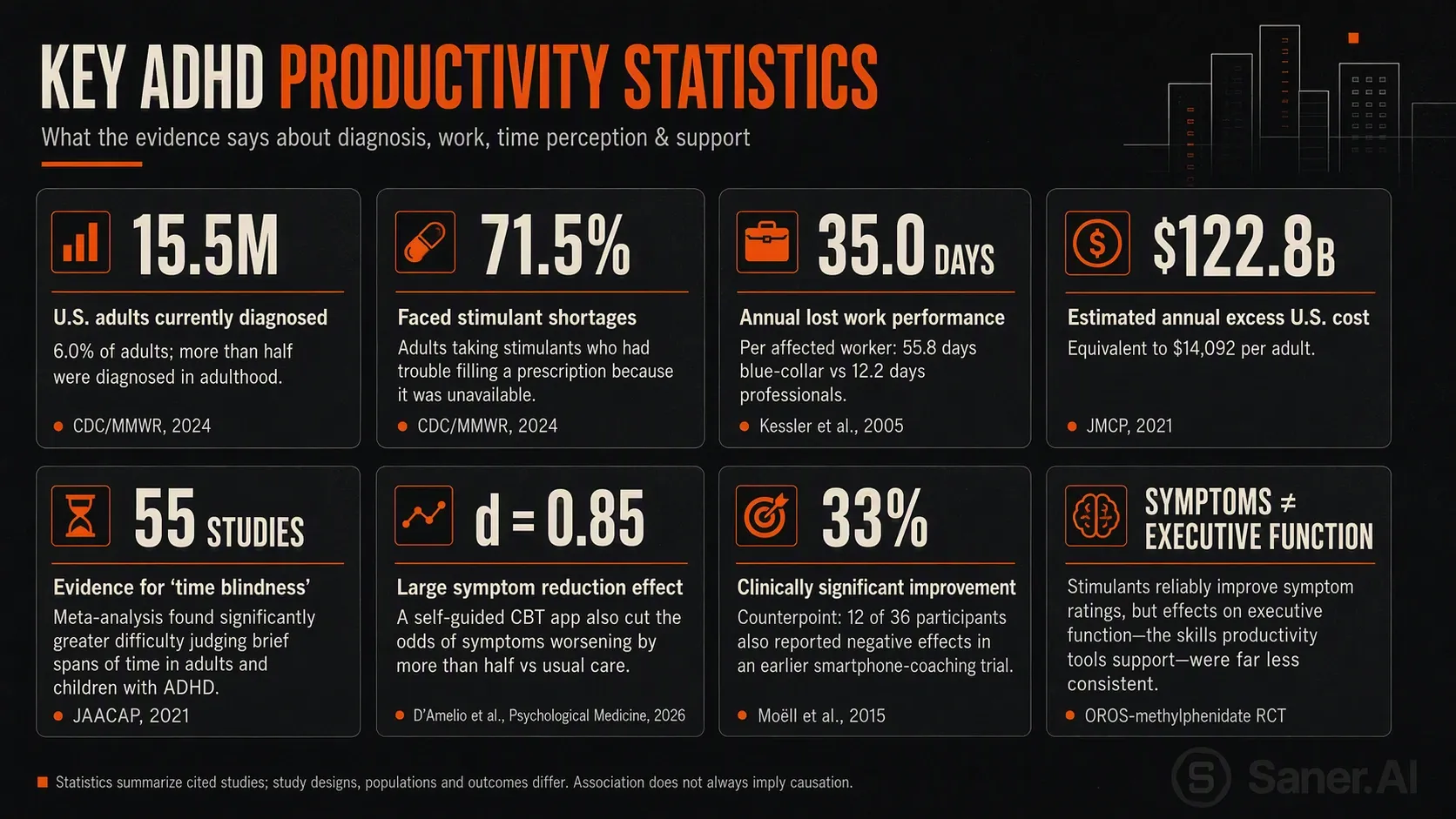
- 15.5 million U.S. adults (6.0%) currently have an ADHD diagnosis, and more than half were diagnosed in adulthood rather than childhood. (CDC/MMWR, 2024)
- 71.5% of adults taking stimulant medication had trouble filling their prescription in the past year because the drug was unavailable. (CDC/MMWR, 2024)
- ADHD was associated with 35.0 days of annual lost work performance per affected worker in a nationally representative U.S. sample — 55.8 days for blue-collar workers versus 12.2 for professionals. (Kessler et al., 2005)
- The estimated annual excess cost of adult ADHD in the U.S. is $122.8 billion, or $14,092 per adult. (Journal of Managed Care & Specialty Pharmacy, 2021)
- A meta-analysis of 55 studies found adults and children with ADHD have significantly more severe difficulty judging brief spans of time than neurotypical people — the closest thing to hard evidence for "time blindness." (JAACAP, 2021)
- In a randomized trial, a self-guided CBT app reduced ADHD symptom severity with a large effect size (d = 0.85) and cut the odds of symptoms worsening by more than half compared to usual care alone. (D'Amelio et al., Psychological Medicine, 2026)
- Counterpoint: in an earlier smartphone-coaching trial, 33% of participants showed clinically significant improvement — but 12 of the 36 participants also reported the intervention had negative effects. (Moëll et al., 2015)
- Stimulant medication improves ADHD symptom ratings reliably, but a randomized trial found its effect on executive function specifically — the skills productivity tools try to support — is far less consistent than its effect on symptoms. (OROS-methylphenidate RCT)
Table of contents
- How many adults actually have ADHD?
- What does ADHD do to time management?
- How much does ADHD cost workplace productivity?
- Do productivity apps and digital tools actually help?
- When do productivity tools and treatments fall short?
- What these statistics mean for ADHD productivity
- Quotable ADHD productivity statistics
- FAQ
- Sources
1) How many adults actually have ADHD?
How many U.S. adults have ADHD?
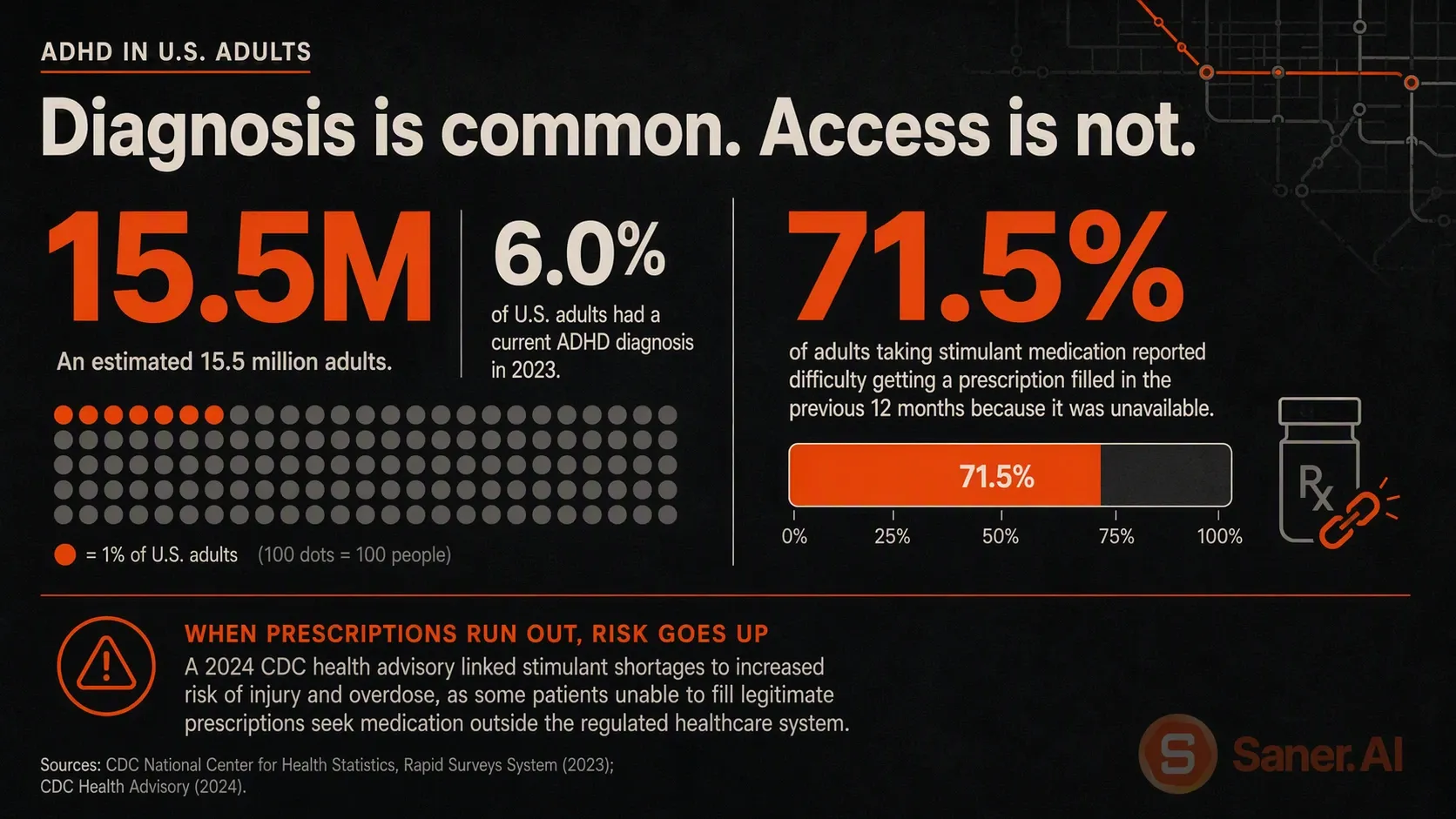
An estimated 15.5 million U.S. adults, or 6.0%, had a current ADHD diagnosis in 2023, according to the CDC's National Center for Health Statistics Rapid Surveys System — the most recent nationally representative estimate available. Approximately half of those adults received their diagnosis in adulthood rather than in childhood, which is worth pausing on: a lot of "ADHD productivity content" implicitly assumes a childhood diagnosis and years of self-knowledge.
For over half of diagnosed adults, that's not the story; the productivity struggles came first, and the explanation came later, often after a decade or more of unexplained friction at work.
Worth flagging: an older, frequently cited figure puts adult ADHD at 4.4% (ages 18–44), from Kessler et al.'s 2006 analysis of the National Comorbidity Survey Replication, which used clinical diagnostic interviews rather than self-reported diagnosis and covered a narrower age band.
Both numbers are legitimate; they're measuring different things (symptom-threshold interviews vs. diagnosed-and-living-with-it), which is a big part of why "how common is ADHD" gets different answers depending on which source a given roundup copied from.
How hard is it to actually get treatment?
Diagnosis is only step one.
71.5% of adults who reported taking a stimulant medication had difficulty getting their prescription filled in the previous 12 months because the medication was unavailable, per the same CDC report.
A 2024 CDC health advisory tied these shortages to increased risk of injury and overdose, as patients unable to fill legitimate prescriptions sometimes seek medication outside the regulated healthcare system — a genuinely serious downstream consequence, not just an inconvenience.
Access gaps show up elsewhere too. Roughly 30.5% of adults with ADHD had a telehealth visit specifically to get a medication prescription, and 30.8% had one for counseling or therapy, per CHADD's analysis of the CDC data — meaning telehealth has become a genuine access point rather than a pandemic-era stopgap.
2) What does ADHD do to time management?
Is "time blindness" a real, measurable thing?
Yes, with caveats.
A 2021 meta-analysis in the Journal of the American Academy of Child & Adolescent Psychiatry pooled 55 studies and found that compared with people without ADHD, those with ADHD had significantly more severe difficulty discriminating stimuli of very brief durations, especially in the sub-second range.
That's a narrower and more specific finding than the popular framing of "ADHD brains can't sense time passing" — the strongest, most consistent deficits show up at the millisecond level, in lab timing tasks, not necessarily in everyday questions like "how long is this meeting going to run."
A separate literature review looking specifically at adults found a mixed picture: some studies show clear deficits in time estimation, reproduction, and management, while other studies were unable to demonstrate a clear association between ADHD and time estimation and time reproduction deficits, largely because diagnostic protocols and methodology vary widely between studies.
The summary: time-perception differences in ADHD are real and replicated at the neurological level, but "time blindness" as a clean, universal, everyday phenomenon is less settled science than most ADHD content implies.
Does medication fix time perception?
Partially.
Reviews note that stimulant medication tends to shift timing performance closer to neurotypical baselines on lab tasks, but — as the next section covers — symptom-level improvement and functional, real-world improvement aren't the same thing.
3) How much does ADHD cost workplace productivity?
How many workdays does ADHD cost per year?
In the most-cited U.S. study on this — Kessler et al.'s 2005 analysis in the Journal of Occupational and Environmental Medicine — 4.2% of workers screened positive for ADHD, and ADHD was associated with 35.0 days of annual lost work performance, with the association far higher among blue-collar workers (55.8 days) than professional workers (12.2 days).
Extrapolated across the labor force, that's 120 million days of annual lost work in the U.S., equivalent to $19.5 billion in lost human capital — at 2005 dollars, using 2001–2003 survey data. It's the best nationally representative U.S. figure available, but it's two decades old; no more recent U.S. replication using the same WHO Health and Work Performance Questionnaire methodology exists.
A cross-national companion study from the WHO World Mental Health Survey Initiative found the pattern holds internationally: an average of 3.5% of workers across 10 countries met DSM-IV criteria for adult ADHD, and this was associated with high work impairment in every country studied, most pronounced in Colombia, Italy, Lebanon, and the USA. Only a small minority of affected workers had ever received treatment for the condition — the productivity loss compounds because most of it is going unaddressed, not because treatment doesn't help.
What's the total economic cost of adult ADHD?
The most rigorous, current answer comes from a 2021 societal-perspective analysis in the Journal of Managed Care & Specialty Pharmacy: the overall excess cost of ADHD among U.S. adults in 2018 was estimated at $122.8 billion, or $14,092 per adult, combining direct healthcare costs with non-healthcare and indirect costs.
That sits toward the higher end of an earlier systematic review's range: a 2012 review found overall national annual incremental costs of ADHD ranging from $143 to $266 billion, with adults accounting for $105–194 billion of that and productivity and income losses making up the single largest cost category for adults, at $87–138 billion. Different methodologies, similar conclusion: lost productivity, not medical bills, is where most of the money goes.
4) Do productivity apps and digital tools actually help?
What does the best available evidence say?
| Study | Year | Adults with ADHD (n) | Format | Symptom-severity result | Source |
|---|---|---|---|---|---|
| Living SMART (Moëll et al.) | 2015 | 57 | 6-week, coach-guided smartphone course | 33% clinically significant responders vs. 0% in control | Internet Interventions |
| Four prior self-guided digital RCTs (Kenter 2023; Nasri 2023; Pettersson 2017; Selaskowski 2022) | 2017–2023 | Small samples per study | Various self-guided digital interventions | Effect sizes ranged d = 0.42–1.21 | Psychological Medicine, 2026 |
| attexis (D'Amelio et al.) | 2026 | 337 | Fully self-guided CBT + mindfulness app | d = 0.85 (large), sustained at 6 months | Psychological Medicine |
Better than a lot of the marketing copy around "ADHD apps" would suggest — but the rigorous evidence is newer and thinner than the prevalence and cost data above.
The strongest current evidence comes from a 2026 randomized controlled trial of attexis, a fully self-guided digital CBT and mindfulness intervention for adults with ADHD, published in Psychological Medicine. A total of 337 adults with confirmed ADHD were randomized to the app plus usual care, or usual care alone. Intent-to-treat analysis showed significantly lower ADHD symptom severity in the intervention group at three months, with a baseline-adjusted mean difference of −5.0 points and a large effect size (d = 0.85, p < .001).
Effects held up at six months, and secondary outcomes — including work and social functioning — also improved significantly, with response rates for meaningful functional improvement at 26.2% versus 11.6% in the control group. Worth noting for transparency: this trial was funded by GAIA, the app's manufacturer, and two of the nine authors are GAIA employees — a vendor-funded study, though the intent-to-treat design and pre-registration are reassuring signs of rigor.
An earlier, smaller trial gets at the same question from a different angle. In Living SMART, 57 adults with ADHD or sub-clinical ADHD were randomized to a six-week, coach-guided course teaching them to use smartphone apps to organize daily life, or a wait-list control. Participants receiving the course reduced their inattention scores significantly more than the control group, and 33% were considered clinically significantly improved by a blind evaluator, compared to 0% in the control group. Adherence was high — an 84% assessment response rate and no explicit dropouts.
The pattern across nearly a decade of trials: sample sizes have grown from dozens to hundreds, and effect sizes have stayed in a consistent "moderate to large" range rather than shrinking — a reassuring sign for a field where bigger, better-powered replications sometimes deflate early promising results.
5) When do productivity tools and treatments fall short?
Does medication alone fix the executive-function problems that hurt productivity?
Not reliably.
A randomized, double-blind trial of OROS-methylphenidate in adults with ADHD set out to answer this directly, and the results were more complicated than "stimulants work."
- The researchers noted that while stimulants are effective at reducing ADHD symptoms in adults, uncertainty remained about their efficacy on executive function deficits specifically — the planning, time-management, and task-initiation skills that determine whether someone actually gets work done.
- A related pattern shows up in the placebo-controlled literature more broadly: stimulant treatment usually produces significant improvement on lab tasks like continuous performance tests, but its association with improved executive-function performance is considerably more limited — studies generally report small-magnitude changes or no effect on tasks with a prominent executive component.
Put plainly: medication can quiet the symptoms doctors measure without necessarily fixing the functional problems that show up at your desk.
6) What these statistics mean for ADHD people?
- The gap between diagnosis and treatment access is itself a productivity problem.
With 71.5% of medicated adults struggling to fill prescriptions and over half of diagnosed adults finding out in adulthood after years of unexplained friction, a meaningful share of the $122.8 billion annual cost isn't ADHD being untreatable — it's ADHD being under-treated, late-treated, or inconsistently treated. Any organization or individual trying to address ADHD-related productivity loss is, in practice, also dealing with a healthcare-access problem.
- Medication and structure solve different parts of the problem, and neither solves it alone.
The evidence that stimulants improve symptoms while leaving executive-function and workplace outcomes only partially addressed is one of the more consequential and least-discussed findings in this research. It's also the clearest evidence-based case for external structure — reminders, task breakdown, time visualization — as a genuine complement to treatment rather than a consolation prize for people who "should just take their meds."
- Tool consolidation, not tool accumulation, is what the evidence supports.
The RCTs that produced real effect sizes tested single, structured, guided programs — not a stack of five different apps competing for attention. That lines up with what the preprint survey data above suggests about tab overload and app fatigue: for a population already fighting task-switching costs, adding another disconnected tool to the pile is often the opposite of help.
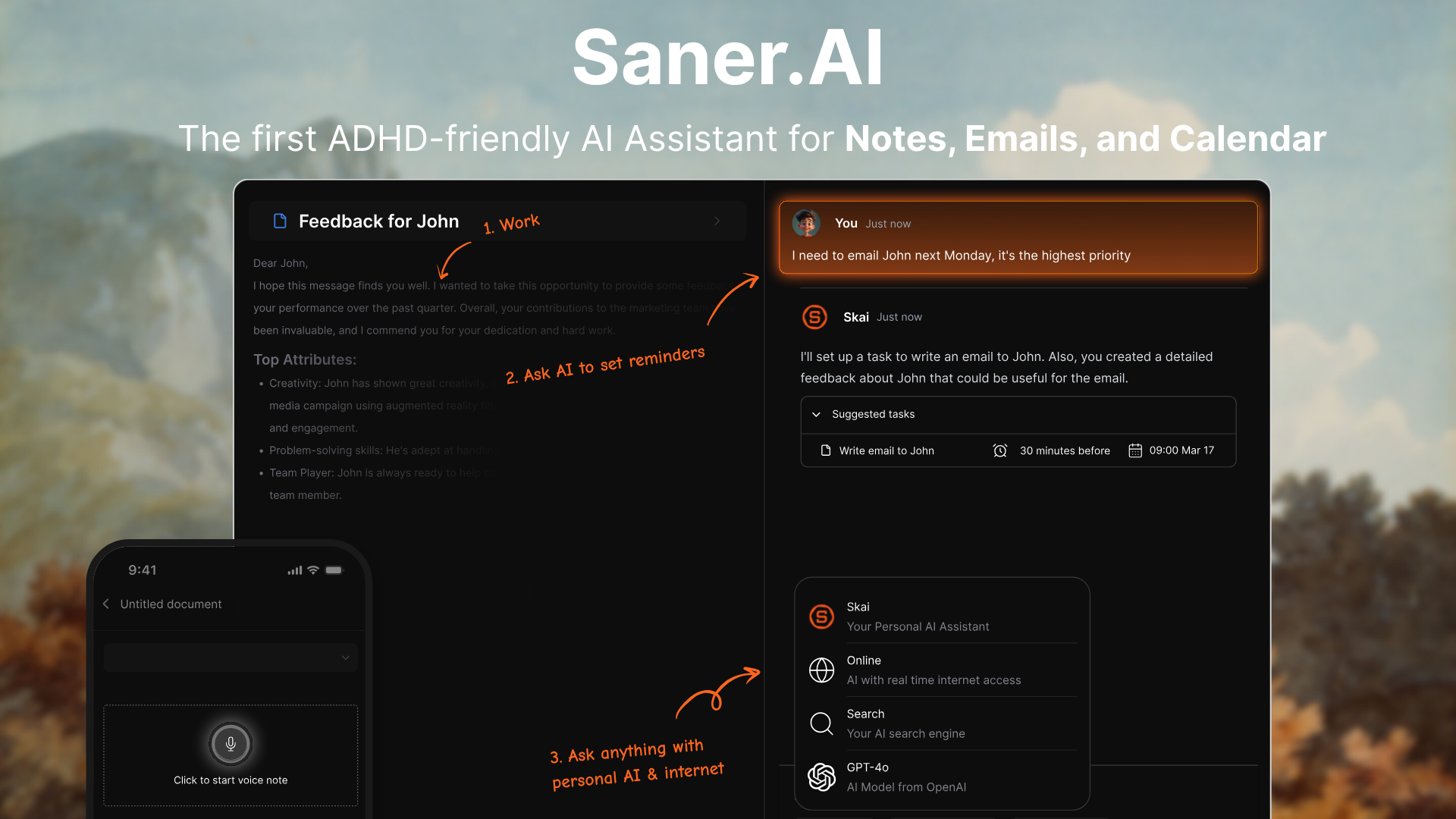
It's the reasoning behind ADHD task management tools like Saner.AI. It consolidates notes, tasks, and planner into one place instead of adding a fourth app to the stack - reducing the number of separate systems competing for the same limited executive-function budget, rather than asking someone with ADHD to manage a to-do app, a notes app, and a calendar as three separate cognitive chores.
Stay on top of your work and life effortlessly
👉 You may like this post on how to improve Productivity for adults with ADHD
Quotable ADHD productivity statistics
- According to the CDC's 2024 MMWR report, an estimated 15.5 million U.S. adults (6.0%) had a current ADHD diagnosis in 2023, and roughly half were diagnosed in adulthood. (CDC)
- 71.5% of U.S. adults with ADHD who take stimulant medication had difficulty filling their prescription in the past 12 months, per CDC's 2024 Rapid Surveys report. (CDC)
- Kessler et al.'s 2005 nationally representative U.S. study found ADHD associated with 35.0 days of annual lost work performance per affected worker, equivalent to $19.5 billion in lost national human capital. (JOEM, 2005)
- The Journal of Managed Care & Specialty Pharmacy's 2021 societal-perspective analysis put the annual excess cost of adult ADHD in the U.S. at $122.8 billion, or $14,092 per adult. (JMCP, 2021)
- A 2021 meta-analysis of 55 studies in the Journal of the American Academy of Child & Adolescent Psychiatry found people with ADHD have significantly more severe deficits discriminating very brief time intervals than neurotypical controls. (JAACAP, 2021)
- A 2026 randomized controlled trial of 337 adults found a self-guided digital CBT intervention reduced ADHD symptom severity with a large effect size (d = 0.85) that was sustained at six months. (Psychological Medicine, 2026)
- In a 2015 randomized trial of a smartphone-coaching intervention, 33% of participants showed clinically significant improvement, but 12 of 36 participants also reported the intervention had negative effects. (Internet Interventions, 2015)
- A 2008 WHO World Mental Health Survey Initiative study across 10 countries found an average 3.5% of workers met criteria for adult ADHD, with high associated work impairment in every country studied. (Occupational and Environmental Medicine, 2008)
FAQ
1. How many adults have ADHD in 2026?
The most recent nationally representative U.S. estimate is 15.5 million adults, or 6.0%, based on 2023 CDC data — though an older, narrower estimate (4.4% of adults 18–44) is still widely cited from earlier research using a different diagnostic method. (CDC)
2. Is ADHD becoming more common, or just diagnosed more?
The data can't fully separate the two. What's measurable is that diagnosis rates have risen and that more than half of currently diagnosed adults were diagnosed in adulthood, suggesting improved recognition is a major driver — whether true prevalence has also changed is a separate, harder question the current data doesn't resolve.
3. What is ADHD "time blindness" and is it scientifically real?
It refers to difficulty perceiving and estimating the passage of time. A 2021 meta-analysis of 55 studies found real, measurable deficits, especially for very brief time intervals, though the evidence for everyday, longer-scale time estimation is more mixed across individual studies. (JAACAP)
4. How much does ADHD cost the U.S. economy per year?
A 2021 analysis estimated $122.8 billion annually among adults, or $14,092 per adult, with lost productivity and income making up the largest share of that cost. (JMCP)
5. Do productivity apps actually help adults with ADHD?
Structured, guided digital programs have real RCT evidence behind them — one 2026 trial found a large effect size for a self-guided CBT app. But the evidence supports structured, purpose-built tools specifically, not an unlimited stack of general productivity apps.
6. Does ADHD medication fix productivity problems on its own?
Not reliably. Medication reliably reduces symptom ratings, but multiple studies found its effect on executive function and broader work/life functioning is considerably less consistent — which is the evidence-based case for pairing medication with external structure rather than relying on it alone.
7. How many workdays does ADHD cost the average affected worker per year?
A U.S. national study found 35.0 days of annual lost work performance per affected worker on average, ranging from about 12 days for professional workers to over 55 days for blue-collar workers. (JOEM, 2005)
8. Can adults be diagnosed with ADHD for the first time later in life?
Yes — CDC data shows more than half of adults currently diagnosed with ADHD received that diagnosis in adulthood, not childhood. (CDC)
Sources
- Ashman JJ, Santo L, Peters ZJ, Okeyode T, Gidali D. Visits to Health Centers by Adults With Attention-Deficit/Hyperactivity Disorder: United States, 2023. NCHS Data Brief No. 543. National Center for Health Statistics, December 2025. cdc.gov/nchs/data/databriefs/db543.pdf
- Staley BS, Robinson LR, Claussen AH, et al. Attention-Deficit/Hyperactivity Disorder Diagnosis, Treatment, and Telehealth Use in Adults — National Center for Health Statistics Rapid Surveys System, United States, October–November 2023. MMWR Morb Mortal Wkly Rep. 2024;73(40):890–895. cdc.gov/mmwr/volumes/73/wr/mm7340a1.htm
- CHADD. General Prevalence of ADHD in Adults. Updated January 2026. chadd.org/about-adhd/general-prevalence-adults
- Kessler RC, Adler L, Ames M, et al. The Prevalence and Effects of Adult Attention Deficit/Hyperactivity Disorder on Work Performance in a Nationally Representative Sample of Workers. J Occup Environ Med. 2005;47(6):565-572. pubmed.ncbi.nlm.nih.gov/15951716
- de Graaf R, Kessler RC, Fayyad J, et al. The Prevalence and Effects of Adult Attention-Deficit/Hyperactivity Disorder (ADHD) on the Performance of Workers: Results from the WHO World Mental Health Survey Initiative. Occup Environ Med. 2008. pmc.ncbi.nlm.nih.gov/articles/PMC2665789
- Meta-analysis: Altered Perceptual Timing Abilities in Attention-Deficit/Hyperactivity Disorder. J Am Acad Child Adolesc Psychiatry. 2021. jaacap.org/article/S0890-8567(21)02045-1/abstract
- Time Perception in Adult ADHD: Findings from a Decade — A Review. PMC. pmc.ncbi.nlm.nih.gov/articles/PMC9962130
- Moëll B, Kollberg L, Nasri B, Lindefors N, Kaldo V. Living SMART — A randomized controlled trial of a guided online course teaching adults with ADHD or sub-clinical ADHD to use smartphones to structure their everyday life. Internet Interv. 2015;2(1):24-31. sciencedirect.com/science/article/pii/S2214782914000347
- D'Amelio R, Betz LT, Jow SM, et al. Effectiveness of attexis, a digital intervention based on cognitive behavioral therapy for adults with ADHD: a randomized controlled trial. Psychol Med. 2026;56:e54. doi.org/10.1017/S0033291726103390 — funded by GAIA, the intervention's manufacturer; two authors are GAIA employees.
- Are stimulants effective in the treatment of executive function deficits? Results from a randomized double blind study of OROS-methylphenidate in adults with ADHD. sciencedirect.com/science/article/abs/pii/S0924977X10002439
- Economic burden of attention-deficit/hyperactivity disorder among adults in the United States: a societal perspective. J Manag Care Spec Pharm. 2021;28(2). jmcp.org/doi/10.18553/jmcp.2021.21290
- Doshi JA, Hodgkins P, Kahle J, et al. Economic Impact of Childhood and Adult Attention-Deficit/Hyperactivity Disorder in the United States. J Am Acad Child Adolesc Psychiatry. 2012. sciencedirect.com/science/article/abs/pii/S0890856712005382
- Toward Neurodivergent-Aware Productivity: A Systems and AI-Based Human-in-the-Loop Framework for ADHD-Affected Professionals. arXiv preprint, 2025. arxiv.org/abs/2507.06864 — preprint, not yet peer-reviewed.