
Best AI for Investors: 5 tools to stay on top of the game


This post is written for self-directed investors and small funds who already use AI for research or execution and want to know which tool does which job well. If you want a single app that does everything, this isn't that. If you want a stack where each piece pulls its weight, read on.
Key answer: Which AIs are best for investors?
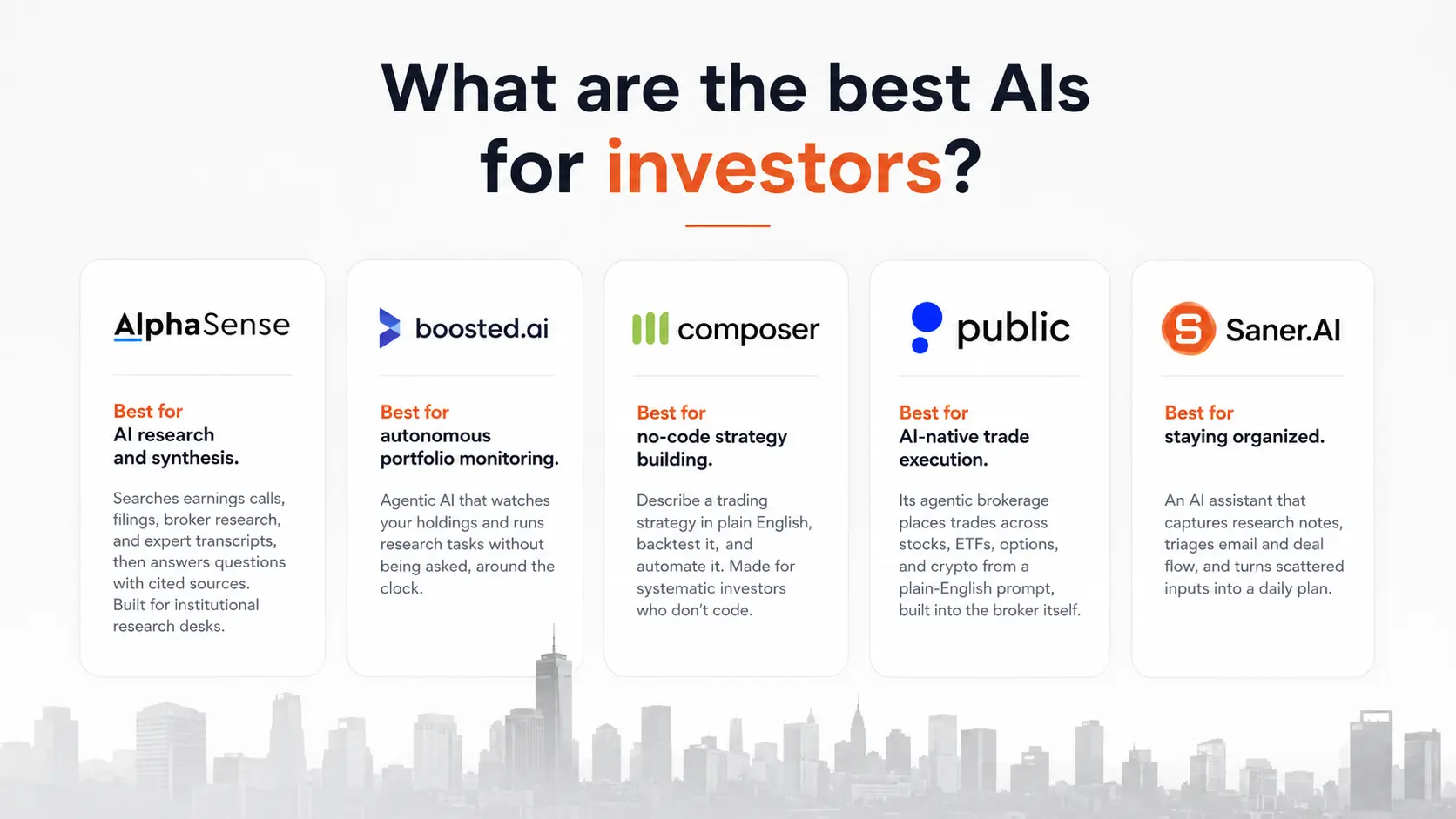
- AlphaSense — Best for AI research and synthesis. Searches earnings calls, filings, broker research, and expert transcripts, then answers questions with cited sources. Built for institutional research desks.
- Boosted.ai (Alfa) — Best for autonomous portfolio monitoring. Agentic AI that watches your holdings and runs research tasks without being asked, around the clock.
- Composer — Best for no-code strategy building. Describe a trading strategy in plain English, backtest it, and automate it. Made for systematic investors who don't code.
- Public — Best for AI-native trade execution. Its agentic brokerage places trades across stocks, ETFs, options, and crypto from a plain-English prompt, built into the broker itself.
- Saner.ai — Best for staying organized. An AI assistant that captures research notes, triages email and deal flow, and turns scattered inputs into a daily plan.
Short version: research with AlphaSense, monitor with Boosted, build strategies in Composer, execute on Public, and keep the whole operation organized with Saner.ai.
What is an AI investing tool?

An AI investing tool uses machine learning and language models to do the analytical and operational work investors used to do by hand: reading documents, spotting patterns, monitoring positions, building strategies, executing trades, and organizing research.
The AI investing problem (why it matters)
In a CFA Institute survey of investment firms, 60% said their employees are anxious about AI, 48% said they are resistant, and only 26% said they are excited. That gap between what the tools can do and what people are comfortable handing over is the real bottleneck.
The investors who figure out where to trust AI and where to keep their hands on the wheel are the ones who get the productivity gains without the blowups.
Sources: McKinsey Global Institute, "The economic potential of generative AI" · CFA Institute, "AI in Finance: Changing Workflows" · CFA Institute, AI adoption survey
How these tools were chosen
Dozens of AI investing tools were reviewed over several weeks, then narrowed to five that each own a distinct job and lean on AI as the core mechanism rather than a feature. Tools that were mostly a chatbot wrapper on public data were cut. Here's what each pick was measured against:
- AI depth — How much of the tool's actual work is done by AI versus manual setup. A tool that just adds a chat box to an old product didn't make it.
- Job ownership — Whether the tool clearly owns one stage of the workflow (research, monitoring, strategy, execution, or organization) without overlapping the others.
- Data and integration — What the AI has access to. Proprietary transcripts, live market data, and brokerage connections matter more than model size.
- Autonomy — How much you can hand off. Reactive tools that need constant prompting scored lower than agents that run on their own.
- Verifiability — Whether outputs cite sources or show their work, which matters when real capital is on the line.
- Access and price — Whether a self-directed investor can actually get in, or whether it's locked behind a five-figure enterprise contract.
Now, let's dive in!
AlphaSense — the research engine that reads everything so you don't have to
AlphaSense is an AI market intelligence platform that searches across SEC filings, earnings transcripts, broker research, and a library of 240,000+ expert interviews, then answers plain-English questions with cited sources. It's built for institutional research desks, equity analysts, and strategy teams who spend hours digging through documents.
Key features:
- Generative Search with cited answers: Ask a question in plain English and get a synthesized answer with source documents attached, so you can verify every claim instead of trusting a black box.
- Expert transcript library: 240,000+ expert-call transcripts covering 25,000 companies, a proprietary dataset that public tools can't reach.
- Smart Summaries and black-lining: Auto-flags material changes in 10-Ks and 10-Qs, including footnotes and risk disclosures, which is where earnings-season surprises hide.
Pros:
- Best-in-class semantic search for financial content; it understands intent, not just keywords.
- One login covers filings, transcripts, news, and sell-side research, replacing three or four separate tools
- AI summaries are genuine time savers, not gimmicks; one analyst reported cutting research time 30–40% (reviews).
Cons:
- Expensive. Contracts run roughly $12K–$40K+ per user per year, quote-only, with premium content billed separately.
- Search results can get noisy on broad queries, and the interface has a real learning curve (reviews).
- Overkill for anyone doing occasional research rather than daily deep work.
Pricing:
- No free tier or public pricing. Annual contracts only, negotiated with sales.
- Reported range: ~$12K/user/yr starting, ~$18K median, climbing past $100K for enterprise teams.
- Check the pricing page.
Best for: Institutional analysts, hedge funds, PE firms, and corporate strategy teams doing daily deep research who can justify a five-figure seat.
Getting started: Request a trial through sales, since there's no self-serve signup. Expect a demo and a learning curve in the first session. Start with one or two saved searches on companies you follow rather than trying to master every filter at once.
Boosted.ai — the analyst that never sleeps

Boosted.ai's Alfa is an agentic AI platform that continuously monitors portfolios and runs research tasks without being prompted each time. It's aimed squarely at institutional investors: hedge funds, asset managers, and wealth management teams. Where most tools wait for you to ask, Alfa watches your holdings around the clock and surfaces what changed.
Key features:
- Autonomous research agents: Runs 50,000+ live agents that execute research tasks and monitor positions without repeated user prompts.
- Continuous portfolio monitoring: Watches your holdings for anomalies, correlation shifts, and emerging risks in real time.
- Shareable reports: Generates decision-ready reports you can hand to a PM or investment committee.
Pros:
- Genuinely autonomous. It works while you're offline, which is the whole point of an agent versus a chatbot.
- Built for scale: processes 120B+ tokens monthly across institutional clients.
- Backed by real funding and adoption, having raised over $100M as of early 2026, so it's not a weekend project.
Cons:
- Institutional-only. There's no retail entry point, and pricing is quote-based.
- Autonomy means you have to trust the system's judgment, which is exactly the friction that slows AI adoption at most firms.
- Requires clean data and setup to be useful; it's not plug-and-play for a solo investor.
Pricing:
- Enterprise, quote-only. No public tiers or free plan. Contact Boosted.ai for a demo.
Best for: Institutional teams that want an always-on layer watching the portfolio, not another dashboard someone has to remember to check.
Getting started: Book a demo through the sales team. Onboarding involves connecting your holdings and defining what you want the agents to watch. Expect the first value to come from monitoring alerts rather than one-off queries.
Composer — build a trading strategy by describing it
Composer lets you build automated trading strategies in plain English, backtest them for free, and deploy them to run on their own. It calls these strategies "symphonies," and it's aimed at retail and prosumer investors who want systematic, rules-based investing without writing code.
Key features:
- Plain-English strategy builder: Describe a strategy and its Trade With AI tool generates an executable algorithm in under 60 seconds.
- Free backtesting: Test any symphony against historical data and S&P 500 benchmarks before risking a dollar, with fees and slippage factored in.
- Automated execution: With a Trading Pass, it rebalances and executes trades automatically once per trading day through Alpaca, commission-free.
Pros:
- No other tool offers this functionality with this simple a UI at this price (reviews).
- The visual editor makes strategy logic easy to build and manipulate, even for non-coders (reviews).
- Free backtesting is rare; most competitors charge for it
Cons:
- AI and Discover limits can cut you off mid-exploration, right when the work gets valuable
- U.S.-only, and you can't fully explore before opening an account
- Trigger conditions are limited to moving averages and RSI, and there's no sensitivity analysis, so expect trial and error
Pricing:
- Free tier for building and backtesting.
- Paid plans from ~$32/mo for automated execution. See the pricing page.
Best for: Retail and self-directed investors who want systematic, backtested strategies running automatically without touching code.
Getting started: Sign up free and browse community symphonies before building your own. Backtest a strategy or two to learn the editor, then upgrade to a Trading Pass only when you're ready to automate.
Public — execute trades from a prompt
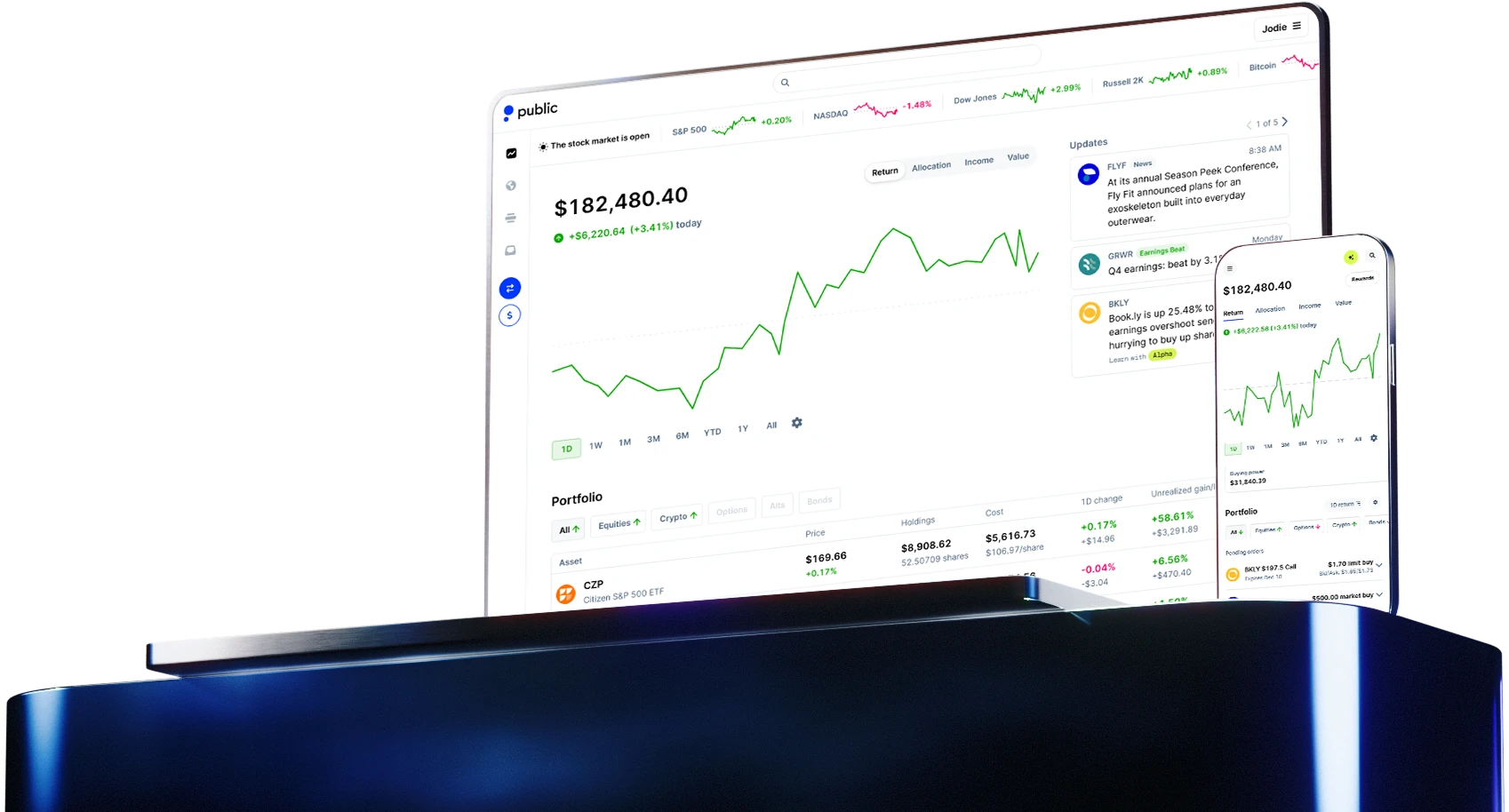
Public is a commission-free brokerage that markets itself as the first agentic brokerage. You define intent in plain English, and its agents can place trades across stocks, ETFs, options, crypto, and bonds. Because the agents are built into the broker itself, you never hand API keys to a third party. It's aimed at self-directed retail investors who want AI baked into execution, not bolted on.
Key features:
- Agentic brokerage: Define conditions and strategies, and agents act on your behalf (currently request-access only).
- Generated Assets: Turn a theme into a custom AI-built index, backtest it against the S&P 500, and invest in a few clicks.
- Alpha AI assistant: Ask any question about a stock and get real-time and historical insights on price, financials, earnings, and analyst ratings.
- Multi-asset in one account: Stocks, ETFs, options, bonds, crypto, and a high-yield cash account.
Pros:
- Clean, easy-to-use interface that recent reviews single out alongside the AI tools and options rebates
- No payment for order flow, a real trust signal versus most mobile brokers
- Broad asset lineup and strong cash yield in a single app
Cons:
- Advanced tools and market data feel thin or paywalled; weak for active traders
- Agents are request-access only, and some capabilities are still listed as coming soon
- No IRAs or retirement accounts, so most users keep a second broker for that
Pricing:
- Free. Commission-free stocks, ETFs, and options; $20 first deposit. Public Premium is ~$10/mo. See fees.
Best for: Self-directed investors who want AI-native execution and broad asset access in one commission-free app.
Getting started: Download the app, verify identity, and fund with $20 to start. Request access to Agents separately since it's gated. Trades always ask for confirmation before executing, so you stay in control while testing the AI features.
Saner.AI — the assistant that keeps the whole operation organized
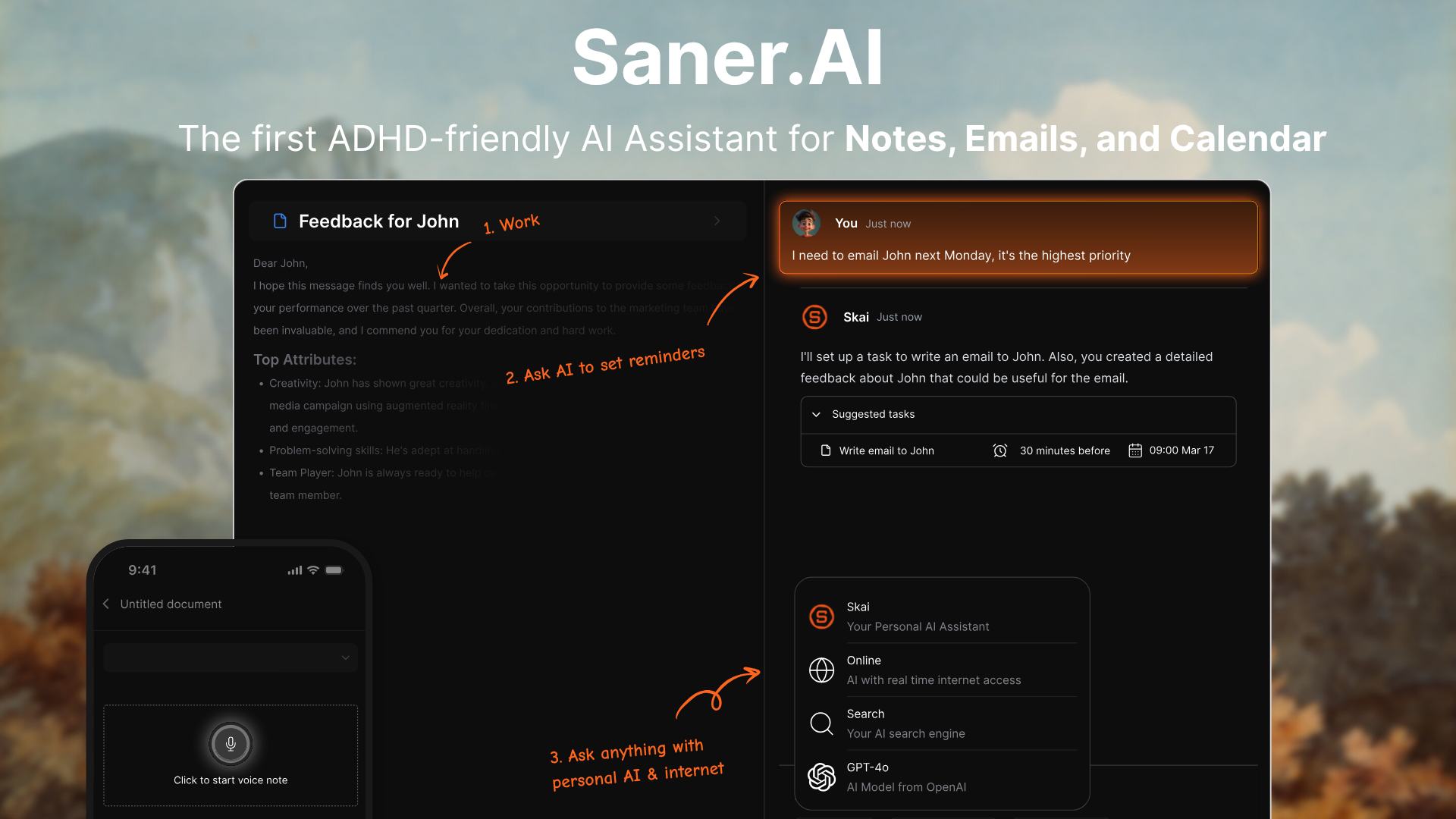
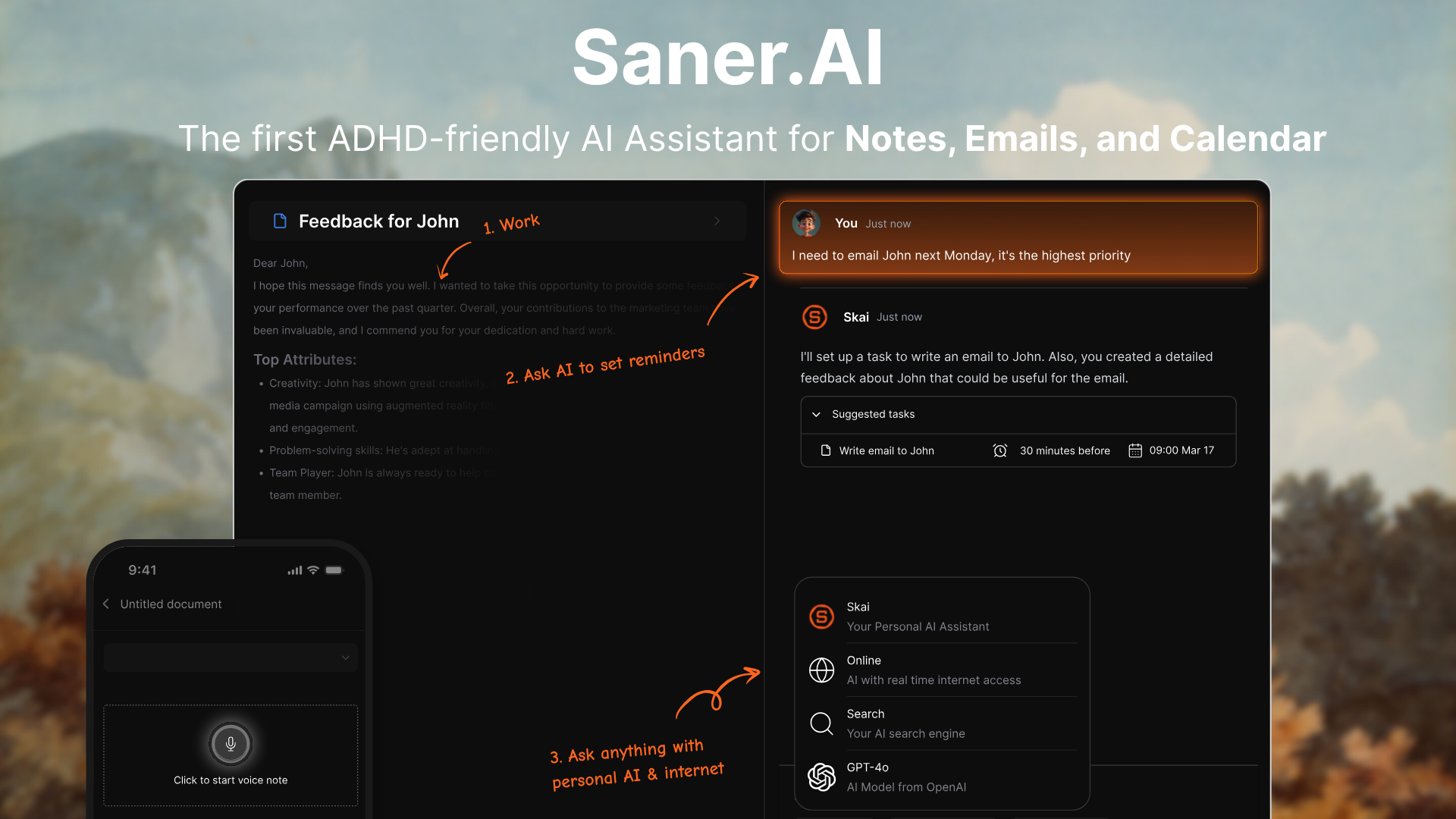
Saner.AI is an AI personal assistant that captures your notes, triages email, and turns scattered inputs into a daily plan. Research platforms find signals and brokers execute trades, but the deal-flow emails, meeting notes, research to-dos, and follow-ups still pile up somewhere. Saner.AI organizes what you capture and proactively tells you what needs attention, without you asking.
Key features:
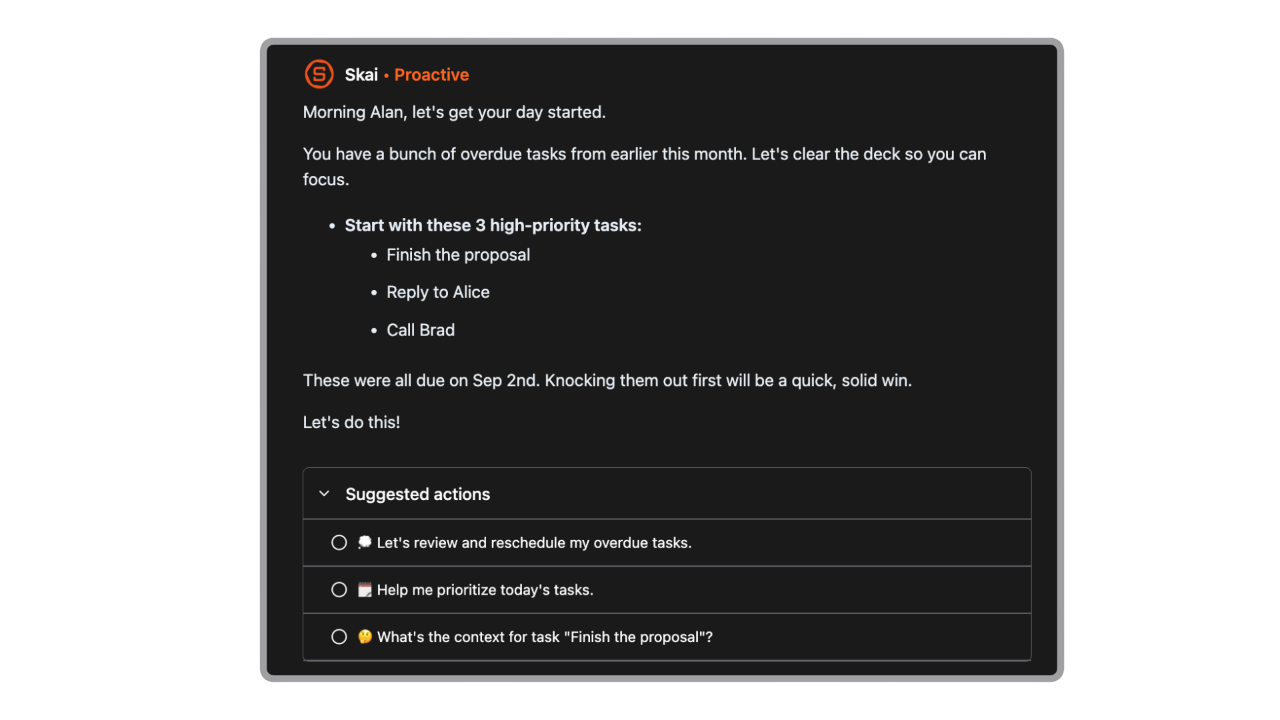
- Proactive daily planning: Skai scans your notes, emails, and calendar each morning and builds a prioritized plan, so you stop checking three apps to figure out your day.
- Unified capture: Drop ideas via voice, Chrome extension, or bulk import, and Skai auto-tags and files them so nothing gets lost.
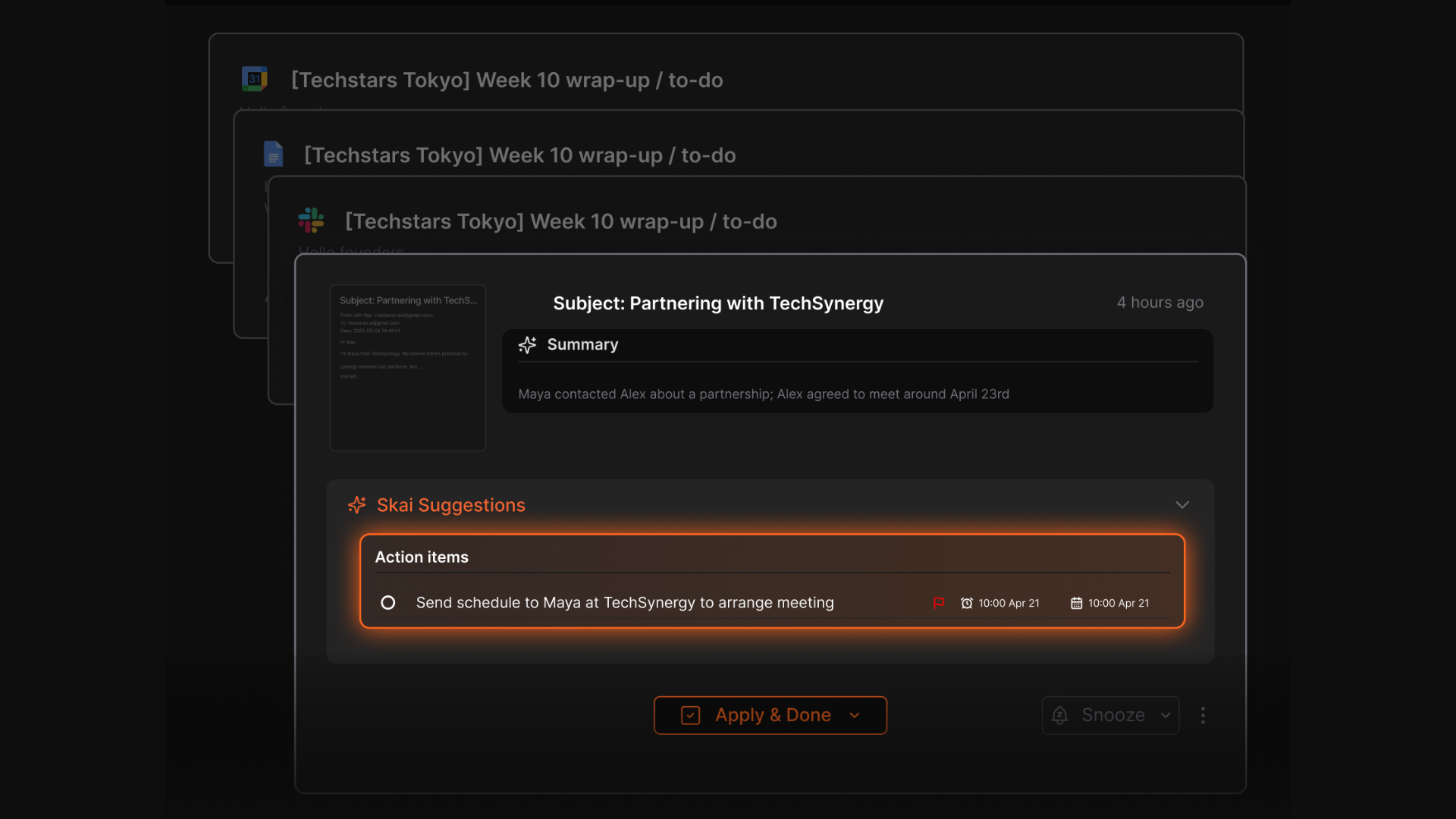
- Email and calendar triage: Pulls email, calendar, and tasks into one workspace and surfaces what needs a response or a follow-up.
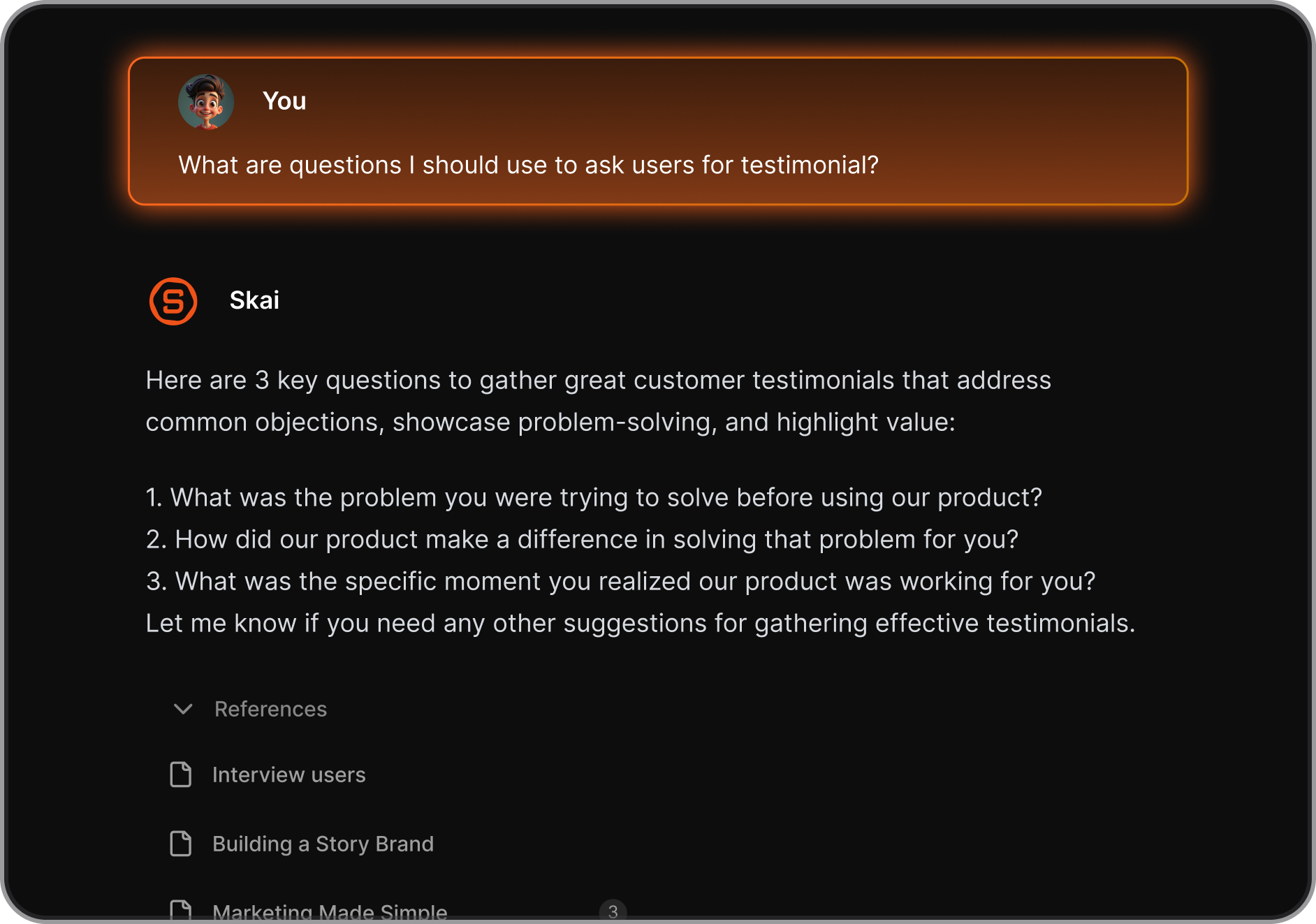
- Semantic search and chat: Ask questions in plain language across everything you've captured and get answers from your own knowledge base.
Pros:
- Consolidates notes, email, calendar, and tasks into one workspace, replacing three or four separate subscriptions
- The proactive AI actually surfaces what matters instead of waiting to be asked
- Low learning curve; it starts organizing your inputs within days, no setup required
Cons:
- Individual-focused, so it's not built for team collaboration yet.
Pricing:
- Free plan: 30 AI messages/month, 100 notes, integrations included.
- Starter $8/mo (annual) or $12/mo monthly; Standard $16/mo (annual) or $20/mo monthly. See pricing.
Best for: Investors and small teams buried in research notes, deal-flow email, and follow-ups who want one AI assistant to keep it all organized and surfaced.
Getting started: Create a free account, connect your email and calendar, and start brain-dumping notes. Skai begins organizing within the first session, and the daily plan gets sharper as it learns your patterns over a few days. No perfect setup needed; just start capturing.
Stay on top of your investment
Conclusion
The real split in AI investing tools isn't features; it's whether the AI reacts to you or works on its own.
- AlphaSense reads and cites; Boosted.ai watches portfolios around the clock;
- Composer builds and backtests strategies from plain English;
- Public executes them;
- Saner.ai keeps the research, email, and follow-ups from piling up while the other four do their jobs.
Pick based on where the bottleneck actually sits. Match the tool to the job, not the other way around, and the stack runs itself.
Stay on top of your work effortlessly
FAQ
What is the best AI tool for investors in 2026?
There isn't one tool that covers everything well. AlphaSense leads for research and document synthesis, Boosted.ai leads for autonomous portfolio monitoring, Composer leads for no-code strategy building, Public leads for AI-native execution, and Saner.ai leads for keeping the whole research and workflow organized. The best setup combines two or three of these rather than picking a single winner.
What's the difference between AlphaSense and Boosted.ai?
AlphaSense answers questions when you ask them, pulling from filings, transcripts, and expert calls with cited sources. Boosted.ai's Alfa works without being asked, continuously monitoring portfolios and flagging risks in real time. One is a research tool you query, the other is an agent that watches your holdings around the clock.
Is AlphaSense worth it in 2026?
For institutional research desks doing daily deep work across filings and transcripts, yes. At $12K–$40K+ per seat per year, it's not worth it for occasional or casual research, where free tools like ChatGPT or Perplexity cover most of the same ground.
Does Composer work with existing brokerage accounts?
No. Composer executes trades through its own connection to Alpaca, not through an outside brokerage. To automate a strategy, funds need to sit in a Composer account rather than being managed inside Fidelity, Schwab, or similar platforms.
What should I look for in an AI investing tool?
Check whether it's reactive or autonomous, whether outputs cite verifiable sources, what data it actually has access to versus public web data, and whether the pricing model matches how often you'll use it. A tool that requires constant prompting isn't doing the work an agent is supposed to do.
Can AI replace a financial advisor?
No. Every tool on this list improves research, monitoring, or execution, but none of them replace judgment on risk tolerance, goals, or when to stay in cash. The tools compress the analysis; the decision is still yours.
Is there a free AI investing tool?
Composer and Public both have free tiers, Composer for building and backtesting strategies, Public for commission-free trading with basic AI features. Saner.ai also has a free plan for organizing research and notes. AlphaSense and Boosted.ai are enterprise-only with no free option.
How much does an AI research platform cost?
It ranges widely. AlphaSense runs $12K–$40K+ per user per year on annual contracts. Boosted.ai is quote-only and enterprise-priced. On the other end, Composer starts free and Saner.ai starts at $8–$16/month, so cost depends entirely on whether the tool is built for institutions or individuals.
Does Public's agentic brokerage actually place trades on its own?
It can, but trades typically ask for confirmation before executing, and full agent access is currently request-only. It's closer to semi-autonomous than fully hands-off, which is a deliberate guardrail rather than a limitation.
What's the best AI tool for a solo retail investor?
Composer for building and automating a strategy, Public for commission-free execution with AI research built in, and Saner.ai for keeping notes and follow-ups organized. AlphaSense and Boosted.ai are priced and built for institutions, not individuals.
Can Saner.AI replace Notion or Todoist for investors?
For research capture, email triage, and daily planning, yes, and several users switch specifically to consolidate multiple apps into one. For team-based project management with complex shared workflows, Notion is still the better fit since Saner.ai is built around a single user.
How do I get started with AI investing tools?
Start with the bottleneck that actually slows you down. If it's research volume, try AlphaSense or a similar platform. If it's execution, use Composer or Public. If it's staying organized across research, email, and follow-ups, Saner.ai has a free tier that takes minutes to set up. Add tools one at a time rather than adopting a full stack at once.
Stay on top of your work and life
👉 You may like this post on the best AI personal assistants and the top Free AI tools