
AI Task Management Statistics 2026: Adoption and Time Saving

Most task managers now ship with an AI layer: auto-prioritization, smart scheduling, status updates, "teammates" that triage your inbox before you open it.
The pitch is consistent: offload the planning, keep the doing. But the data tells a more textured story.
In narrow, well-defined tasks, the speed and quality gains are real and repeatable. But the same body of research that documents those gains also documents a jagged edge.
Here's what the numbers actually say.
Key AI task management statistics
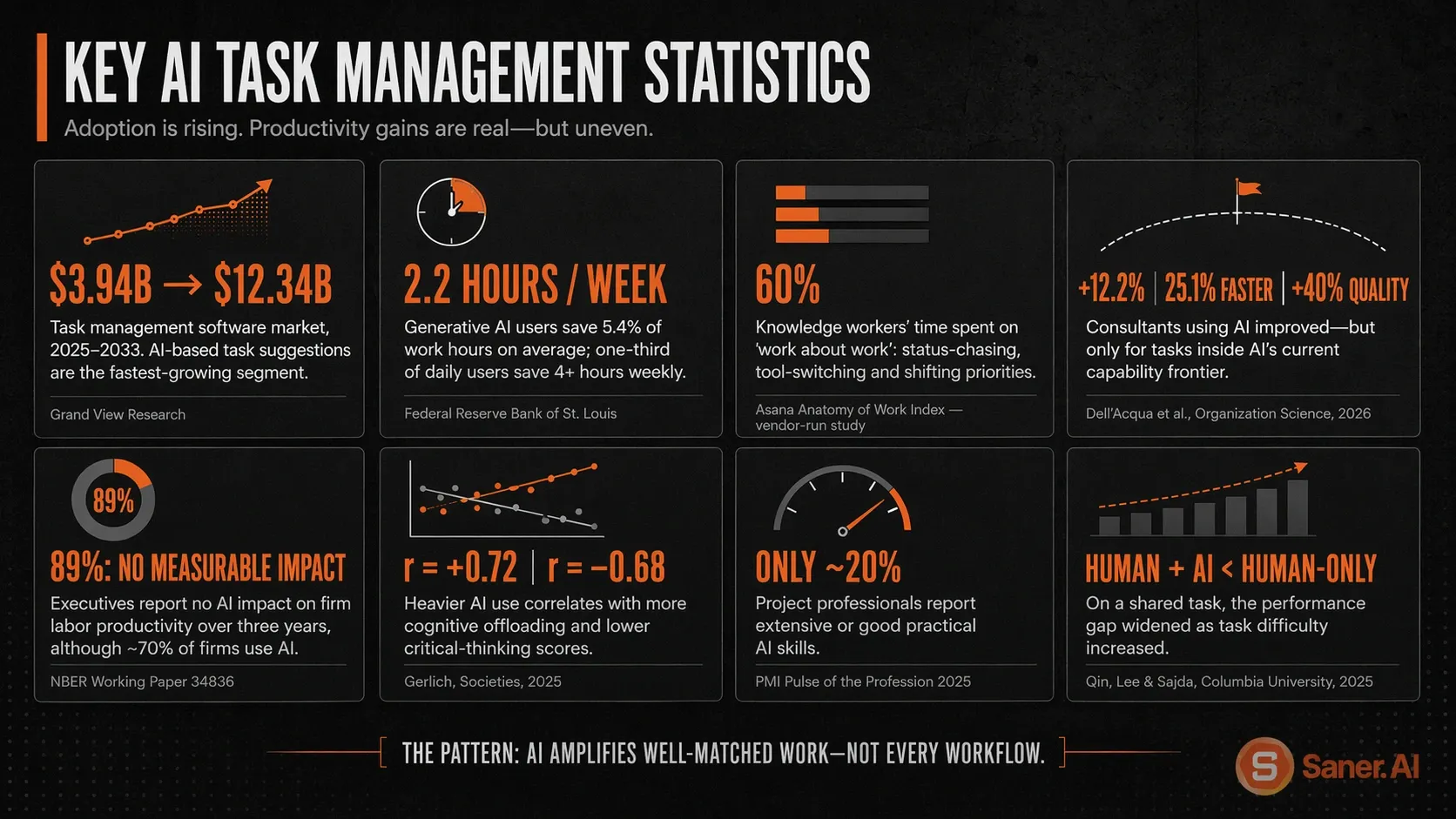
- The AI-based task suggestions segment is the fastest-growing part of a task management software market projected to grow from $3.94 billion (2025) to $12.34 billion by 2033. (Grand View Research)
- Generative AI users save an average of 5.4% of their work hours — about 2.2 hours in a 40-hour week — with a third of daily users saving 4+ hours weekly. (Federal Reserve Bank of St. Louis)
- Knowledge workers spend roughly 60% of their time on "work about work" — status-chasing, tool-switching, and shifting priorities — rather than the skilled tasks they were hired to do. (Asana Anatomy of Work Index, vendor-run study)
- Consultants using AI completed 12.2% more tasks, 25.1% faster, at 40% higher quality — but only on tasks inside AI's current capability frontier. (Dell'Acqua et al., Organization Science, 2026)
- 89% of executives report no measurable impact of AI on their firm's labor productivity over the past three years, despite roughly 70% of firms actively using it. (NBER Working Paper 34836)
- Heavier AI tool use correlates strongly with cognitive offloading (r = +0.72) and a decline in critical thinking scores (r = -0.68). (Gerlich, Societies, 2025)
- Only about 20% of project professionals report having extensive or good practical AI skills, despite AI features now built into nearly every task and project tool. (PMI Pulse of the Profession 2025)
- Human-AI teams performed worse than human-only teams on a shared task, with the gap widening as task difficulty increased. (Qin, Lee & Sajda, Columbia University, 2025)
Table of contents
- How many people and companies are using AI to manage tasks?
- How much time does AI actually save on managing tasks?
- Where does the time go before AI ever gets involved?
- Does AI task management ever backfire?
- What these statistics mean for how you manage your day
- Quotable AI task management statistics
- FAQ
- Sources
1) How many people and companies are using AI to manage tasks?
How big is the AI task management market?
Estimates vary by research firm and methodology, which is worth naming upfront rather than picking whichever number sounds most dramatic.
Grand View Research puts the global task management software market at $3.94 billion in 2025, growing to $12.34 billion by 2033 at a 15.6% compound annual growth rate. Within that market, the AI-based task suggestions segment is expected to grow fastest of any function, ahead of core scheduling and tracking features.
Other firms size the same 2026 market anywhere from roughly $1.4 billion to $6.6 billion, depending on whether they count adjacent categories like retail operations or IT service management. The direction is consistent across every estimate — this is a market growing well into double digits — even where the base number isn't.
How many organizations have adopted AI-based task prioritization?
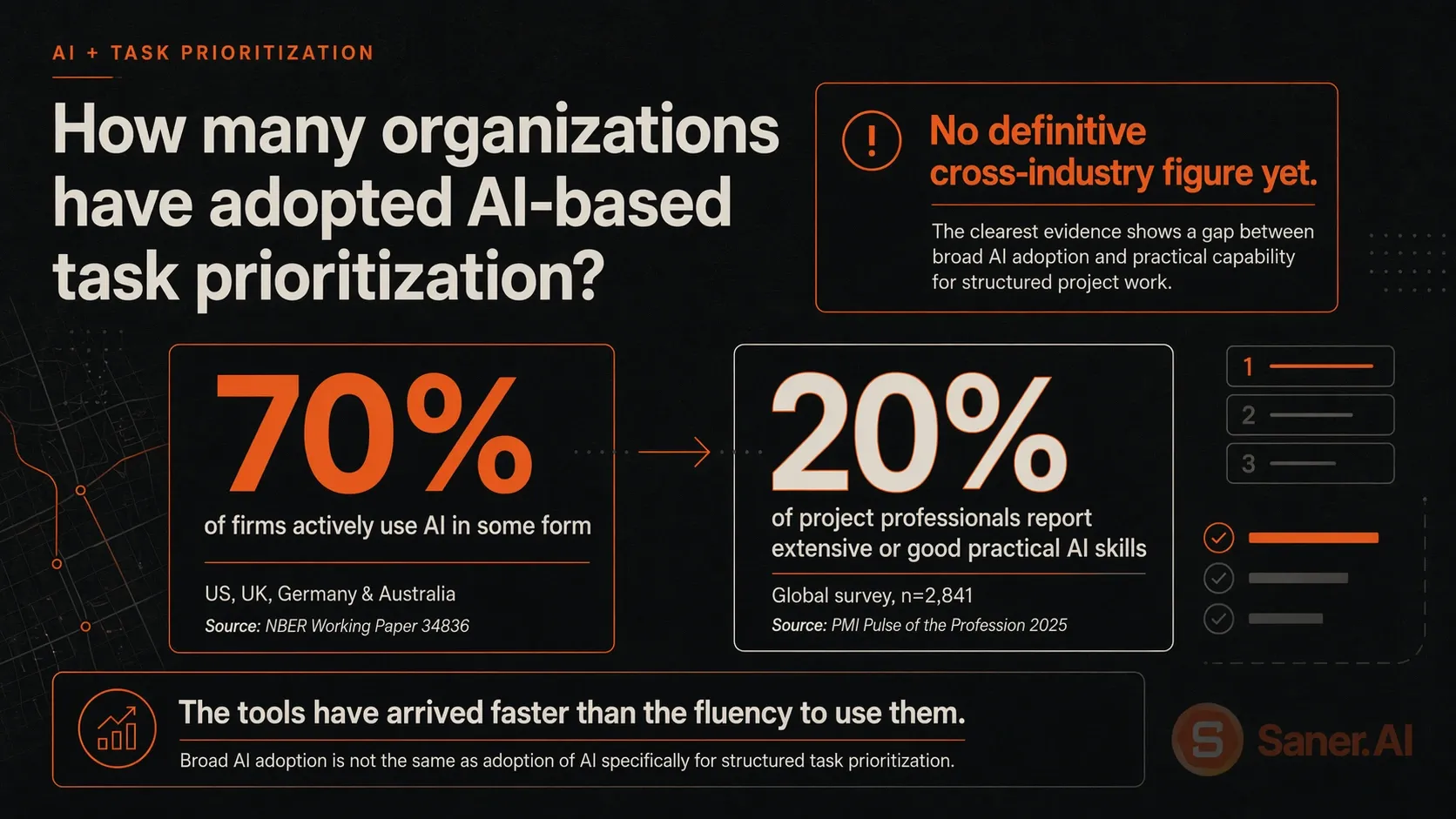
Enterprise AI adoption broadly has gone mainstream: around 70% of firms across the US, UK, Germany, and Australia now actively use AI in some form (NBER Working Paper 34836).
But adoption of AI specifically for structured task and project work lags general-purpose use.
In PMI's Pulse of the Profession 2025 survey of 2,841 project professionals globally, only about 20% report having extensive or good practical AI skills — meaning most of the people responsible for organizing and prioritizing work at scale are still building the capability to use AI for that job well. The tools have arrived faster than the fluency to use them.
2) How much time does AI actually save on managing tasks?
How many hours per week does AI save workers?
The most rigorous population-level estimate comes from the Federal Reserve Bank of St. Louis, whose economists asked generative AI users how much additional time they'd have needed to finish the same work without the technology. The answer: 5.4% of work hours, or roughly 2.2 hours in a 40-hour week.
That average understates the spread — a third of daily users report saving four or more hours weekly, while occasional users save far less. Frequency of use, not access to the tool, is what predicts the time saved.
Where do AI task tools deliver the biggest speed gains?
The clearest evidence on task-level gains comes from a field experiment with 758 Boston Consulting Group consultants, published in Organization Science (Dell'Acqua et al., 2026). Inside what the researchers call AI's "capability frontier" — tasks well-matched to what the model can actually do — consultants using AI completed 12.2% more tasks, finished 25.1% faster, and produced work rated 40% higher quality than consultants working without it. Those are large, consistent effects. The catch, covered in detail below, is that the same study found the opposite result just outside that frontier.
3) Where does the time go before AI ever gets involved?
How much of the workday is "work about work"?
Asana's Anatomy of Work Index — a large-scale survey of the company's own user base, so treated here as vendor-run research — has repeatedly found that knowledge workers spend roughly 60% of their time on "work about work": chasing status updates, switching between five different tools that all sort of track tasks, and re-clarifying priorities that shifted since the last meeting (Asana).
Only about a quarter of the workday goes to the skilled work people were actually hired for. In the same research, 88% of knowledge workers agree that time-sensitive projects have fallen behind schedule simply because of the sheer volume of tasks competing for attention.
Does adding an AI tool reduce coordination overhead or add to it?
This is the gap AI todo list tools are explicitly built to close: auto-prioritization, cross-tool status summaries, and smart reminders are all direct responses to the "work about work" problem. The Federal Reserve time-savings data above suggests it's working at the margin: real hours are coming back for the workers who use these tools consistently.
But the coordination overhead Asana documents is a structural problem (too many tools, too many shifting priorities, too little single-source-of-truth), and no single AI feature bolted onto an existing five-tool stack fully resolves that.
The next section explains why organization-wide productivity often doesn't move even when individual task-level speed clearly does.
Task-level performance across primary sources
| Study | Population | What was measured | Result |
|---|---|---|---|
| Federal Reserve Bank of St. Louis (2025) | US workers using generative AI | Time saved on weekly work tasks | 5.4% of work hours saved on average; 33% of daily users save 4+ hrs/week |
| Dell'Acqua et al., Organization Science (2026) | 758 BCG consultants, tasks inside AI's frontier | Tasks completed, speed, quality | +12.2% tasks completed, 25.1% faster, +40% quality rating |
| Dell'Acqua et al., Organization Science (2026) | Same consultants, tasks outside AI's frontier | Error rate vs. no-AI control | 19 percentage points more likely to produce a wrong answer |
| NBER Working Paper 34836 (2026) | ~6,000 executives, US/UK/Germany/Australia | Firm-level labor productivity impact, 3-year lookback | 89% report no measurable impact |
4) Does AI task management ever backfire?
Does offloading task planning to AI weaken critical thinking?
The convenience of letting AI decide what to prioritize has a measurable cost. A peer-reviewed study of 666 participants, published in the journal Societies, found that heavier AI tool use correlates strongly with cognitive offloading — delegating memory, planning, and decision-making to an external system — and that cognitive offloading in turn correlates strongly with lower critical thinking scores (r = -0.75) (Gerlich, 2025).
The overall relationship between AI tool use and critical thinking was also strongly negative (r = -0.68), and a mediation analysis confirmed cognitive offloading explains a meaningful share of that decline. Younger, heavier users showed the pattern most clearly.
This doesn't mean every to-do list app is eroding your judgment - the study measured general AI tool reliance, not task management specifically - but it's a direct answer to "is there a downside to letting AI plan everything for me,"
Do human-AI teams actually manage tasks better than people alone?
Not always, and not evenly. A Columbia University study using a virtual-reality collaborative task found that teams with an active AI teammate performed worse than human-only teams, with the performance gap widening as the task got harder (Qin, Lee & Sajda, 2025). The researchers traced this to disrupted team dynamics: participants working alongside the AI showed elevated arousal, reduced engagement, and less communication with each other.
The lesson generalizes beyond VR labs - an AI "teammate" inserted into task coordination isn't neutral. It changes how humans coordinate with each other, and that change isn't automatically for the better.
Why do most organizations still report zero productivity gain?
The BCG study shows individual tasks getting faster and better - but only inside a frontier that isn't obvious to the person doing the work, and consultants in the study tended to over-rely on AI precisely where it was weakest.
Scale that pattern across an organization and the picture the NBER survey captures makes sense: 89% of executives see no measurable productivity effect, not because AI doesn't help with tasks, but because task-level speed gains get absorbed by the same coordination overhead ("work about work") that was eating 60% of the day before AI arrived. Faster task completion doesn't automatically mean faster work if the surrounding system - priorities, handoffs, competing tools - hasn't changed.
5) What these statistics mean for how you manage your day
Task-level speed is real, but it's locally scoped. The 5.4% time-savings figure and the BCG study's 25.1% speed gain are both genuine, replicated effects — but both are measured on discrete, well-bounded tasks.
The frontier is the whole game. The gap between "AI made me 25% faster" and "AI made me 19 points more likely to be wrong" is the same technology, the same user, different tasks. The organizations and workers actually capturing AI's task-management value aren't using it more — they're getting better at knowing when not to
Offloading has a cost, and it's not just about accuracy. The cognitive-offloading research and the human-AI teaming study point at something task management vendors rarely mention: handing planning to a system changes how you think and how you work with other people, not just how fast you check things off.
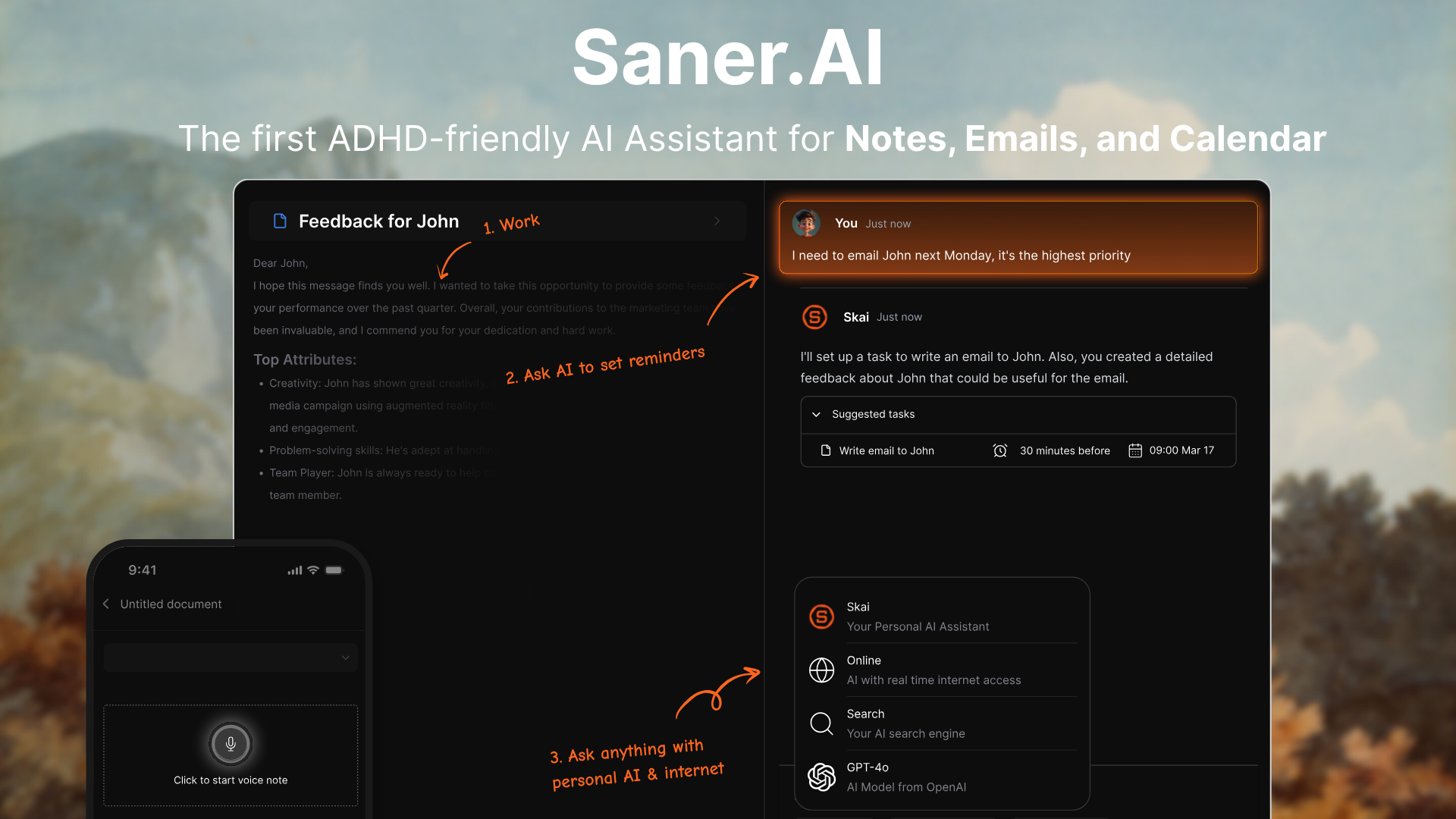
A tool built around consolidating the scattered, tool-switching version of task management is a more direct answer to the "work about work" problem than another prioritization feature. That's the gap Saner.AI is built to close: one place for tasks, time, and context instead of AI bolted onto a fragmented stack.
Stay on top of your work and life
Quotable AI task management statistics
Single-sentence, self-contained versions for citation:
- According to the Federal Reserve Bank of St. Louis, generative AI users save an average of 5.4% of their work hours, or roughly 2.2 hours in a 40-hour week. (St. Louis Fed)
- A 2026 study in Organization Science found BCG consultants using AI completed 12.2% more tasks and finished 25.1% faster on tasks within AI's capability frontier. (Dell'Acqua et al.)
- The same 2026 Organization Science study found consultants using AI were 19 percentage points more likely to produce a wrong answer on tasks outside that frontier. (Dell'Acqua et al.)
- A 2026 NBER survey of nearly 6,000 executives found 89% report no measurable impact of AI on their firm's labor productivity over the past three years. (NBER Working Paper 34836)
- Asana's Anatomy of Work Index found knowledge workers spend roughly 60% of their time on "work about work" rather than skilled tasks. (Asana)
- A 2025 peer-reviewed study of 666 participants found AI tool use correlates strongly with cognitive offloading (r = +0.72) and a decline in critical thinking scores (r = -0.68). (Gerlich, Societies)
- PMI's Pulse of the Profession 2025, surveying 2,841 project professionals, found only about 20% report having extensive or good practical AI skills. (PMI)
- A Columbia University study found human-AI teams performed worse than human-only teams on a shared task, with the gap widening as difficulty increased. (Qin, Lee & Sajda)
FAQ
1. Does AI actually save time on task management?
Yes, on average, but the effect is concentrated among frequent users. The Federal Reserve Bank of St. Louis found generative AI users save 5.4% of work hours on average, but a third of daily users save four or more hours a week, while occasional users save far less. (St. Louis Fed)
2. How big is the AI task management software market?
Estimates range from roughly $1.4 billion to $6.6 billion for 2026 depending on the research firm's scope. Grand View Research puts the broader task management software market at $3.94 billion in 2025, growing to $12.34 billion by 2033, with AI-based task suggestions as the fastest-growing segment. (Grand View Research)
3. Can relying on AI for task planning hurt your critical thinking?
There's evidence for a correlation, though not a randomized-trial proof of causation. A 2025 peer-reviewed study found AI tool use correlates strongly with cognitive offloading, and cognitive offloading in turn correlates strongly with lower critical thinking scores. (Gerlich, Societies)
4. Do AI-assisted teams manage tasks better than people working alone?
Not necessarily. A Columbia University study found human-AI teams performed worse than human-only teams on a shared task, and the gap grew as the task got harder — the AI teammate disrupted communication and coordination between the human participants. (Qin, Lee & Sajda)
5. Why do so many companies see no productivity gain despite high AI adoption?
Task-level speed gains don't automatically translate to firm-level productivity. A 2026 NBER survey found 89% of executives report no measurable productivity impact despite roughly 70% of firms using AI — largely because individual task speed gets absorbed by unchanged coordination overhead elsewhere in the organization. (NBER Working Paper 34836)
6. What percentage of the workday is spent on "work about work" instead of actual tasks?
Roughly 60%, according to Asana's Anatomy of Work Index, a large-scale (vendor-run) survey of knowledge workers. The remainder splits between skilled work and strategic planning. (Asana)
7. Where does AI help most with task management, and where does it fail?
It helps most on well-bounded, familiar tasks inside what researchers call AI's "capability frontier" — in a 2026 Organization Science study, consultants completed 12.2% more tasks and finished 25.1% faster on these. On tasks just outside that frontier, the same consultants using AI were 19 percentage points more likely to be wrong, largely because the frontier's edge isn't obvious in the moment. (Dell'Acqua et al.)
8. Are project managers and team leads actually equipped to use AI task tools well?
Not yet, by their own report. PMI's Pulse of the Profession 2025, surveying 2,841 project professionals globally, found only about 20% report having extensive or good practical AI skills, even as AI features have become standard in most task and project platforms. (PMI)
Sources
- Grand View Research. "Task Management Software Market Size, Share & Trends Report." 2026. https://www.grandviewresearch.com/industry-analysis/task-management-software-market-report
- Federal Reserve Bank of St. Louis. "Generative AI, Productivity and the Future of Work." October 2025. https://www.stlouisfed.org/open-vault/2025/oct/generative-ai-productivity-future-work
- Asana. "How Work About Work Gets in the Way of Real Work" (Anatomy of Work Index). 2026. https://asana.com/resources/why-work-about-work-is-bad
- Dell'Acqua, F., McFowland III, E., Mollick, E., Lifshitz-Assaf, H., Kellogg, K., Rajendran, S., Krayer, L., Candelon, F., & Lakhani, K. "Navigating the Jagged Technological Frontier: Field Experimental Evidence of the Effects of Artificial Intelligence on Knowledge Worker Productivity and Quality." Organization Science, 37(2), 403–423 (2026). DOI: 10.1287/orsc.2025.21838. https://pubsonline.informs.org/doi/10.1287/orsc.2025.21838 (Originally circulated as an SSRN/HBS working paper in 2023.)
- Yotzov, I., Barrero, J.M., Bloom, N., Bunn, P., Davis, S.J., Foster, K.M., Jalca, A., Meyer, B.H., Mizen, P., Navarrete, M.A., Smietanka, P., Thwaites, G., & Wang, B.Z. "Firm Data on AI." NBER Working Paper No. 34836 (2026). https://www.nber.org/papers/w34836
- Gerlich, M. "AI Tools in Society: Impacts on Cognitive Offloading and the Future of Critical Thinking." Societies, 15(1), 6 (2025). DOI: 10.3390/soc15010006. https://www.mdpi.com/2075-4698/15/1/6
- Project Management Institute. "Pulse of the Profession® 2025." April 2025. https://www.pmi.org/-/media/pmi/documents/public/pdf/learning/thought-leadership/pulse/pulse_of_the_profession_2025-1.pdf
- Qin, Y., Lee, R.T., & Sajda, P. "Perception of an AI Teammate in an Embodied Control Task Affects Team Performance, Reflected in Human Teammates' Behaviors and Physiological Responses." Columbia University, 2025 (preprint). https://arxiv.org/pdf/2501.15332