
Context Switching Statistics 2026: Focus, Cost, and the Multitasking Myth


I went looking for every traceable primary study on context switching I could find: the controlled lab experiments, the field observations of real offices, the corporate telemetry, the longitudinal attention-tracking research. What I found is a research base that's both more alarming and more nuanced than the version that circulates online. Below is what the primary research actually supports
Key context switching statistics
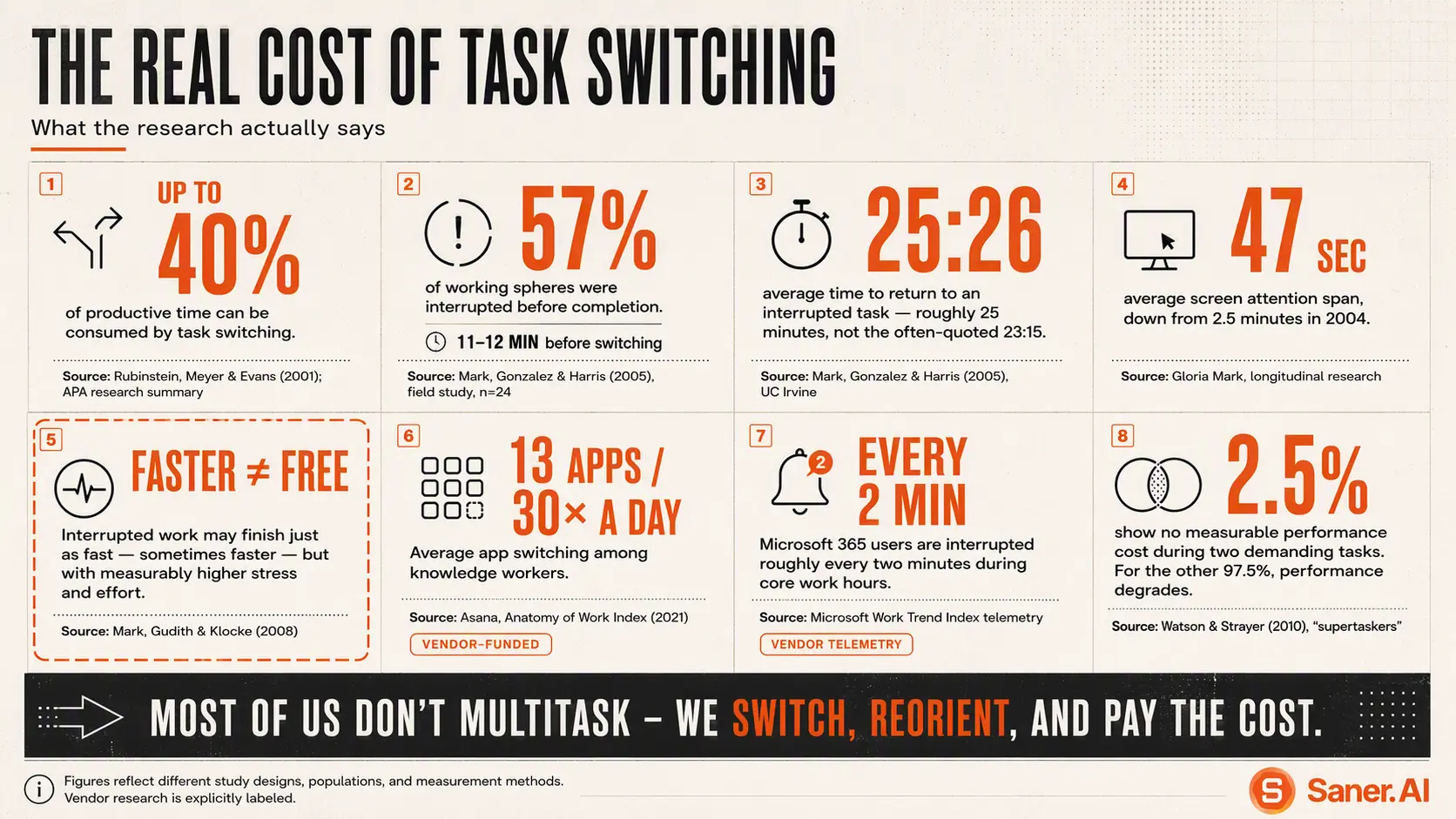
- Task switching can consume up to 40% of a person's productive time, according to the foundational 2001 study behind the American Psychological Association's official read of the research.
- 57% of "working spheres" get interrupted before completion, and people spend an average of just 11 to 12 minutes in a task before switching, per Gloria Mark, Victor Gonzalez, and Justin Harris's 2005 field study of 24 information workers.
- It takes roughly 25 minutes to return to an interrupted task, not the often-quoted "23 minutes and 15 seconds." The real, documented figure (25 minutes 26 seconds) comes from the same 2005 UC Irvine field study.
- Average attention span on a screen has fallen to 47 seconds, down from 2.5 minutes in 2004, according to Gloria Mark's two decades of longitudinal research.
- Interrupted work often gets finished just as fast, sometimes faster, but at a measurable cost in stress and effort, per Mark, Gudith, and Klocke's 2008 experimental study. This is a counterpoint worth sitting with.
- Knowledge workers switch between an average of 13 apps roughly 30 times a day, according to Asana's 2021 Anatomy of Work Index (vendor-funded research, flagged below).
- Employees using Microsoft 365 are interrupted roughly every 2 minutes during core work hours, per Microsoft's own Work Trend Index telemetry analysis (vendor telemetry, flagged below).
- Only 2.5% of people show no measurable performance cost when doing two demanding tasks at once, the "supertaskers" identified in Watson and Strayer's 2010 study. For the other 97.5%, dual-tasking measurably degrades performance.
Table of contents
- How often do people actually switch tasks?
- What does context switching cost, in time and performance?
- What's happening to attention spans, and why does "residue" matter?
- How the numbers compare across study types
- Does context switching ever help? The counterevidence
- What these statistics mean for how we work
- Quotable context switching statistics
- FAQ
- Sources
1) How often do people actually switch tasks?
How often do people switch tasks in a day?
- People spent an average of just 11 to 12 minutes in a "working sphere" (a coherent unit of activity, not necessarily a single app) before switching, and 57% of those working spheres were interrupted before completion. This is one company, observed nearly two decades ago, before Slack or smartphone notifications existed (Mark, Gonzalez, and Harris's 2005 study)
How many apps does the average worker juggle?
- Average worker switches between 13 apps roughly 30 times per day, rising to 14 apps and 31 switches among C-suite respondents. (Asana's Anatomy of Work Index (2021))
For clarity: Asana sells work-management software built to reduce exactly this kind of app sprawl, so this is vendor-funded research measuring a problem the vendor's own product addresses. The topline number is directionally consistent with what other researchers have found in adjacent studies, but it should be read as self-reported survey data, not observed behavior.
2) What does context switching cost, in time and performance?
What percentage of productive time is lost to task switching?
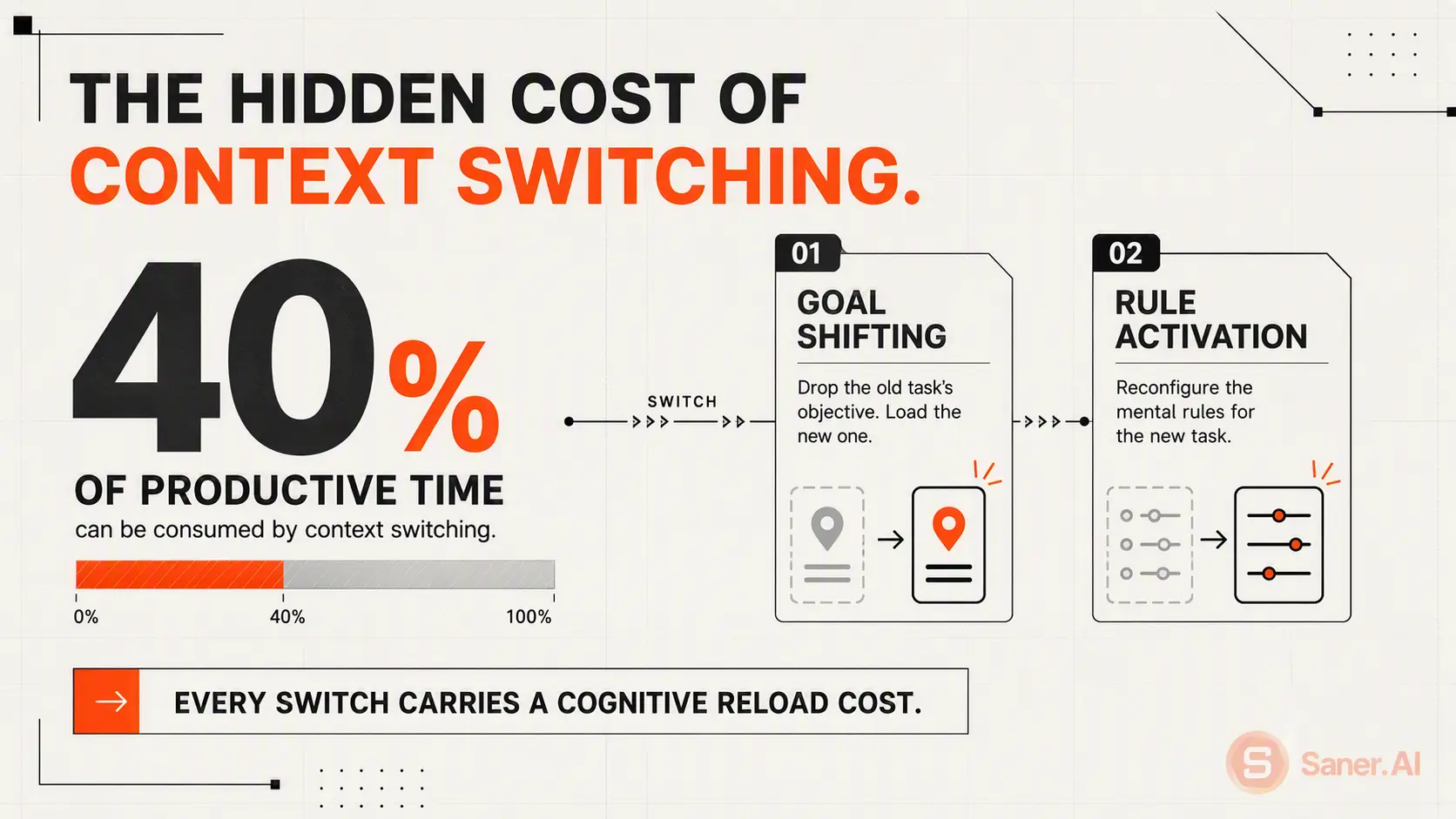
- The American Psychological Association's own summary of this research states plainly that switching costs can consume up to 40% of someone's productive time, driven by two distinct mental operations: "goal shifting" (dropping the old task's objective and loading the new one) and "rule activation" (reconfiguring the mental rules for the new task).
- The 40% ceiling applies specifically to complex, unfamiliar tasks. Simple, well-practiced switches cost far less, sometimes just fractions of a second.
How long does it actually take to refocus after an interruption?
- The number you've probably seen, "23 minutes and 15 seconds," is attributed almost everywhere to a UC Irvine study, but that exact figure does not appear in either of Gloria Mark's foundational papers.
- The documented number from her 2005 field study is 25 minutes and 26 seconds as the average delay before returning to the same task, a period during which people typically worked on roughly two other tasks first, not 23 minutes of idle refocusing. Mark's later longitudinal work, summarized on her own research page, rounds this to "about 25 minutes" and has held up across replication.
Resuming a task and fully recovering the depth of concentration you had before the interruption are not the same thing, and the original research measured the former.
Why does switching cost time in the first place?
- Sophie Leroy's 2009 research found that when people move to a new task before finishing the previous one, part of their attention stays fixed on the unfinished task, a phenomenon she termed "attention residue."
- That residue measurably degrades performance on the new task, and it's strongest when the abandoned task was time-pressured, incomplete, or emotionally engaging, which describes most workplace interruptions.
3) What's happening to attention spans, and why does "residue" matter?
What is attention residue, and why does it matter more than the switch itself?
Leroy's 2009 study and the 2016 follow-up by Leroy and Schmidt both found that unfinished work doesn't just create a to-do list entry; it occupies working memory that would otherwise be available for the next task.
Practically, this means the cost of an interruption isn't fixed. It scales with how unresolved the interrupted task feels, which is one reason the same 30-second Slack ping can cost almost nothing on a routine day and derail an hour of deep work on a day full of half-finished threads.
How has average attention span on screens changed over time?
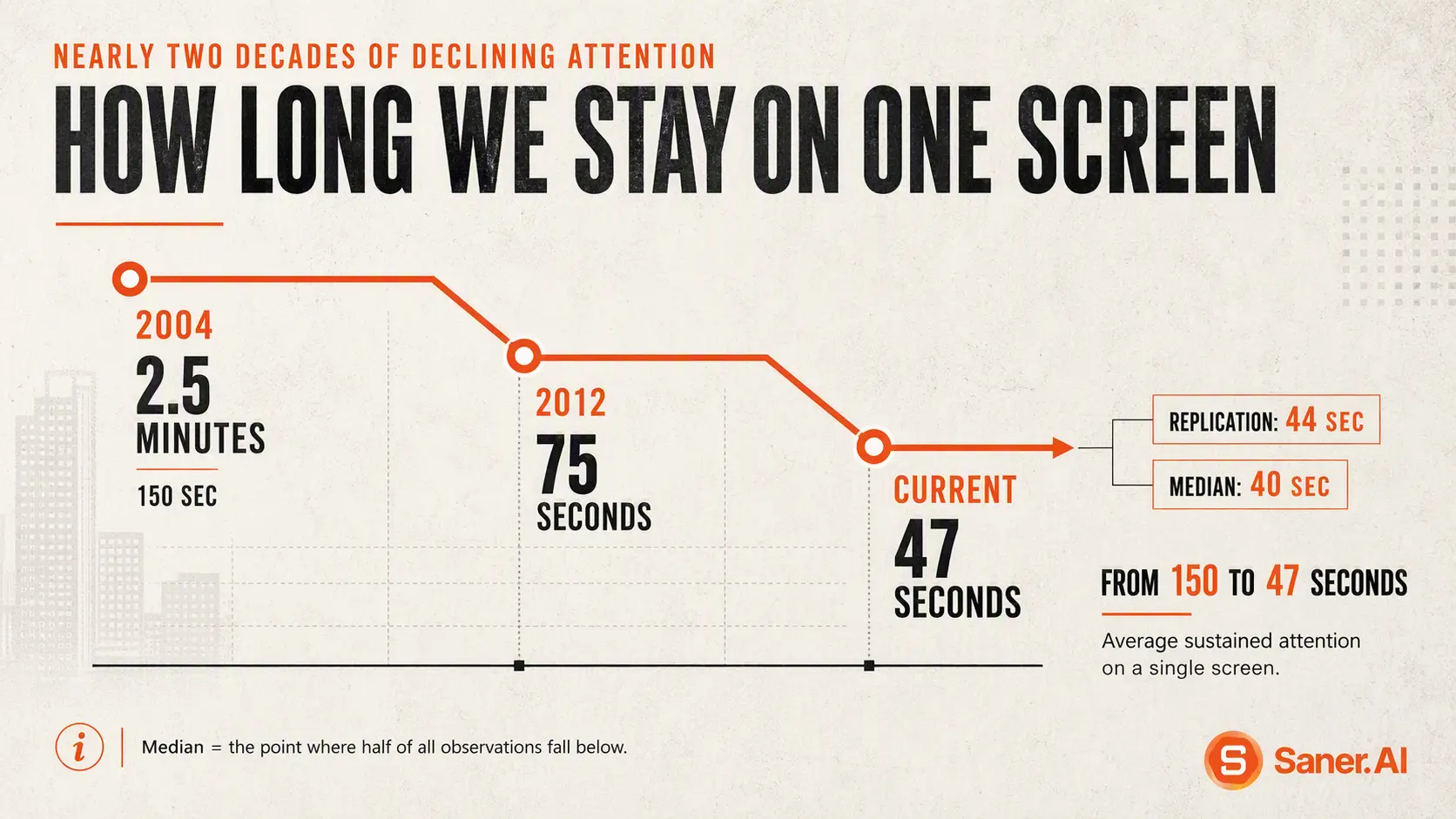
Gloria Mark's lab at UC Irvine has tracked how long people sustain attention on a single screen for nearly two decades.
- In 2004, the average was 2.5 minutes. By 2012, it had fallen to 75 seconds. Her most recent measurements, replicated across several independent studies, place the current average at 47 seconds, with one replication finding 44 seconds and the median (the point where half of all observations fall below) sitting at just 40 seconds.
How the numbers compare across study types
One reason context-switching statistics seem to contradict each other is that they're measuring different things, in different settings, with different methods. Laid out side by side, the picture becomes more coherent, not less.
| Study | Method | Setting | Key finding | Source |
|---|---|---|---|---|
| Rubinstein, Meyer & Evans (2001) | Controlled lab experiment | Simple classification/arithmetic tasks | Up to 40% of productive time lost, scaling with task complexity | APA |
| Mark, Gonzalez & Harris (2005) | Field observation (24 workers shadowed) | One outsourcing company office | 25 min 26 sec average return time; 57% of work fragmented | ACM CHI |
| Mark, Gudith & Klocke (2008) | Field experiment (interrupted vs. uninterrupted) | Simulated office task | Interrupted work often finished as fast or faster, but with measurably higher stress | ACM CHI |
| Mark, longitudinal ("Attention Span," 2023) | Repeated field measurement, 2004 to present | Knowledge workers, screen logging | Average screen attention fell from 2.5 min to 47 sec | gloriamark.com |
| Microsoft Work Trend Index | Telemetry (M365 product usage data) | Microsoft 365 users, global | Interrupted roughly every 2 minutes during core hours | Microsoft |
| Asana Anatomy of Work Index (2021) | Self-report survey, 13,123 respondents | Global knowledge workers, 8 countries | Average 13 apps switched roughly 30 times per day | Asana |
The lab studies isolate the pure cognitive cost of switching under ideal conditions. The field studies and telemetry show that real workdays add interruption frequency on top of that baseline cost. Neither number is wrong; they're answering different questions.
4) Does context switching ever help, or is the cost overstated?
Interrupted work sometimes finishes just as fast, or faster
- People compensated for interruptions by working faster once resumed, completing tasks in comparable or shorter total time. (Mark, Gudith, and Klocke's 2008 study)
- The catch: they did it under measurably higher stress, frustration, and perceived workload. The time cost of interruption is partly absorbed by working harder, not by working slower, which is a very different (and more exhausting) mechanism than "lost time."
Task switching can increase creativity.
- Lu, Akinola, and Mason's 2017 study found that switching between tasks can reduce "cognitive fixation," the tendency to get stuck on an unproductive approach, and measurably improve performance on both divergent and convergent creative thinking tasks.
- When incentivized to maximize creative output, most people still choose not to switch, even though switching would have served them better.
A small minority can multitask without cost.
- Watson and Strayer's 2010 study tested 200 people on a demanding dual-task combination (driving plus a memory and math task) and found that 2.5% of participants, dubbed "supertaskers," showed no measurable performance decline on either task.
This is a genuine, replicated individual difference, not a self-perception. Most people believe they're better at multitasking than they are; supertaskers are the rare case where the belief is correct.
The boundary condition that reconciles these findings is task complexity and completeness.
- Switching hurts most when the interrupted task is complex, unfamiliar, and left unresolved (the exact conditions Rubinstein, Meyer, and Evans, and later Leroy, studied).
- Switching helps, or at least doesn't cost much, when the task is simple, well-practiced, or when the goal is creative exploration rather than execution of a defined procedure.
- The research doesn't support "all switching is bad." It supports "switching cost depends heavily on what you're switching away from and why."
5) What these statistics mean for how we work
1. The cost is real, but it's not a fixed tax; it's a function of how much gets left unfinished.
- The 40% figure, the 25-minute recovery window, and the attention residue research all point to the same underlying mechanism: an incomplete task occupies mental resources long after you've physically moved on.
- It's less "how do I stop switching" (often not fully possible in collaborative work) and more "how do I reduce the number of tasks I leave dangling mid-thought."
- Frequency is compounding faster than raw switch-cost is changing.
- The lab-measured cost of a single switch (Rubinstein, Meyer & Evans, 2001) hasn't changed since 2001, because it's a property of human cognition, not of technology.
- Microsoft's own telemetry shows interruptions roughly every two minutes during core hours, and Asana's survey data shows the average worker moving through 13 apps a day.
=> The tools generating the interruptions have multiplied faster than anyone's cognitive switching cost has adapted.
- The tool-sprawl side of this is measurable, not just anecdotal, and it's the part organizations can actually act on.
- You can't change how the brain reloads context after an interruption.
- You can change how many separate tools a person has to reload context in the first place, which is precisely the argument Asana's own app-switching data makes about consolidation.
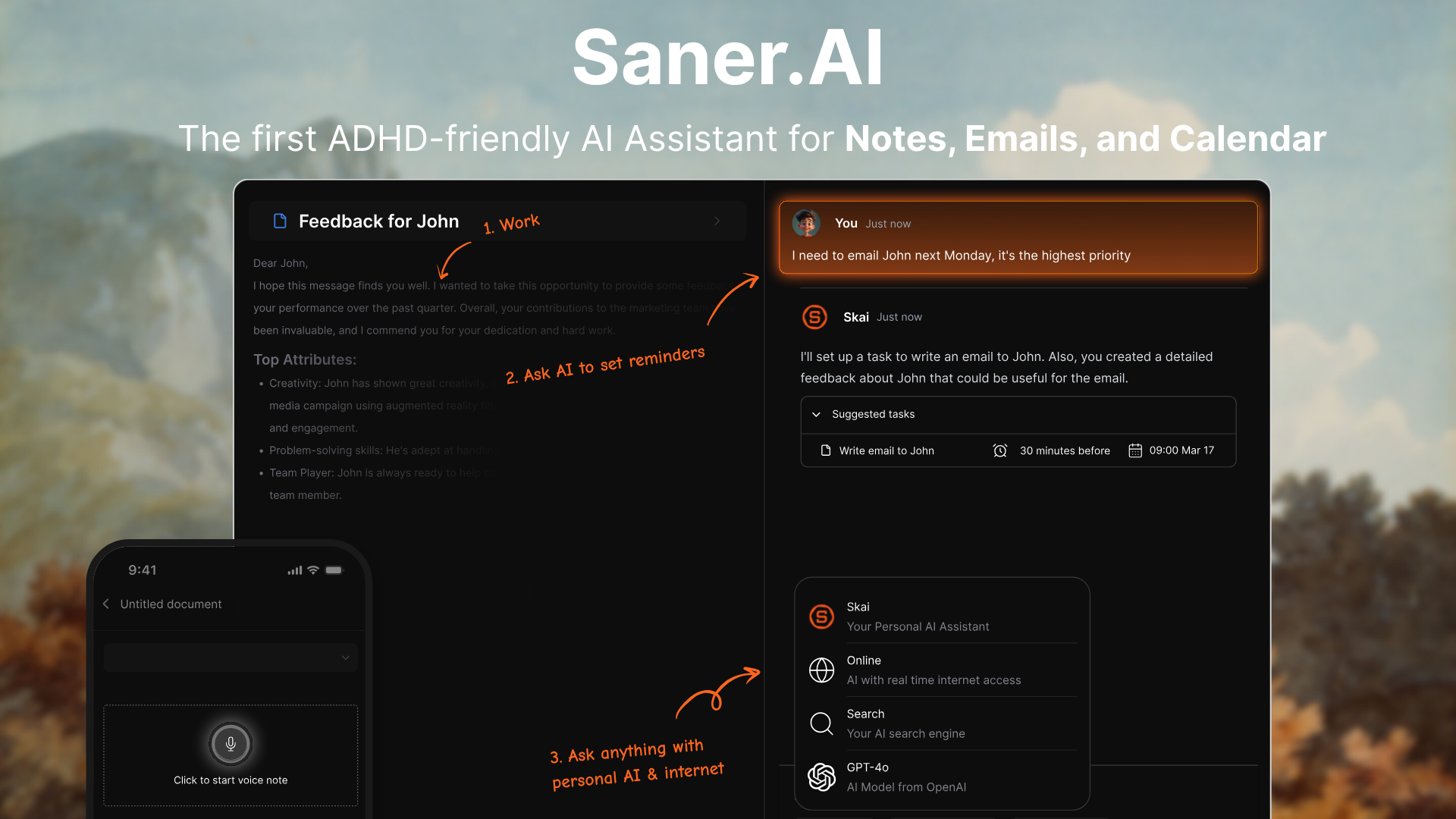
- It's the same logic behind Saner.AI's approach: keeping notes, tasks, and context in one connected workspace instead of scattered across a dozen disconnected apps, so each switch is a shift in attention rather than a full context reload.
Stay on top of your work and life effortlessly
Quotable context switching statistics
- According to the American Psychological Association's summary of Rubinstein, Meyer, and Evans's 2001 research, task switching can consume up to 40% of a person's productive time. (APA)
- Gloria Mark, Victor Gonzalez, and Justin Harris's 2005 field study found that 57% of workers' "working spheres" were interrupted before completion. (ACM)
- The documented average time to return to an interrupted task is 25 minutes 26 seconds, per the 2005 UC Irvine field study, not the commonly misquoted "23 minutes 15 seconds." (ACM)
- Average human attention span on a screen has fallen to 47 seconds as of Gloria Mark's most recent measurements, down from 2.5 minutes in 2004. (Gloria Mark)
- Sophie Leroy's 2009 research found that unfinished tasks create "attention residue" that measurably impairs performance on the next task. (ScienceDirect)
- Mark, Gudith, and Klocke's 2008 study found interrupted work is often completed in comparable or shorter time than uninterrupted work, but at the cost of measurably higher stress. (ACM)
- Knowledge workers switch between an average of 13 apps roughly 30 times a day, according to Asana's 2021 Anatomy of Work Index. (Asana)
- Only 2.5% of people, termed "supertaskers," show no measurable performance decline when performing two demanding tasks simultaneously, per Watson and Strayer's 2010 study. (Springer)
FAQ
Is multitasking a myth?
Mostly, yes. What feels like multitasking is almost always rapid task switching, and Rubinstein, Meyer, and Evans's research shows this carries a measurable time cost for the vast majority of people. The exception is the 2.5% of people Watson and Strayer identified as "supertaskers", who show no measurable performance cost. For everyone else, what looks like doing two things at once is really doing them worse, one after another.
How much does context switching actually cost in lost productivity?
The most defensible figure is up to 40% of productive time on complex, unfamiliar tasks, from Rubinstein, Meyer, and Evans's 2001 lab research. Widely-circulated dollar figures like "$450 billion annually" could not be traced to any primary economic study and were excluded from this post.
How long does it take to refocus after an interruption?
About 25 minutes, per the documented 2005 UC Irvine field study, not the commonly cited "23 minutes and 15 seconds," which doesn't appear in the original research.
Does context switching ever improve performance?
Sometimes. Lu, Akinola, and Mason's 2017 study found that switching between tasks can boost creative problem-solving by interrupting unproductive fixation, and Mark, Gudith, and Klocke's 2008 study found interrupted work sometimes finishes just as fast, though at a real cost in stress.
Why does switching between tasks feel so draining, even for quick interruptions?
Because of what Sophie Leroy calls "attention residue": part of your attention stays fixed on an unfinished task even after you've moved to something new, which reduces the mental resources available for the new task.
How many times a day do people switch between apps or tasks?
Asana's 2021 Anatomy of Work Index found knowledge workers switch between an average of 13 apps roughly 30 times per day, and Microsoft's Work Trend Index telemetry found Microsoft 365 users are interrupted roughly every 2 minutes during core work hours.
Has attention span actually gotten shorter over time?
Yes, according to Gloria Mark's own longitudinal measurements: average screen attention fell from 2.5 minutes in 2004 to 47 seconds in her most recent data, replicated across several independent studies.
Is everyone equally affected by context switching?
No. Task complexity and familiarity matter more than most coverage suggests, per Rubinstein, Meyer, and Evans, and a small subset of people, about 2.5%, show no measurable dual-task performance cost at all.
Sources
- Rubinstein, J. S., Meyer, D. E., & Evans, J. E. (2001). Executive Control of Cognitive Processes in Task Switching. Journal of Experimental Psychology: Human Perception and Performance, 27(4), 763-797. American Psychological Association
- American Psychological Association. Multitasking: Switching Costs. apa.org
- Mark, G., Gonzalez, V. M., & Harris, J. (2005). No Task Left Behind? Examining the Nature of Fragmented Work. Proceedings of the SIGCHI Conference on Human Factors in Computing Systems (CHI '05), 321-330. ACM Digital Library
- Mark, G., Gudith, D., & Klocke, U. (2008). The Cost of Interrupted Work: More Speed and Stress. Proceedings of the SIGCHI Conference on Human Factors in Computing Systems (CHI '08), 107-110. ACM Digital Library
- Mark, G. (2023). Attention Span: A Groundbreaking Way to Restore Balance, Happiness and Productivity. Longitudinal research summary. gloriamark.com
- Leroy, S. (2009). Why Is It So Hard to Do My Work? The Challenge of Attention Residue When Switching Between Work Tasks. Organizational Behavior and Human Decision Processes, 109(2), 168-181. ScienceDirect / DOI
- Leroy, S., & Schmidt, A. M. (2016). The Effect of Regulatory Focus on Attention Residue and Performance During Interruptions. Organizational Behavior and Human Decision Processes, 137, 218-235. Experts@Minnesota
- Lu, J. G., Akinola, M., & Mason, M. F. (2017). "Switching On" Creativity: Task Switching Can Increase Creativity by Reducing Cognitive Fixation. Organizational Behavior and Human Decision Processes, 139, 63-75. ScienceDirect
- Watson, J. M., & Strayer, D. L. (2010). Supertaskers: Profiles in Extraordinary Multitasking Ability. Psychonomic Bulletin & Review, 17(4), 479-485. Springer
- Asana. (2021). Anatomy of Work Index 2021. Survey of 13,123 knowledge workers, 8 countries. asana.com (vendor-funded)
- Microsoft. Work Trend Index: Breaking Down the Infinite Workday. Product telemetry analysis. microsoft.com/worklab (vendor telemetry)