
Deep work with ADHD: How to get into it and stay there

You sit down to write the report. You open the doc. Then you check Slack "for one second", remember you never replied to your sister, wonder if the museum is open on Saturdays, and somehow it's 11:40, and the doc still says "Untitled"
If you have ADHD, that scene probably feels like a normal day. And yet the same brain that can't start a spreadsheet will happily lose six hours to a side project nobody asked for.
Deep work with ADHD is possible. It just doesn't come from willpower, and it rarely looks like the calm, monk-in-a-cabin version you read about in productivity books.
This guide explains what happens in the ADHD brain when focus won't come and what the research says helps. Then it lays out a practical routine for getting into deep work and coming back out without wrecking the rest of your day. I'll also show where an AI assistant like Saner.AI fits in, because some of the hardest parts of focus (remembering and planning) are the parts you can hand off.
Quick answer: how do you get into deep work with ADHD?
You get into deep work with ADHD by lowering the cost of starting. In practice, that means picking one concrete task the night before, blocking a short window on your calendar, removing your phone and open tabs, using a start ritual such as a quick walk or background noise, parking stray thoughts somewhere outside your head, and setting a hard stop so hyperfocus doesn't eat your whole day.
Deep work, flow and hyperfocus: what's the difference?
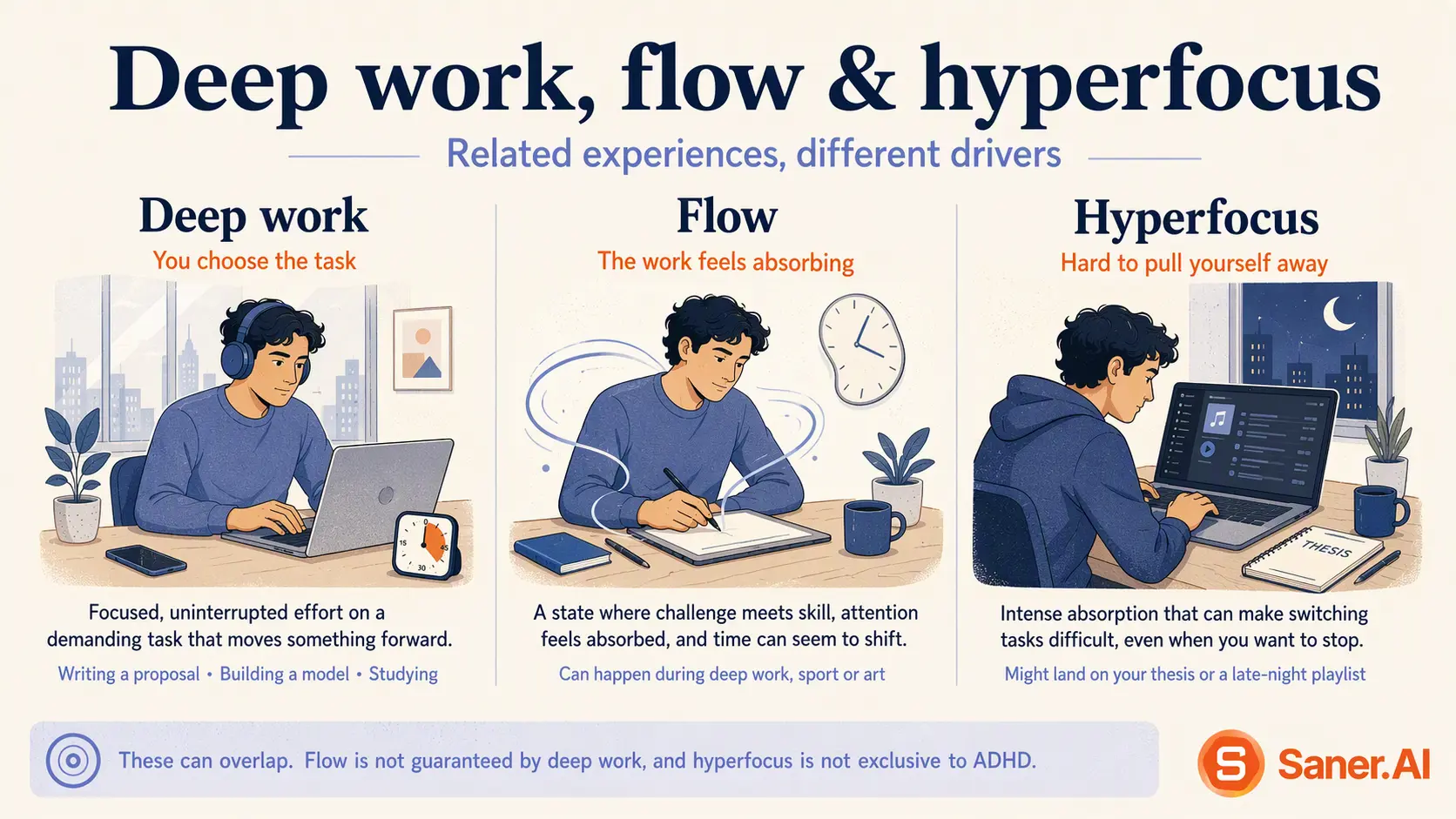
- Deep work is focused, uninterrupted time spent on a task that actually moves something forward: writing the proposal, building the model, studying for the exam. You choose the task.
- Flow is the feeling you get when deep work goes well. Time bends, the work feels easier than it should, and you come out of it a bit proud of yourself.
- Hyperfocus is the ADHD version of intense absorption, and it often picks the task for you. It can land on your thesis. It can also land on reorganizing your Spotify playlists at 2 a.m.
- Hyperfocus is real and measurable. In a 2019 study published in ADHD, Attention Deficit and Hyperactivity Disorders, University of Michigan researchers built the Adult Hyperfocus Questionnaire and found that adults with more ADHD symptoms reported hyperfocus more often across school, hobbies, and screen time.
Why deep work feels so hard with ADHD
1) Motivation runs on interest, and interest runs on dopamine
- A PET imaging study led by Nora Volkow, published in Molecular Psychiatry, found that adults with ADHD scored lower on a measure of motivation, and those scores tracked with lower dopamine receptor and transporter availability in the brain's reward pathway.
- In plain English: a task that feels flat to your brain is harder to start. That's why "just sit down and do it" advice falls apart. Making the task more interesting or more urgent is how you feed that system.
2) Starting is its own skill
- Most ADHD people don't struggle with the middle of a task as much as the doorway into it. Vague tasks ("work on the report") give your brain nothing to grab. Big tasks feel like a wall.
3) Interruptions cost more than the minutes they take
- In a well-known experiment at UC Irvine, Gloria Mark and colleagues found that people who were interrupted actually finished tasks faster but reported more stress, frustration, time pressure, and effort.
- The summary: "Interrupted work may be done faster, but at a price."
4) Time gets slippery
- Time management is one of the executive functions most tied to inattention in adults with ADHD. A study in Psychological Assessment found that ratings of time management problems predicted inattention over and above lab test scores. That's the "I'll start in 10 minutes" that turns into two hours, and the hyperfocus session that ends with you realizing you skipped lunch.
The 4-step system to get into Deep work with ADHD
Step 1: Set things up before you need focus
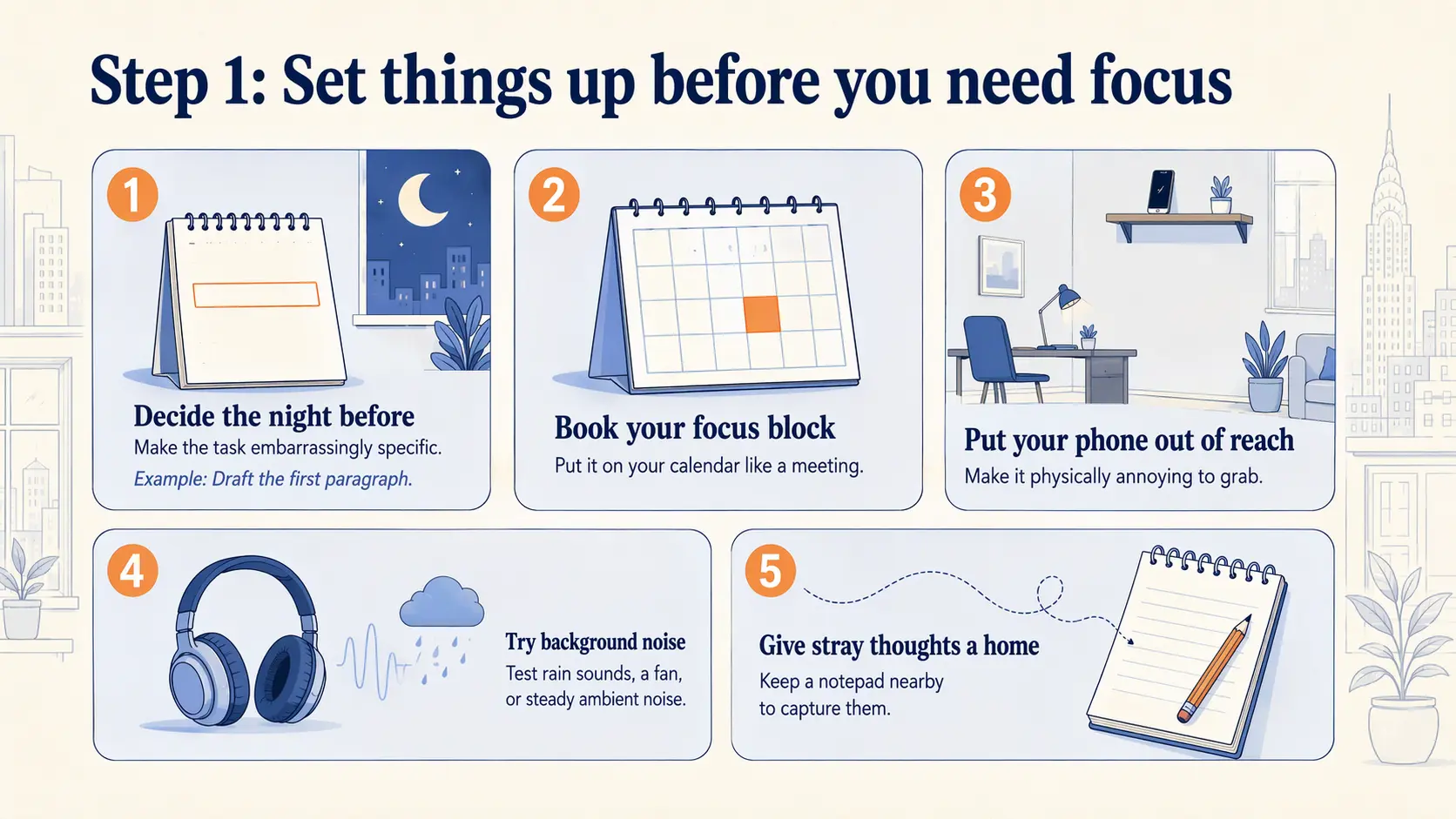
Decide the task the night before
A good deep work task:
- Starts with a verb you can picture yourself doing (draft, list, outline, call, fix)
- Fits inside one session, even if the whole project doesn't
- Has a clear "done" point, like "first 300 words" or "5 cleaned rows of data"
- Doesn't depend on someone else replying before you can begin
If you can't name the first physical action, the task is still too big. Break it again.
Put the block on your calendar like a meeting
Choose a window when your energy is usually decent, and other people are quieter. For many people, that's mid-morning or right after medication kicks in, if you take it. Start small: 25 to 45 minutes is plenty while you're building the habit. A short session you actually do beats a three-hour block you avoid all day.
Make the phone physically annoying to reach
Airplane mode helps. Another room helps more. Close every tab you don't need for this one task, and turn off desktop notifications for email and chat for the length of the block.
Try background noise
- Keep the volume low enough that you stop noticing it after a few minutes
- Some people with ADHD still find noise distracting, so test it on yourself for a week
Set up a capture spot for stray thoughts
You will remember something urgent five minutes in. You always do. Decide in advance where that thought goes (a sticky note, a voice memo, an app) so you can drop it and get back to work instead of acting on it.
Step 2: Get through the doorway
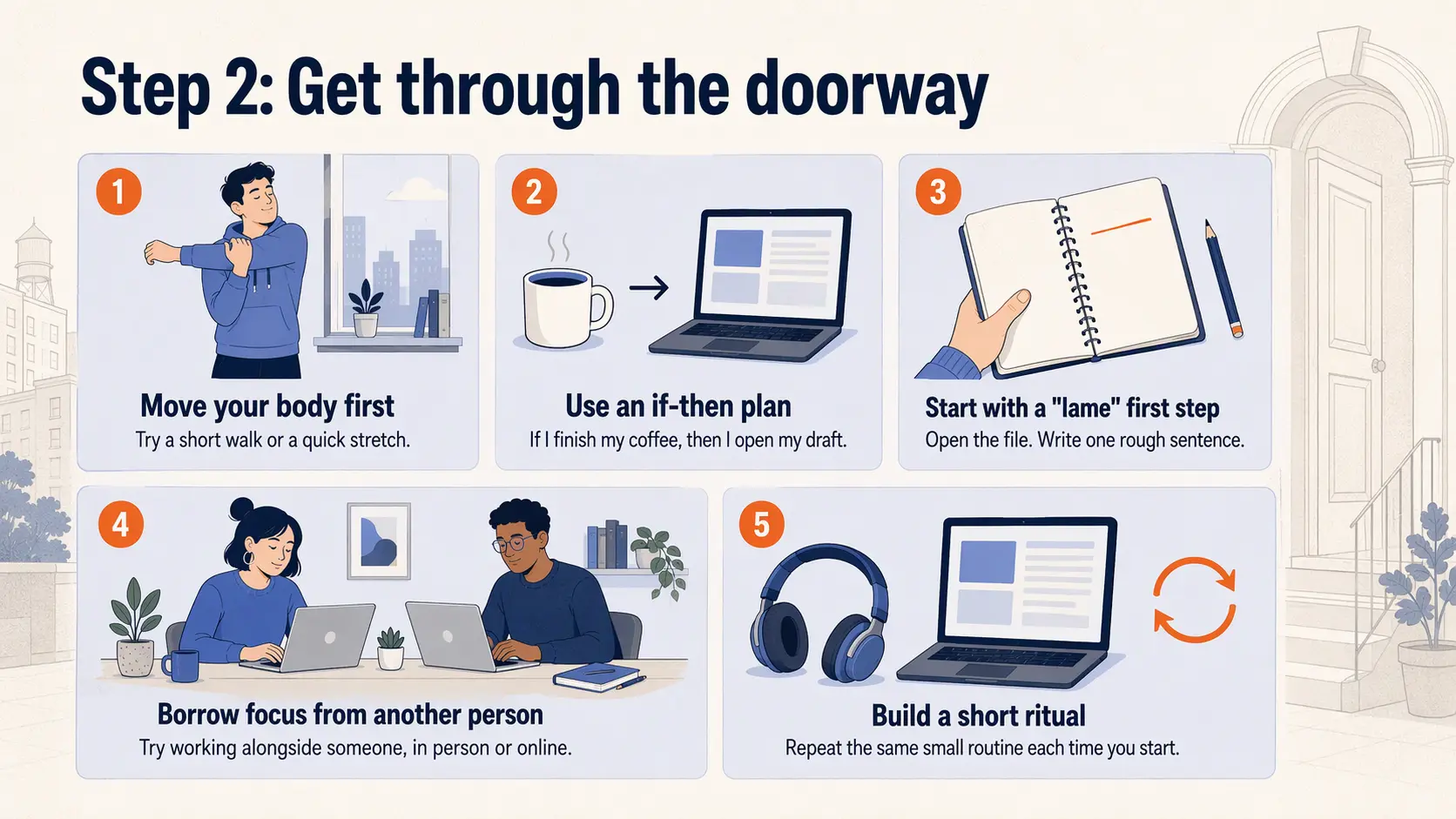
Move your body first
A 2025 meta-analysis in the Journal of Global Health looked at 14 studies with 373 participants and found that both single exercise sessions and longer exercise programs improved inhibitory control in adults with ADHD. Inhibitory control is the brake system that stops you from reaching for your phone mid-sentence.
You don't need a gym session. A brisk 10-minute walk or a short dance to one loud song before a session is a reasonable place to start.
Use an if-then plan
A few if-then plans that work well for deep work:
- If I sit down at my desk at 10, then I open the doc and type the first sentence, even a bad one.
- If I feel the urge to check my phone, then I write the urge on my capture note and keep going.
- If I get stuck for more than two minutes, then I switch to the easiest next piece of the same task.
- If the timer goes off, then I stand up, even if I'm in the zone.
Start with a "lame" first step
Give yourself permission to do a version of the task that's almost too easy. Open the file and name the sections. Write the ugliest first draft of one paragraph. Once you're moving, the interest system often kicks in and carries you forward.
Borrow focus from another person
Body doubling means working alongside someone else, in person or on video, while you each do your own thing.
A 2024 study in ACM Transactions on Accessible Computing surveyed 220 neurodivergent people and found that many had discovered body doubling on their own before they ever heard the name. It's worth trying.
Build a short ritual you repeat every time
Rituals tell your brain "we're doing the focus thing now." Mine is boring on purpose: refill water, put the phone in the drawer, start the same playlist, open the one task. Pick three or four small actions and keep them identical so they become a cue instead of a decision.
Step 3: Stay in long enough to make progress
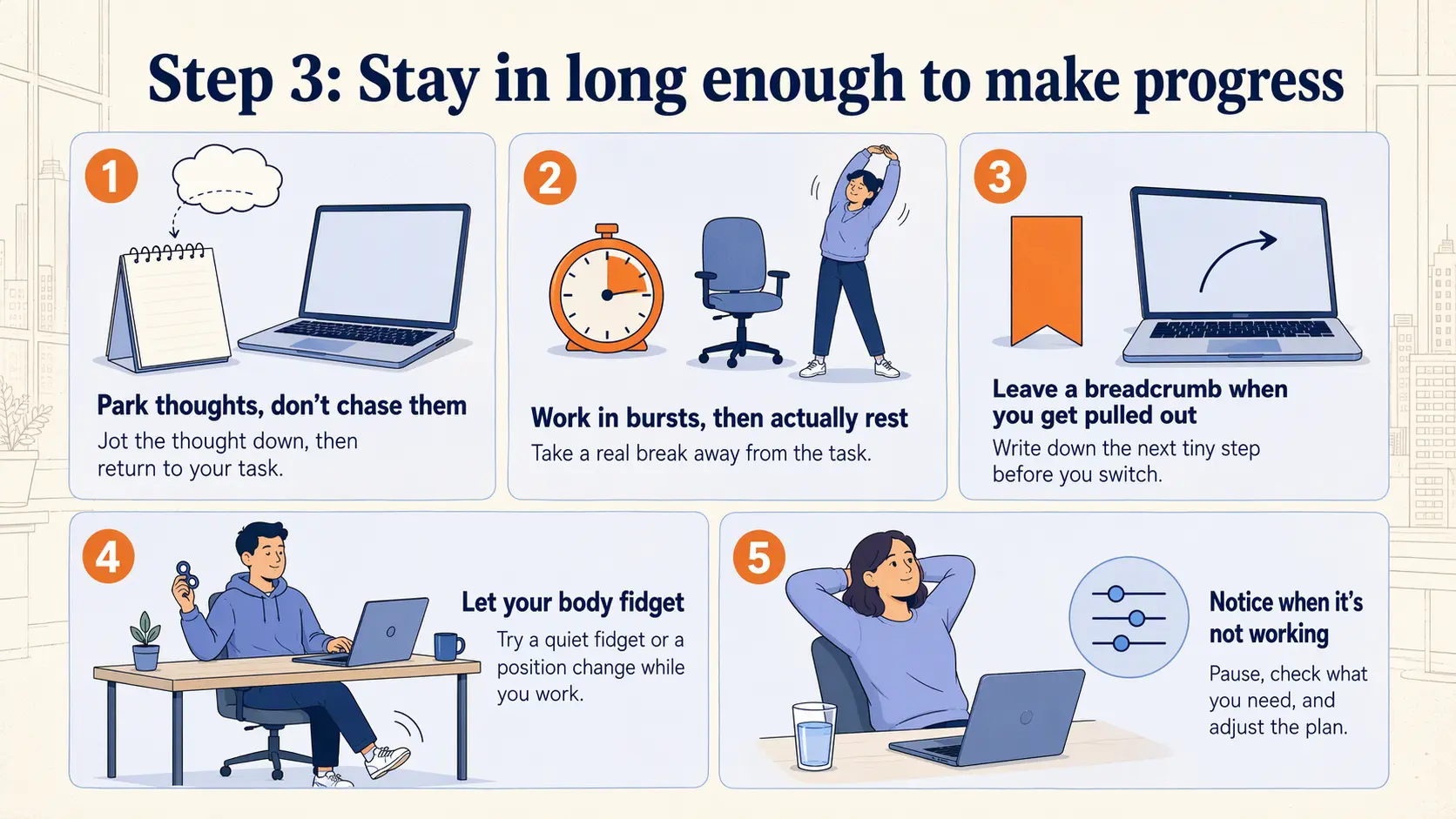
Park thoughts, don't chase them
When a thought pops up ("pay the electricity bill," "that idea for the newsletter," "did I lock the door?"), write it down in your capture spot in under ten seconds and return to the task. Writing it down tells your brain the thought is safe, so it can stop holding onto it.
Work in bursts, then actually rest
A 2022 meta-analysis in PLOS ONE covering 22 study samples found that micro-breaks of 10 minutes or less gave a small boost to vigor and reduced fatigue. The authors put it simply: "micro-breaks are efficient in preserving high levels of vigor and alleviating fatigue." They also found that for mentally demanding tasks, longer breaks seemed to help performance more.
A rhythm that works for many people with ADHD:
- 25 to 50 minutes of focus on one task
- 5 to 10 minutes of break that involves standing up, moving or getting water
- A longer break (20 minutes or more) after two or three rounds
- No phone scrolling during short breaks, because "just five minutes" on social media rarely stays five
Leave a breadcrumb when you get pulled out
Sometimes the interruption wins: a call or a manager with a "quick question." Before you switch, spend 15 seconds typing a note to future you: where you stopped and what the next step is. "Halfway through section 2, next: add the Q3 numbers." Re-entry becomes far less painful
Let your body fidget
If sitting still eats your attention, stop fighting it. Stand at the counter, bounce your leg, use a fidget toy, pace while you think through a problem. Movement that doesn't need your eyes or hands on a screen usually helps rather than hurts.
Notice when it's not working
Some days, focus won't come no matter what you do. Maybe sleep was bad, or the task is still too fuzzy. On those days, switch to shallow work you can still finish (email, admin) and try deep work again tomorrow.
Step 4: Come back out on purpose
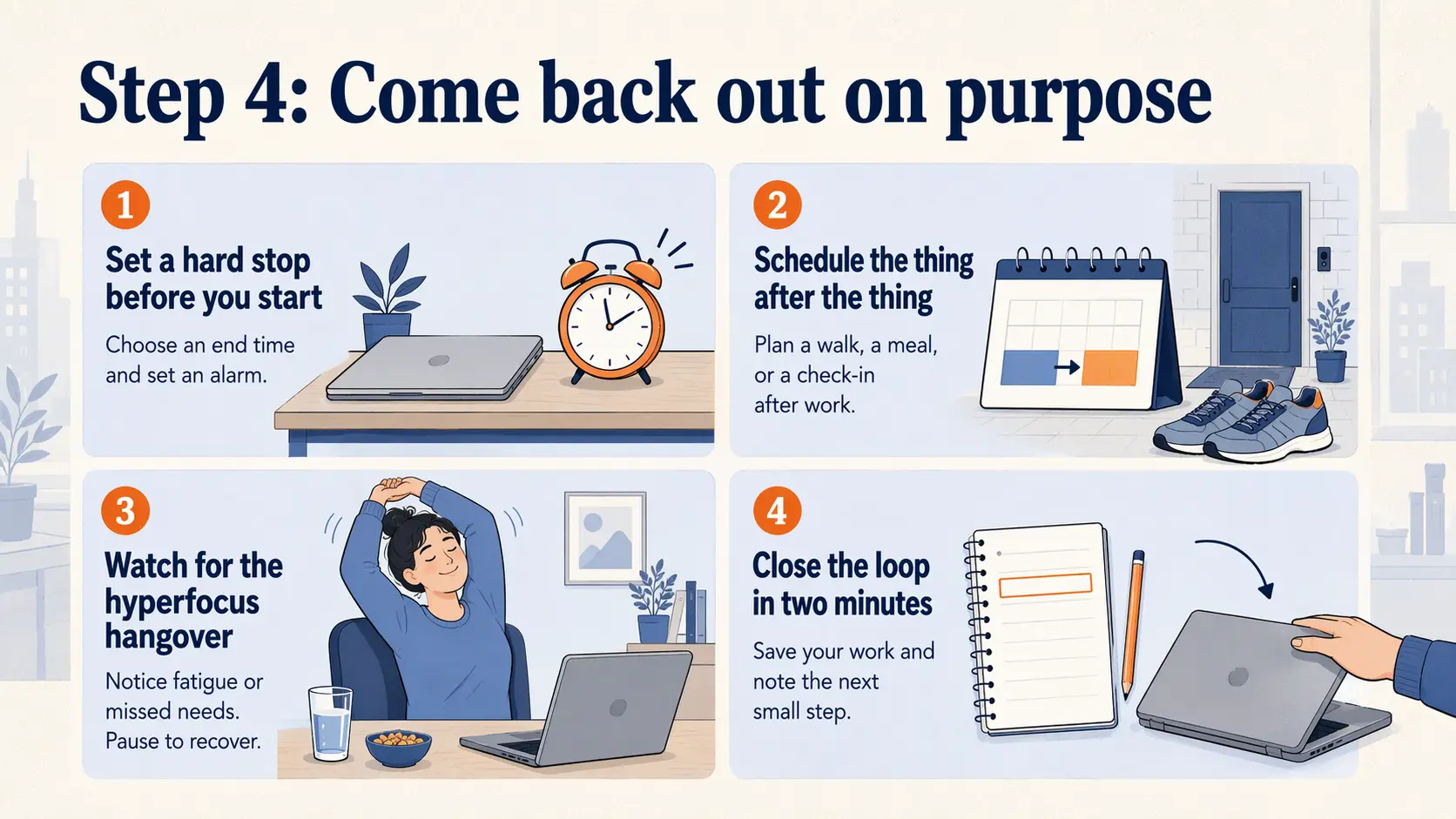
For ADHD brains, getting out of focus can be as hard as getting in. You look up, and it's dark, and your back hurts from four hours in the same position.
Set a hard stop before you start
Use an alarm that's annoying enough to break through hyperfocus, and put it across the room if you need to. Decide what happens when it rings: stand up and check the clock and your calendar. You can choose to go another round, but make it a choice instead of a drift.
Schedule the thing after the thing
Transitions are easier when the next activity is already decided. "Deep work until 11:30, then lunch with my sister" gives you a reason to stop. "Deep work until... whenever" usually ends with a crash.
Watch for the hyperfocus hangover
Long hyperfocus sessions can leave you drained and a bit foggy for the rest of the day. ADDitude calls this the hyperfocus crash. If you know a big session is coming, plan something light afterward and eat a real meal.
What a deep work day can look like with Saner.AI
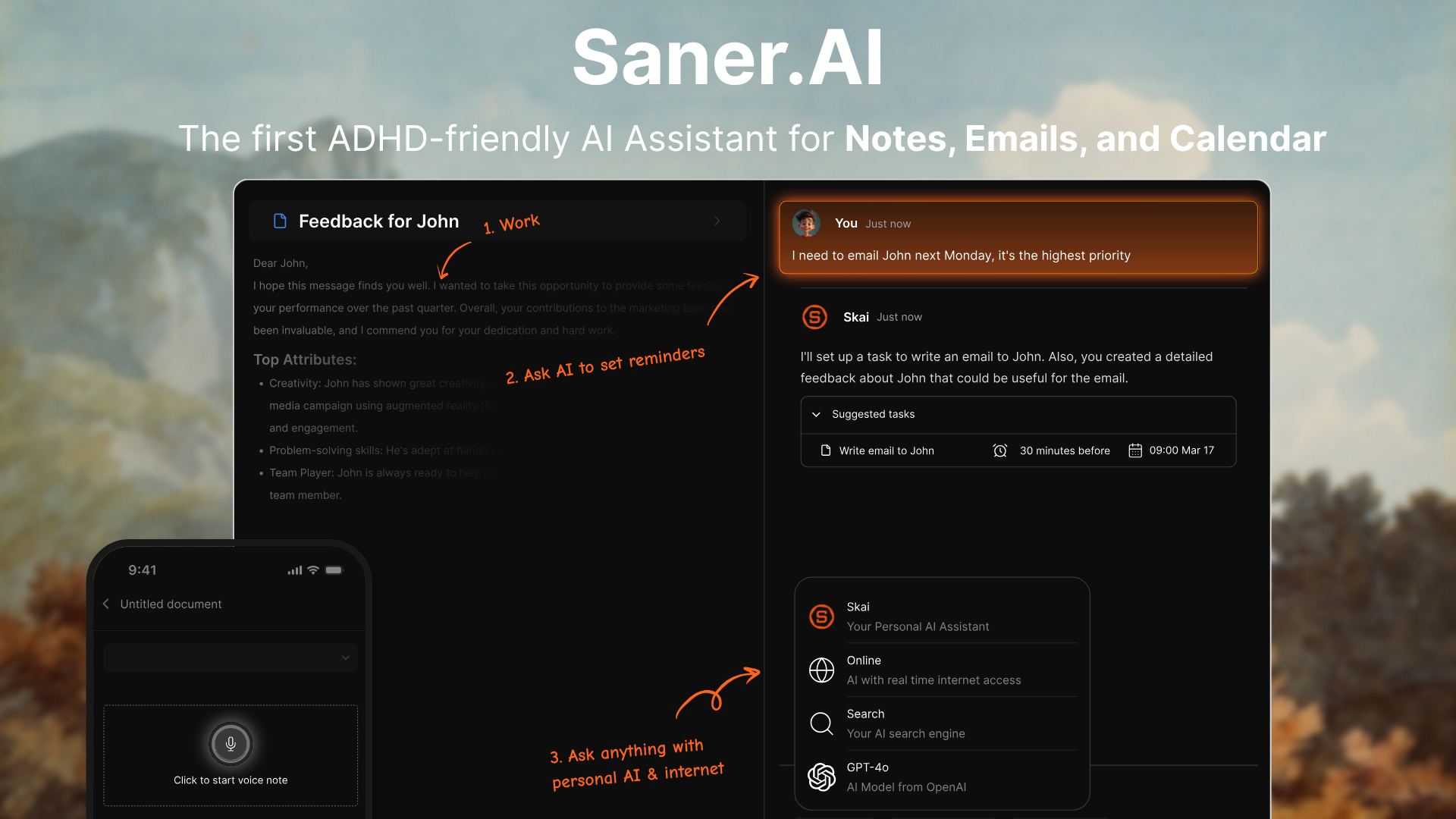
Every step above has the same weak spot: it depends on you remembering to do it. That's a lot to ask of a brain whose working memory is already juggling too much. Saner.AI is an AI personal assistant built for ADHD brains, and its assistant, Skai, can carry some of that load.
- The night before: brain dump. You type or voice everything rattling around your head, from "finish client proposal" to "buy cat food." Skai turns that mess into tasks and notes, so your head is a bit quieter going to bed.
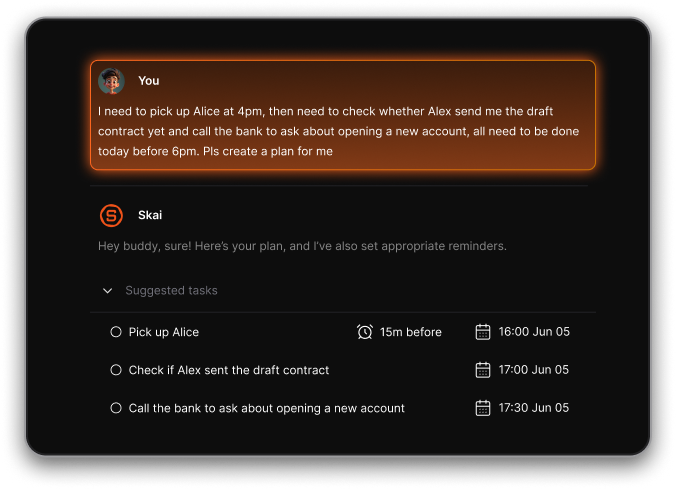
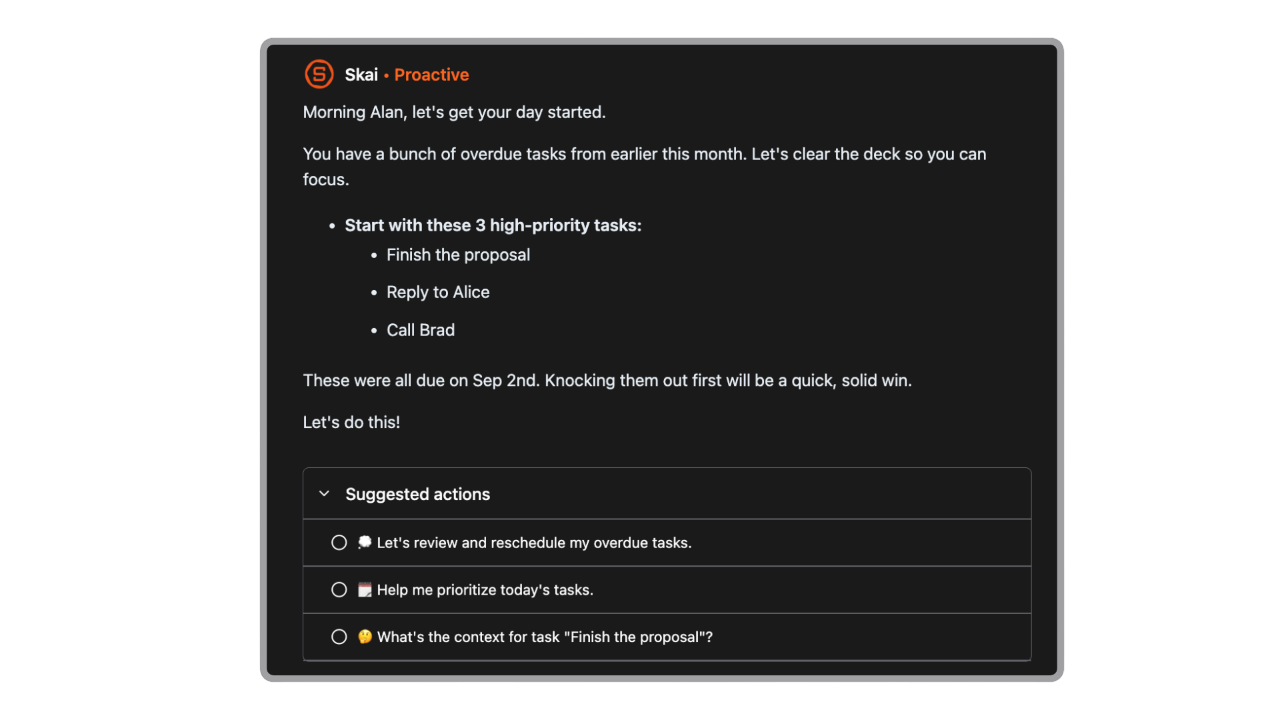
- Morning: a plan you didn't have to build. With Skai Proactive, the assistant scans your calendar, overdue tasks, and recent notes and sends a short summary of what needs your attention. You pick the one deep work task from that list instead of from a blank page.
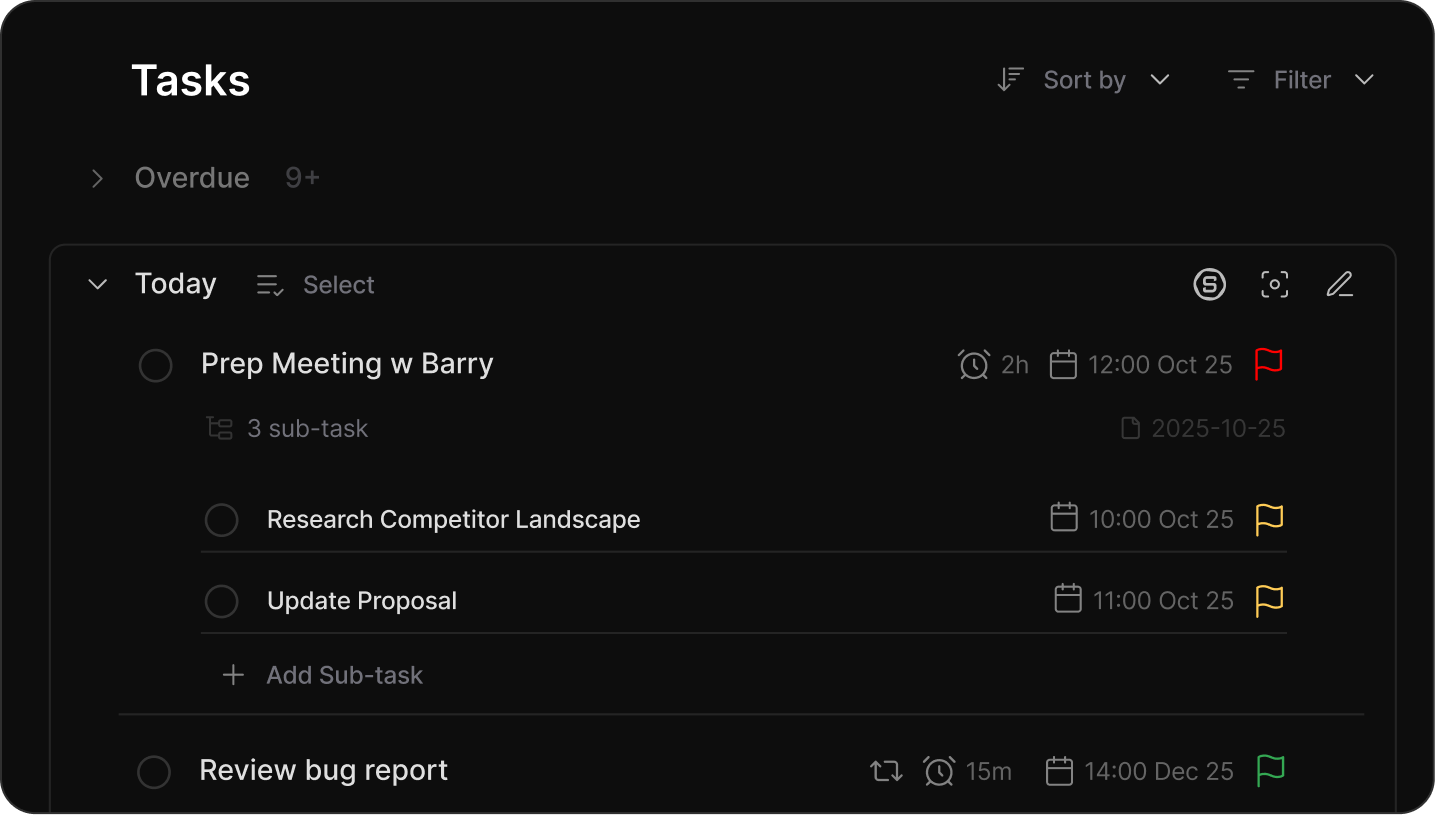
- Before the session: shrink the task. Ask Skai to "break this down for me," and it splits the proposal into sub-tasks with durations. Give the task a time estimate, and it shows up as a block on your calendar
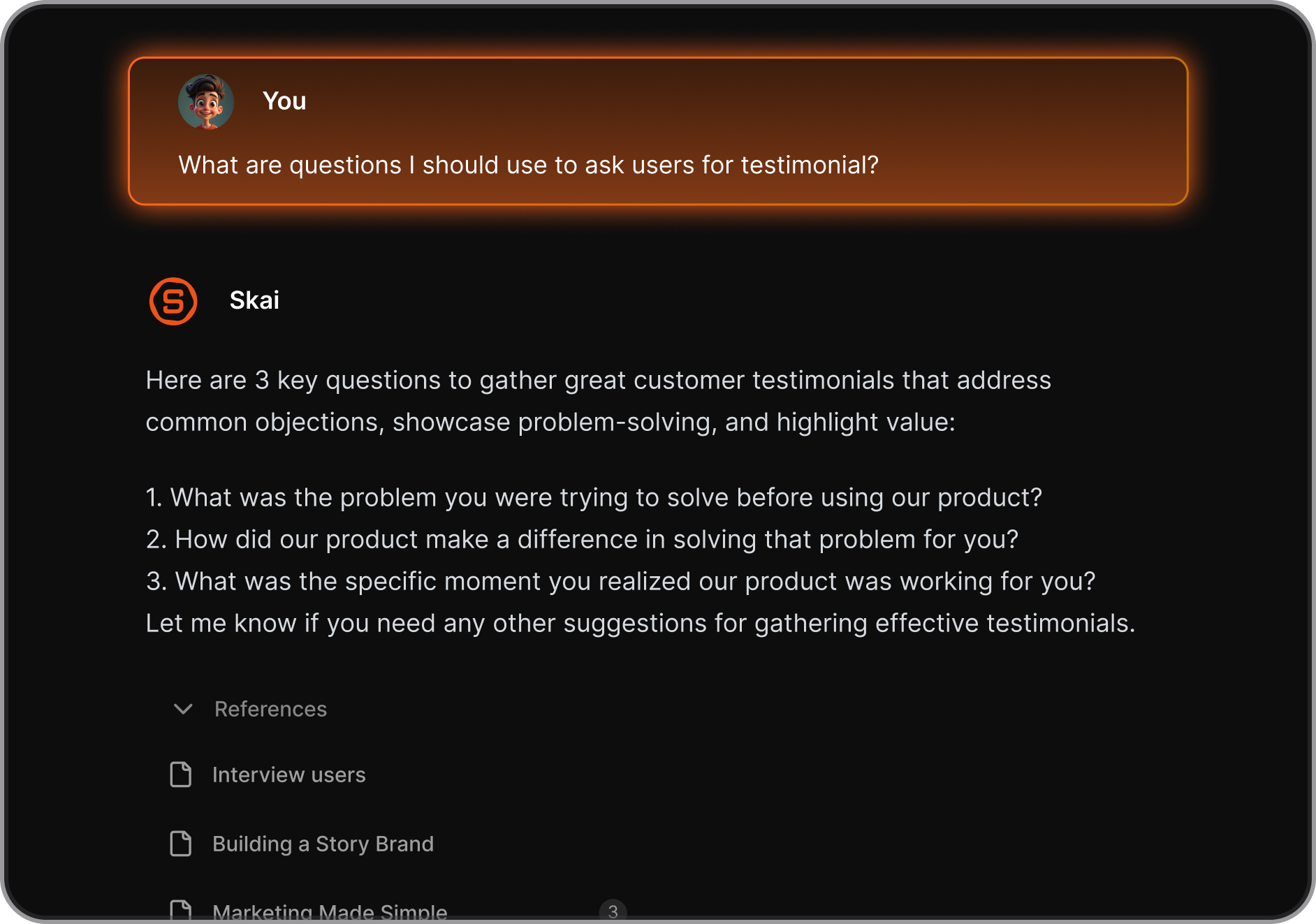
- When you need information: ask instead of digging: Saner.AI's semantic search can find "the meeting about the marketing budget" even if the note is titled "Q3 Financials."
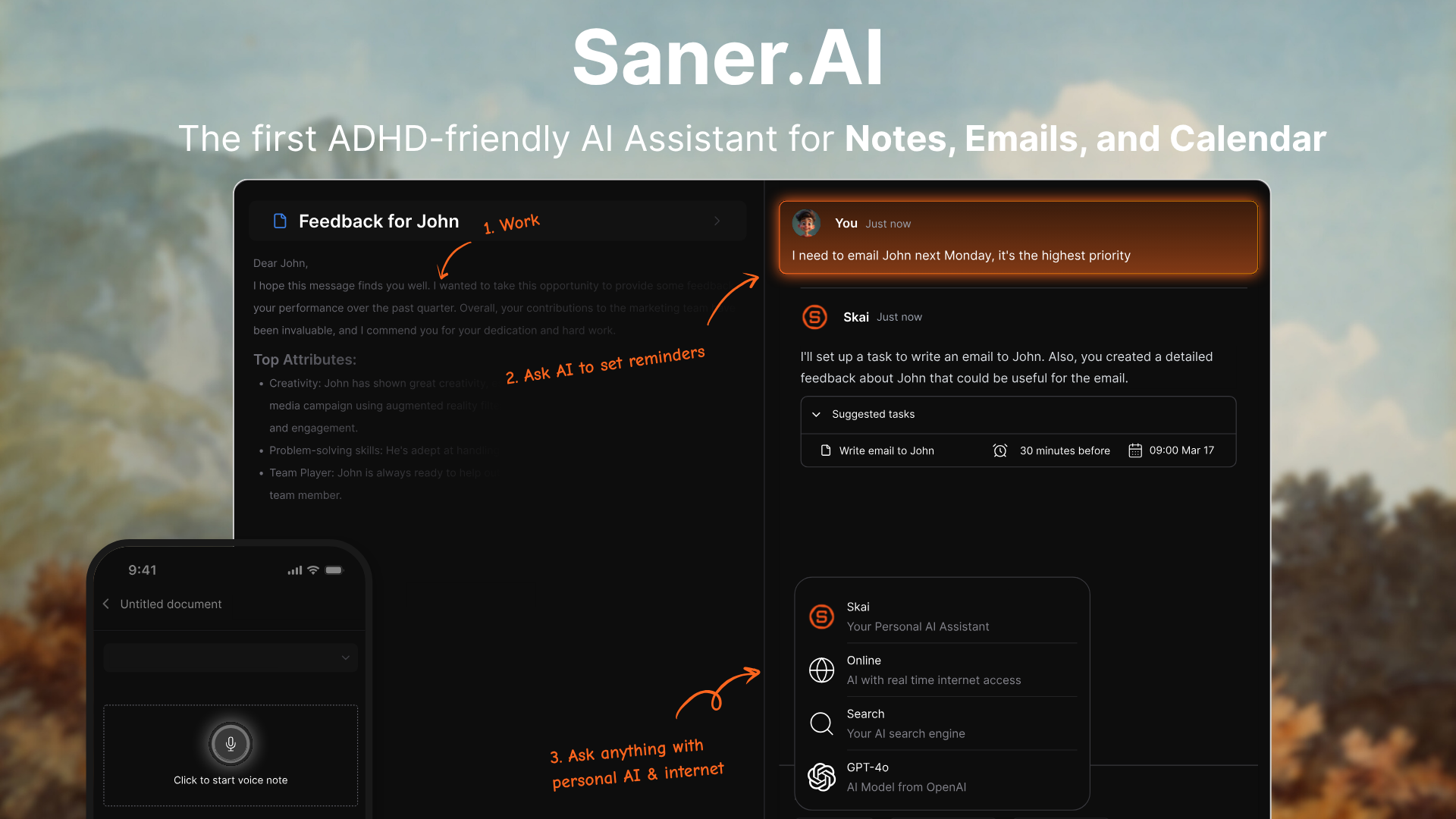
- After the session: the inbox gets handled in one batch. Saner.AI connects to Gmail, Outlook, Slack, and Google Calendar, and can pull action items out of emails into your task list.
Stay on top of your work and life effortlessly
FAQ: deep work with ADHD
Can people with ADHD do deep work?
Yes. Research on hyperfocus shows that adults with ADHD often experience long, intense periods of concentration, sometimes more than people without ADHD. The challenge is usually choosing where that focus lands and starting on demand, which is what the steps in this guide are for.
How long should a deep work session be if I have ADHD?
Start with 25 to 45 minutes and a 5 to 10 minute break. Once that feels easy, try stretching to 60 or 90 minutes. A shorter session you actually complete builds more momentum than a long one you avoid.
Is hyperfocus the same as a flow state?
They overlap a lot. Flow is usually described as absorbed, enjoyable focus that you feel in control of. Hyperfocus is the ADHD-linked version of intense absorption, and it can lock onto tasks you didn't choose and make it hard to stop.
Do I need medication to do deep work with ADHD?
Not necessarily, but medication helps many people. The CDC report found that about half of U.S. adults with ADHD had been prescribed medication in the past year. Whether it's right for you is a conversation for your doctor. The strategies here work with or without it.
What's the best app for deep work with ADHD?
The best app is the one that makes starting easier and doesn't become another place to procrastinate. Look for fast capture (voice or quick-add), help breaking tasks into steps, a way to see one priority at a time, and reminders tied to your calendar. Saner.AI covers all of these in one place and adds an assistant that plans your day for you.
What should I do when I can't focus at all?
Lower the bar. Pick the smallest possible version of the task and do it for five minutes, or switch to shallow work and come back tomorrow. If focus problems are affecting your work or relationships most days, it's worth talking to a health professional about an ADHD assessment.
Conclusion
If you take one thing from this post, let it be this: deep work with ADHD gets easier when you spend less energy on remembering and deciding, and more on the work you care about. Choose the task early, make the first step small, protect a short window, park your stray thoughts, and plan your exit.
You won't nail it every day. I still have mornings where the only thing I finish is a cold coffee. But each session where you get in and come back out in one piece makes the next one a little easier.
If you want help with the parts your brain would rather not hold, try Saner.AI for free. Dump your thoughts in and let Skai turn them into a plan, so your focus goes where it counts.
Stay on top of your work and life effortlessly
👉 You may like this post on how to improve Productivity for adults with ADHD
Sources
- Staley BS, et al. ADHD Diagnosis, Treatment, and Telehealth Use in Adults. CDC MMWR, 2024.
- National Institute of Mental Health. ADHD in Adults: 4 Things to Know.
- Hupfeld KE, Abagis TR, Shah P. Living "in the zone": hyperfocus in adult ADHD. ADHD Attention Deficit and Hyperactivity Disorders, 2019. Interview quote via ADDitude.
- Volkow ND, et al. Motivation deficit in ADHD is associated with dysfunction of the dopamine reward pathway. Molecular Psychiatry, 2011.
- Mark G, Gudith D, Klocke U. The cost of interrupted work: more speed and stress. CHI 2008 Proceedings.
- Barkley deficits in executive functioning study: Executive function assessment and adult ADHD. Psychological Assessment, 2014.
- Nigg JT, et al. Do white noise or pink noise help with task performance in youth with ADHD? JAACAP, 2024.
- Yang Y, et al. The impact of physical activity on inhibitory control of adult ADHD. Journal of Global Health, 2025.
- Gawrilow C, Gollwitzer PM. Implementation intentions facilitate response inhibition in children with ADHD. Cognitive Therapy and Research, 2008.
- Eagle T, Baltaxe-Admony LB, Ringland KE. An investigation of body doubling with neurodivergent participants. ACM Transactions on Accessible Computing, 2024.
- Albulescu P, et al. "Give me a break!" A meta-analysis on micro-breaks. PLOS ONE, 2022.
- Josel L. How can distracted ADHD brains slipstream into a flow state? ADDitude, updated 2025.