
Remote Work Productivity Statistics 2026: Adoption, Trust, and What the Evidence Shows

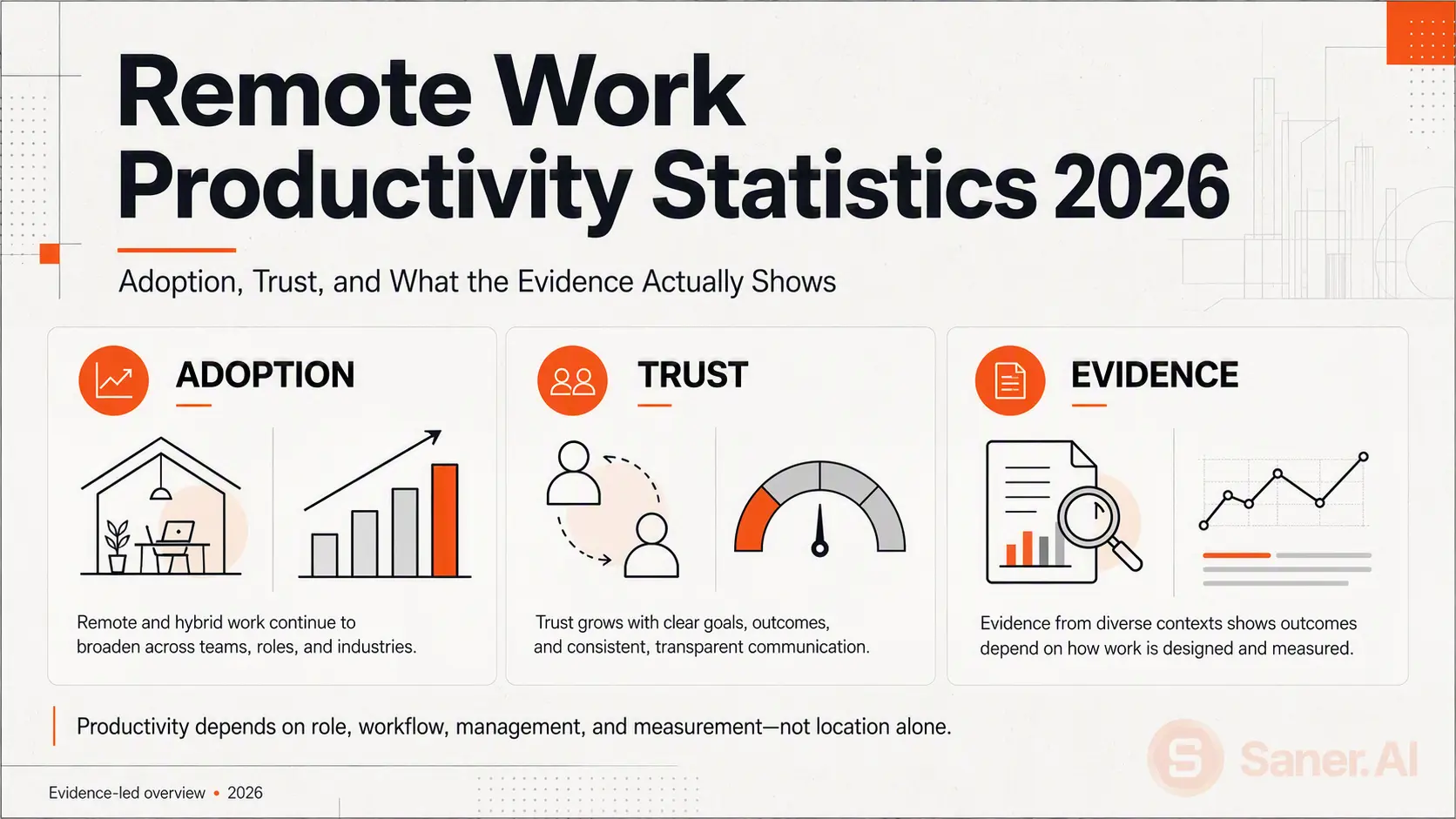
The picture that emerges isn't "remote work works" or "remote work doesn't" - it's that the effect depends heavily on the type of work, how it's measured, and whether trust and structure travel with the employee out of the office.
Key remote work productivity statistics
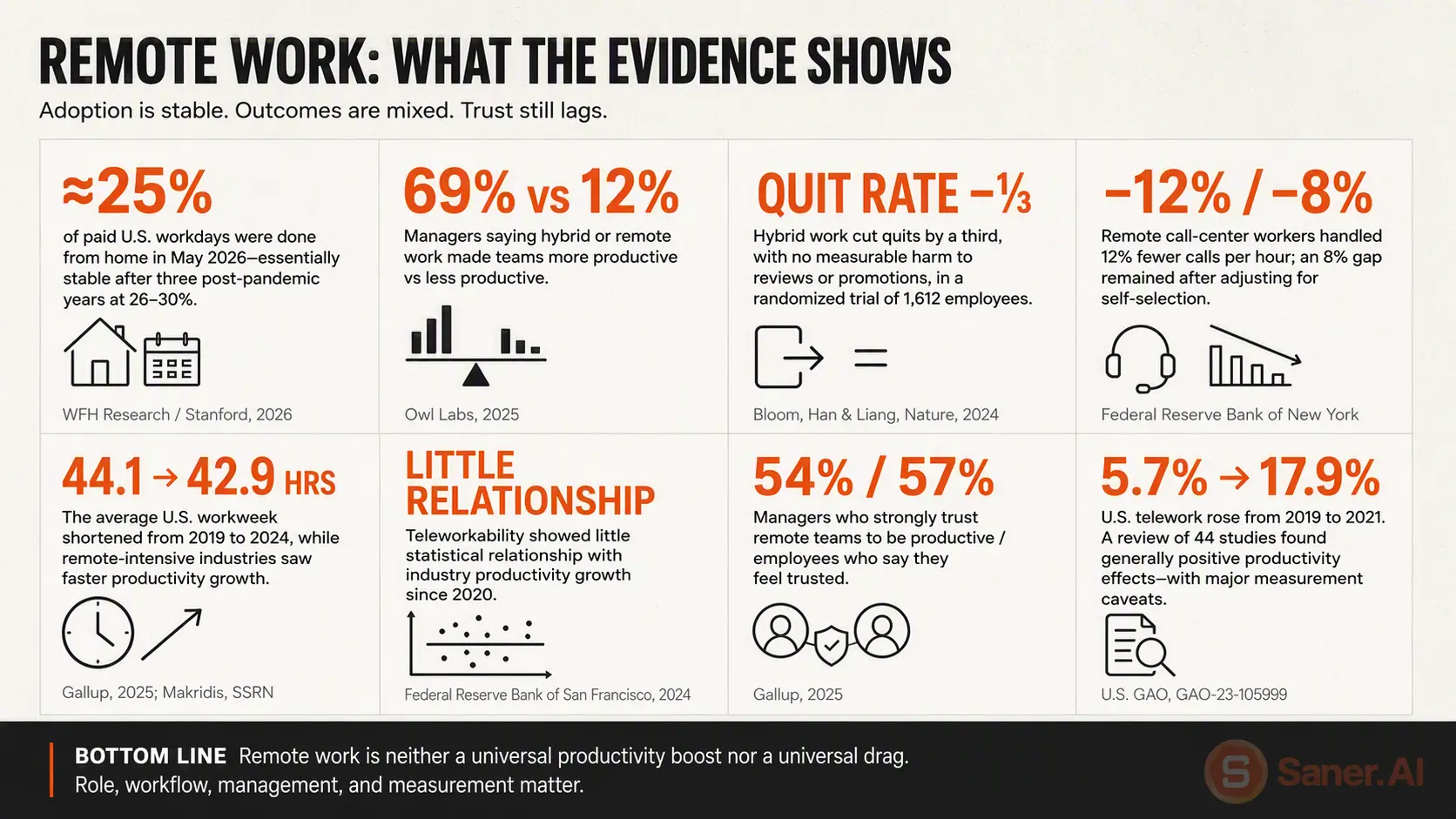
- About 25% of all paid workdays in the US were done from home as of May 2026, essentially unchanged from the 26-30% range that has held for three years post-pandemic. (WFH Research / Stanford, 2026)
- 69% of managers say hybrid or remote work has made their team more productive, versus 12% who say it made their team less productive. (Owl Labs, 2025)
- Hybrid work cut quit rates by a third with zero measurable damage to performance reviews or promotion rates, in a six-month randomized controlled trial of 1,612 employees. (Bloom, Han & Liang, Nature, 2024)
- Remote call-center workers answered 12% fewer calls per hour than on-site colleagues before the pandemic, and an 8% productivity gap persisted even after accounting for who self-selects into remote roles. (Federal Reserve Bank of New York)
- The average US workweek fell from 44.1 hours in 2019 to 42.9 hours in 2024 — yet the industries with the highest remote intensity saw faster labor-productivity growth over roughly that same period. (Gallup, 2025; Makridis, SSRN)
- Federal Reserve economists found "little statistical relationship" between how teleworkable an industry is and its productivity growth since 2020 — directly complicating the idea that remote work moved the needle either way. (Federal Reserve Bank of San Francisco, 2024)
- Only 54% of managers who oversee remote workers say they strongly trust their team to be productive off-site, even as 57% of employees say they feel trusted. (Gallup, 2025)
- Telework rose from 5.7% of US workers in 2019 to 17.9% in 2021, and a review of 44 qualifying studies found it "generally appeared to positively affect productivity" — with a major caveat about how hard output is to measure in many roles. (U.S. Government Accountability Office, GAO-23-105999)
Table of contents
- How many people actually work remotely in 2026?
- Does hybrid work actually improve productivity?
- When does remote work hurt productivity?
- What do economists find at the industry level?
- What these statistics mean for distributed teams
- Quotable remote work productivity statistics
- FAQ
- Sources
1) How many people actually work remotely in 2026?
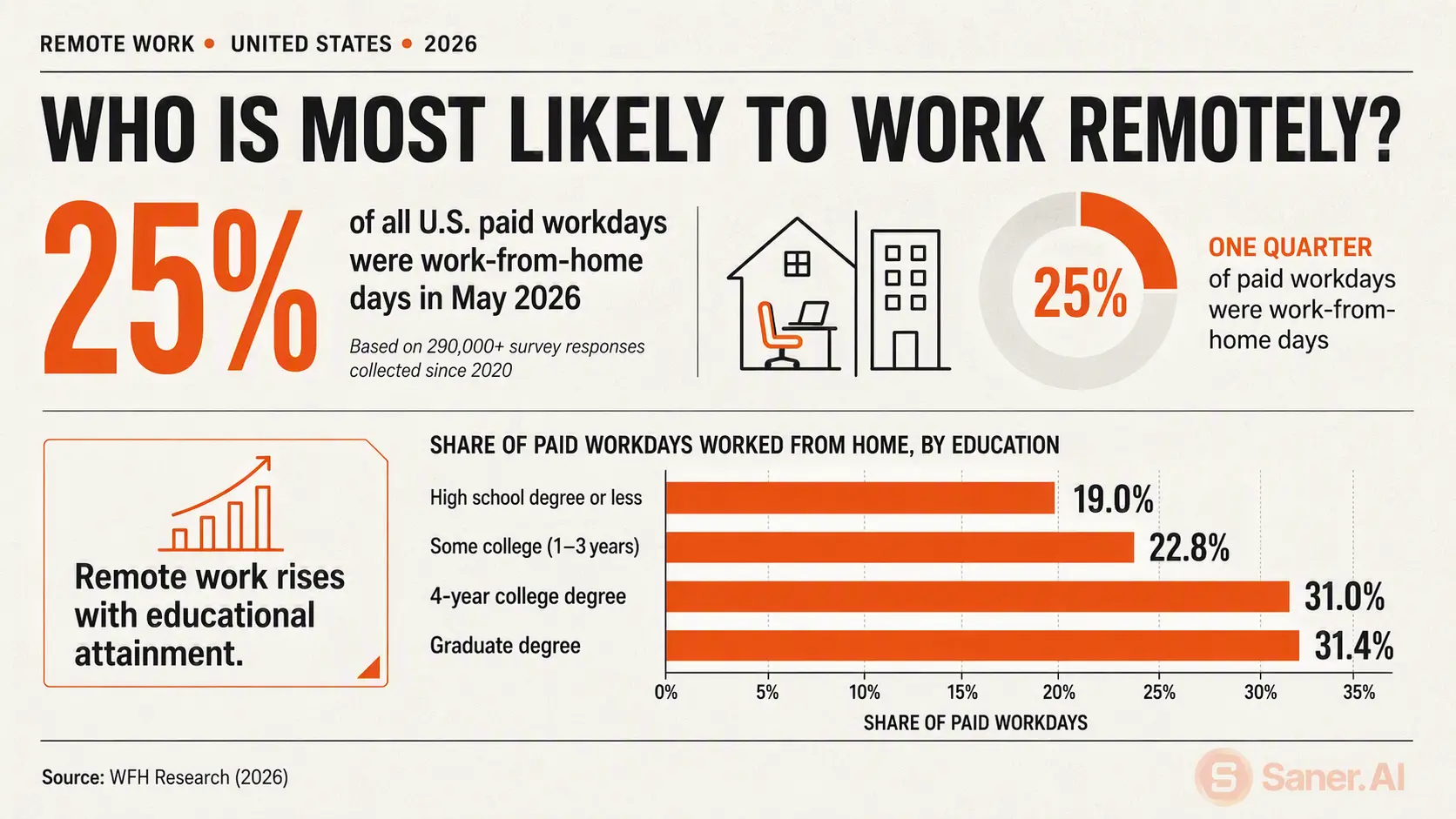
What share of US workdays are done from home right now?
- It peaked near 61.5% in April 2020, collapsed through 2021 and 2022, and has held in a narrow 26-30% band since.
- Looking specifically at full-time employees over the past year, the same research team found 12% were fully remote, 62% were full-time on-site, and 26% were in a hybrid arrangement — meaning hybrid, not fully remote, is now the meaningful "flexible work" category to watch (WFH Research, 2026).
Who is most likely to work remotely?
| Education level | Share of paid workdays worked from home (2026) |
|---|---|
| High school degree or less | 19.0% |
| Some college (1-3 years) | 22.8% |
| 4-year college degree | 31.0% |
| Graduate degree | 31.4% |
Source: WFH Research / Stanford SWAA, June 2026
- A worker with a graduate degree is now working from home about 65% more often than one with a high school diploma (WFH Research, 2026).
2) Does hybrid work actually improve productivity?
What does the strongest experimental evidence show?
Let's look at this case example: Economists Nicholas Bloom, Ruobing Han, and James Liang randomly assigned 1,612 employees at Trip.com's Shanghai office — split into 395 managers and 1,217 non-managers — to either a hybrid schedule (two days a week at home) or five days in the office, based on whether their birthday fell on an even or odd day of the month (Bloom, Han & Liang, Nature, 2024).
- Quit rates fell by a third for the hybrid group, with the effect strongest among non-managers, women, and employees with long commutes.
- Performance reviews and promotion rates showed no measurable difference between groups over the following two years, and computer-engineer employees' lines of code — one of the few directly quantifiable output measures in the study — also showed no significant change.
Before the experiment:
- The 395 participating managers expected hybrid work to reduce their team's productivity by 2.6% on average. After six months of actually managing hybrid teams, that expectation flipped to a perceived positive 1.0% effect (Bloom, Han & Liang, Nature, 2024).
Do managers believe hybrid or remote work helps their teams?
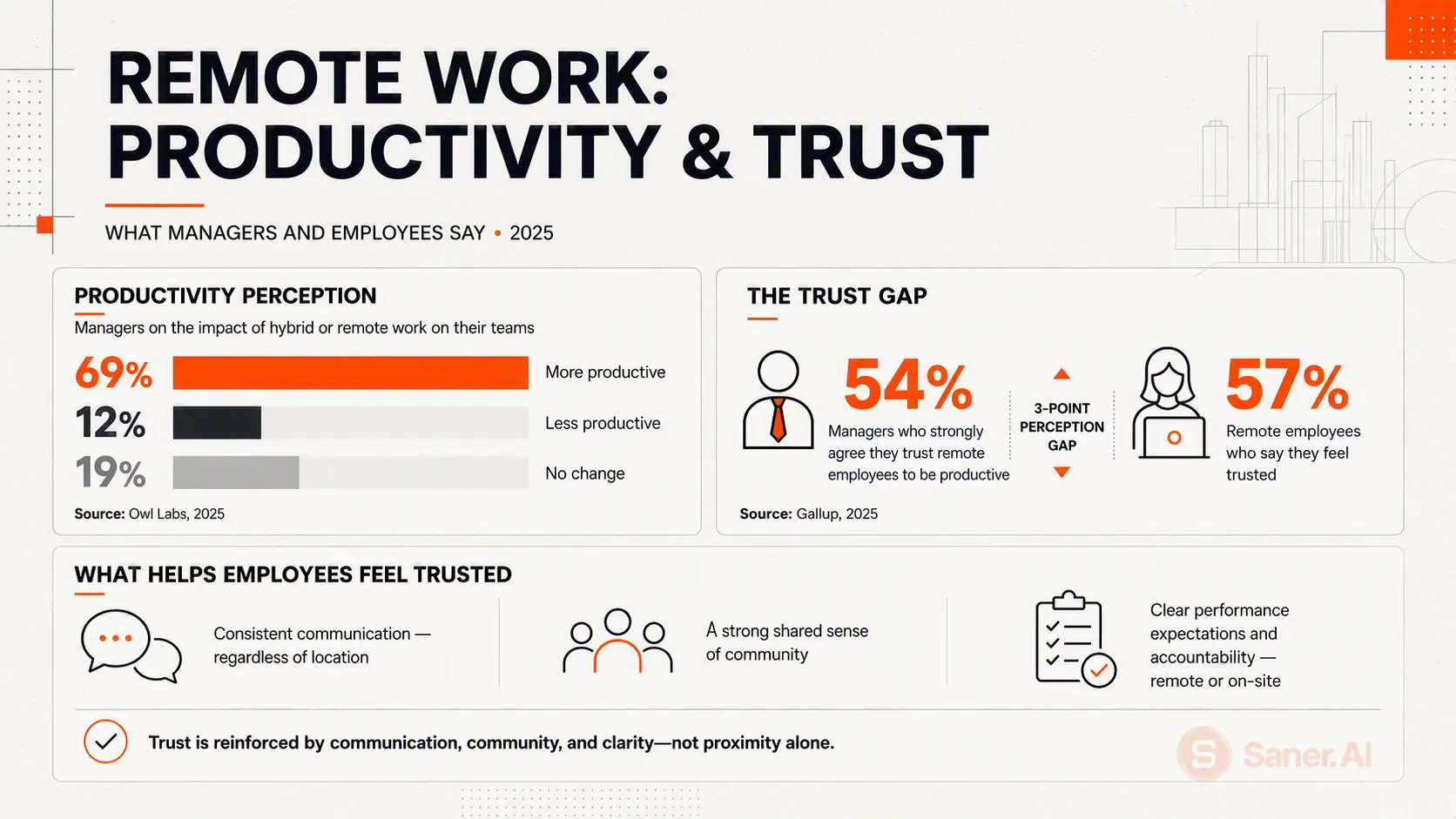
2. 54% of managers who oversee remote employees strongly agree they trust their team to be productive when working remotely, even though 57% of those employees say they feel trusted (Gallup, 2025).
(Worth flagging: Owl Labs sells video-conferencing hardware built for hybrid offices, so this is vendor-adjacent research — worth reading alongside the independently funded studies elsewhere in this post rather than in isolation.)
- Workers themselves were more measured about their own output: 51% said their current working style made them more productive, 6% said it made them less productive, and 39% reported no change (Owl Labs, 2025).
- Gallup's research also points to a fix: employees are meaningfully more likely to feel trusted when they get consistent communication regardless of location, when their team has a strong shared sense of community, and when their manager holds them accountable to clear performance expectations whether they're remote or on-site.
3) What do economists find at the industry level?
- The shift to remote work, on its own, is "unlikely to be a major factor" explaining differences in productivity performance across sectors. (Fernald, Goode, Li & Meisenbacher, Federal Reserve Bank of San Francisco, 2024).
- Full-time employees in the most remote-intensive jobs were working about an hour less per day by 2022 than they had in 2019 — redirecting 30 to 60 minutes of that time to leisure rather than commuting, which explains only a small share of the reduction (Makridis, SSRN working paper, "The Allocation of Time and Remote Work").
- 5.7% of US workers in 2019 to 17.9% in 2021, and GAO's review of 44 studies meeting its methodological bar found telework "generally appeared to positively affect productivity" — but flagged that many roles simply don't have measurable outputs, making the true economy-wide effect hard to pin down with confidence (U.S. Government Accountability Office, GAO-23-105999).
Taken together: at the level of an individual, well-measured job, remote work's effect can be clearly positive or clearly negative depending on the task. At the level of the whole economy, that signal mostly washes out — a genuinely unsatisfying but honest place to land.
4) What these statistics mean for distributed teams
1. The productivity debate is really a measurement debate.
- Every study above that found a clear effect — positive or negative — was measuring something specific and quantifiable: calls answered, lines of code, promotion timelines, hours logged.
- Studies with "no effect" or a "little statistical relationship" results was working with broader, noisier measures like industry-level output per hour. If your organization can't currently define what "productive" looks like for a given role in specific, countable terms, that's a bigger risk to getting hybrid work right than the location decision itself.
2. Trust and structure are doing more work than location.
- The Bloom, Han and Liang RCT and Gallup's trust data point at the same underlying mechanism from two different angles: Hybrid and remote work perform well when managers set clear expectations and communicate consistently regardless of where someone is sitting, and perform worse when that structure is missing.
- The Federal Reserve's New York call-center study found the opposite of trust — degraded quality, reduced promotions — in an environment with comparatively little structured feedback for remote staff.
3. Visibility is the resource remote and hybrid teams are shortest on.
- Teams that keep a shared, current record of what's been done, what's in progress, and what's blocked give managers something concrete to trust instead of relying on presence as a proxy for output.
That's a big part of why tools like Saner.AI have leaned into centralizing tasks, notes, and context in one place rather than scattering them across a dozen apps: the data above suggests that closing the visibility gap, not mandating a location, is the actual lever on hybrid-team productivity.
Quotable remote work productivity statistics
Single-sentence, self-contained versions for citation:
- According to Stanford's WFH Research project, about 25% of all paid workdays in the US were done from home in May 2026. (WFH Research, 2026)
- A 2024 Nature study found hybrid work cut quit rates by a third among 1,612 Trip.com employees, with no measurable damage to performance reviews or promotions over two years. (Bloom, Han & Liang, Nature, 2024)
- Owl Labs' 2025 State of Hybrid Work survey of 2,000 US workers found 69% of managers believe hybrid or remote work has made their team more productive. (Owl Labs, 2025)
- The Federal Reserve Bank of New York found remote call-center workers answered 12% fewer calls per hour than on-site colleagues before the pandemic, with an 8% gap persisting after accounting for worker selection. (Federal Reserve Bank of New York)
- Gallup reports the average US employee's workweek fell from 44.1 hours in 2019 to 42.9 hours in 2024. (Gallup, 2025)
- A 2024 Federal Reserve Bank of San Francisco analysis found "little statistical relationship" between an industry's teleworkability and its productivity growth since 2020. (Federal Reserve Bank of San Francisco, 2024)
- Gallup found only 54% of managers overseeing remote workers strongly trust their team to be productive off-site, versus 57% of employees who say they feel trusted. (Gallup, 2025)
- The U.S. Government Accountability Office found American telework rose from 5.7% of workers in 2019 to 17.9% in 2021. (GAO-23-105999, 2023)
FAQ
1. Does remote work actually increase productivity?
The evidence is mixed and depends on what's measured. A 2024 Nature randomized trial found hybrid work caused no productivity loss and cut turnover by a third (Bloom, Han & Liang, 2024), while a Federal Reserve Bank of New York call-center study found remote workers were measurably less productive on a directly comparable task (Emanuel & Harrington). The honest answer is "it depends heavily on the role and how output is measured," not a universal yes or no.
2. What percentage of US employees work from home in 2026?
About 25% of all US paid workdays were done from home as of May 2026, and among full-time employees over the past year, 12% were fully remote, 26% were hybrid, and 62% worked entirely on-site (WFH Research, 2026).
3. Do managers actually trust remote employees to be productive?
Only 54% of managers who oversee remote workers strongly agree they trust their team to be productive off-site, even though a higher share of employees (57%) say they feel trusted by their manager (Gallup, 2025). Gallup's research links that trust gap most closely to inconsistent communication and unclear accountability, not to location itself.
4. Is hybrid work better than fully remote work for productivity?
Most of the highest-quality evidence — including the Nature randomized trial — studies hybrid arrangements specifically, typically two office days a week, rather than fully remote setups (Bloom, Han & Liang, 2024). Gallup separately reports hybrid workers now spend about 46% of their workweek in the office, the equivalent of 2.3 days, a figure that has held steady since 2023 (Gallup, 2025).
5. Why do some studies find remote work reduces productivity?
The clearest negative findings come from settings with directly comparable, easily measured output, like calls answered per hour. A Federal Reserve Bank of New York study of call-center staff found a persistent 8% productivity gap for remote workers even after controlling for who chooses remote roles in the first place (Emanuel & Harrington). Tasks that are harder to measure tend to show smaller, less certain effects in either direction.
6. How many hours do remote-capable employees actually work?
The average US employee's reported workweek fell from 44.1 hours in 2019 to 42.9 hours in 2024, and workers in the most remote-intensive jobs were working roughly an hour less per day by 2022 than in 2019 (Gallup, 2025; Makridis, SSRN).
7. Does remote work hurt career advancement?
In the Federal Reserve Bank of New York's call-center study, remote work reduced promotion rates (Emanuel & Harrington). In contrast, the Nature randomized trial of hybrid (not fully remote) work found no measurable difference in promotion rates over two years (Bloom, Han & Liang, 2024) — another sign that the specific arrangement (hybrid vs. fully remote) and the role's visibility matter more than remote work as a single category.
8. Which employees are most likely to work remotely?
Remote work is heavily concentrated among more educated workers: employees with a graduate degree worked from home 31.4% of paid workdays in 2026, versus 19.0% for those with a high school diploma or less (WFH Research, 2026). It's also concentrated in information, finance and insurance, and professional and business services.
Sources
- Barrero, J.M., Bloom, N., Buckman, S., & Davis, S.J. (2026). SWAA June 2026 Updates. WFH Research, Stanford University. wfhresearch.com
- Bloom, N., Han, R., & Liang, J. (2024). "Hybrid working from home improves retention without damaging performance." Nature, 630, 920-925. nature.com
- Owl Labs. (2025). State of Hybrid Work 2025 | US Report. owllabs.com
- Pendell, R. (2025). "Hybrid Work in Retreat? Barely." Gallup. gallup.com
- Makridis, C. (2025). "Remote Staff Hours Fall, but Productivity Steady (For Now)." Gallup. gallup.com
- Makridis, C. (2023). "The Allocation of Time and Remote Work." SSRN Working Paper. papers.ssrn.com
- Emanuel, N., & Harrington, E. "Working Remotely? Selection, Treatment, and the Market for Remote Work." Federal Reserve Bank of New York Staff Report. newyorkfed.org
- Fernald, J., Goode, E., Li, H., & Meisenbacher, B. (2024). "Does Working from Home Boost Productivity Growth?" Federal Reserve Bank of San Francisco Economic Letter. frbsf.org
- U.S. Government Accountability Office. (2023). Telework: Growth Supported Economic Activity During the Pandemic, but Future Impacts Are Uncertain. GAO-23-105999. gao.gov
- Langemeier, K., & Tito, M.D. (2021). "The Ability to Work Remotely: Measures and Implications" (citing Morikawa, 2020). Federal Reserve FEDS Notes. federalreserve.gov