AI Assistant Statistics 2026: Adoption, Productivity Gains, and Where They Fall Short


Ask ten people what "AI assistant" means and you'll get ten different answers: a chatbot on a phone, a smart speaker in the kitchen, Copilot inside a spreadsheet, an agent that drafts code.
The 2026 data treats all of these as the same underlying shift, and the numbers tell a more complicated story than either the adoption headlines or the backlash headlines suggest.
AI Assistants are now mainstream by any measure. Whether they're actually making the people using them more productive depends heavily on who's asking and what they're measuring.
Key AI assistant statistics
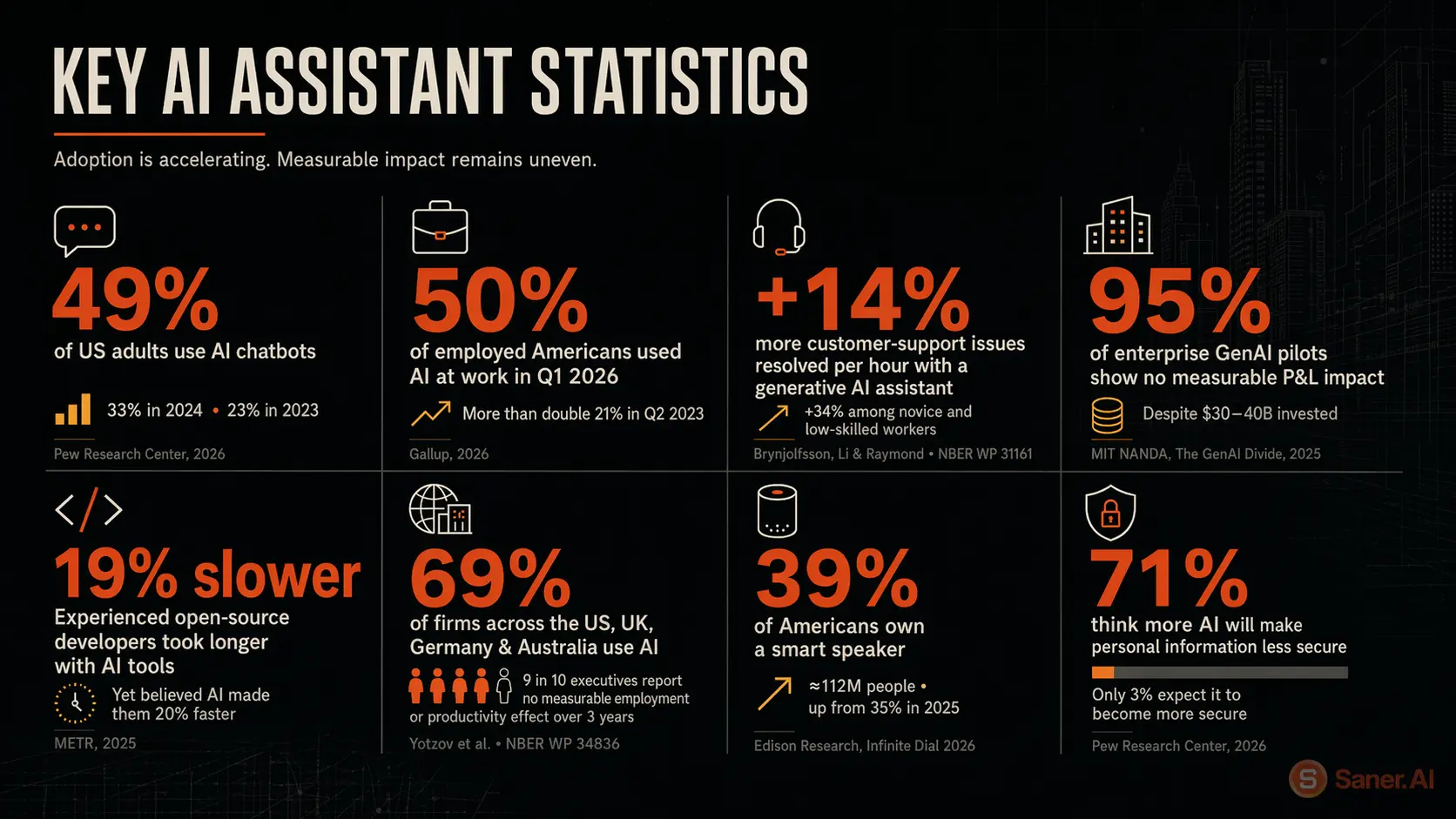
- 49% of US adults now use AI chatbots, up from 33% in 2024 and 23% in 2023 (Pew Research Center, 2026)
- 50% of employed Americans used AI in their job at least a few times in Q1 2026, more than double the 21% recorded in Q2 2023 (Gallup, 2026)
- Customer support agents using a generative AI assistant resolved 14% more issues per hour, with a 34% gain concentrated among novice and low-skilled workers (Brynjolfsson, Li & Raymond, NBER Working Paper 31161)
- 95% of enterprise generative AI pilots show no measurable impact on profit or loss, despite $30–40 billion in combined investment (MIT NANDA, "The GenAI Divide," 2025)
- Experienced open-source developers took 19% longer to complete coding tasks with AI tools — and still believed afterward that AI had made them 20% faster (METR, 2025)
- 69% of US, UK, German and Australian firms now use AI, but nine-in-ten executives report no measurable effect on their firm's employment or productivity over the past three years (Yotzov et al., NBER Working Paper 34836)
- 39% of Americans now own a smart speaker, an estimated 112 million people, up from 35% in 2025 (Edison Research, Infinite Dial 2026)
- 71% of US adults think increased AI use will make their personal information less secure, versus just 3% who expect it to get more secure (Pew Research Center, 2026)
The Statistics Break Down
1) How many people actually use AI assistants?
How many Americans use AI chatbots in 2026?
Just under half of US adults, 49%, now say they use AI chatbots like ChatGPT, Gemini or Copilot, according to Pew Research Center's February 2026 survey of 5,119 adults. That's up from 33% in 2024 and 23% in 2023, meaning adoption has more than doubled in two years. About one-in-four Americans (24%) now use a chatbot daily, including 4% who describe themselves as using one almost constantly.
ChatGPT dominates the field. 44% of US adults report using ChatGPT, more than double the 18% who said so when Pew first asked in 2023. Gemini is a distant second at 24%, followed by Copilot (17%), Meta AI (14%), Grok (8%), Claude (6%), and Character.ai (3%).
How does workplace AI assistant use compare to personal use?
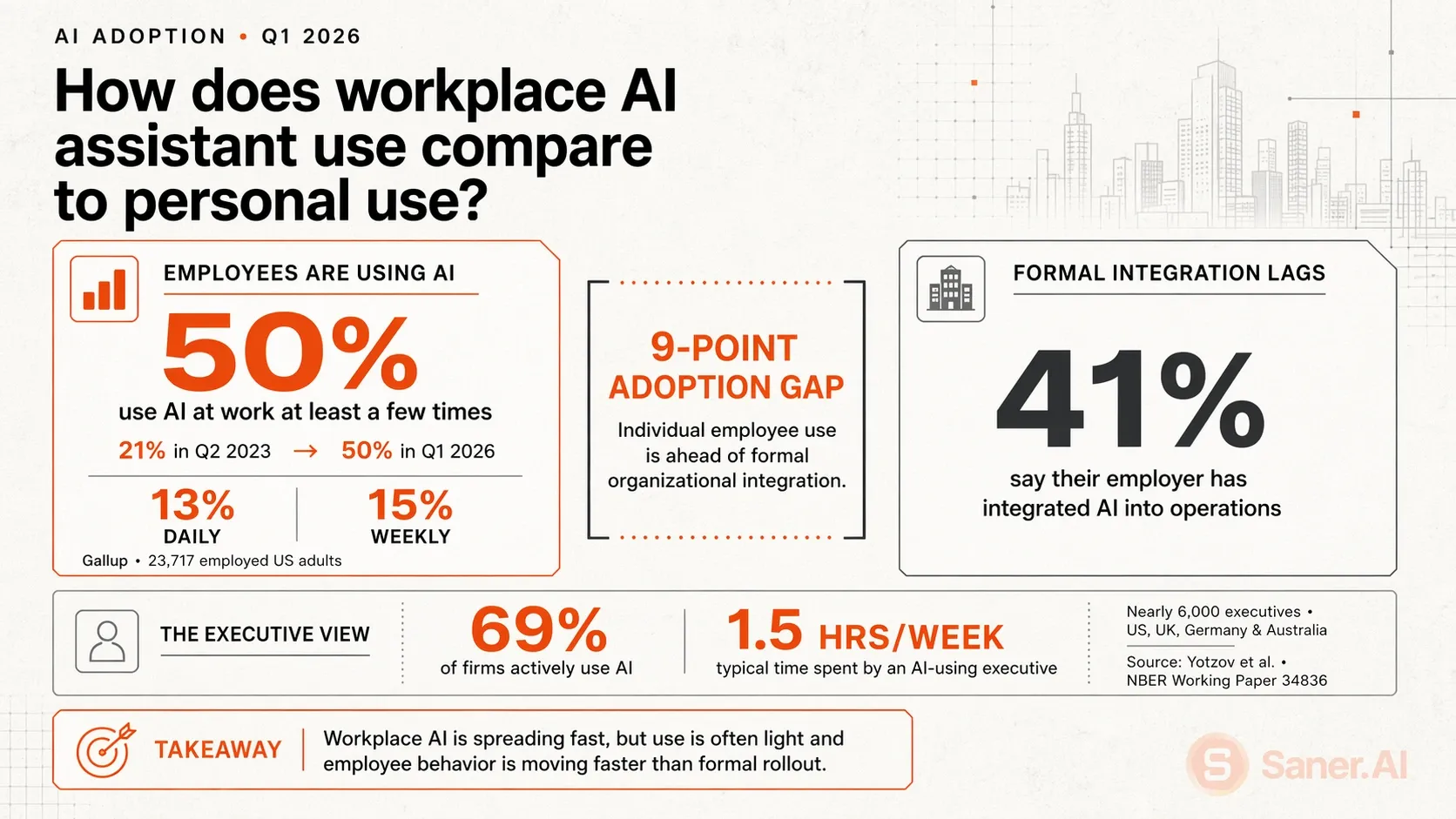
Workplace adoption is tracking a similar curve, measured independently.
- Gallup's quarterly workforce survey of 23,717 employed US adults found that 50% used AI in their job at least a few times in Q1 2026, up from 21% in Q2 2023. Daily use has climbed to 13% of employees, with another 15% using AI weekly. But formal organizational rollout still lags individual behavior: only 41% of employees say their employer has actually integrated AI tools or technology into how the organization operates, a gap that matters for the counterevidence discussed below.
Internationally, the picture is more conservative.
- A representative, multi-country survey of nearly 6,000 executives found that 69% of firms in the US, UK, Germany and Australia now actively use AI, though usage remains light: the typical AI-using executive spends only about 1.5 hours a week with these tools (Yotzov et al., NBER Working Paper 34836).
Do voice assistants still matter, or has the story moved to chatbots?
Smart speakers have stopped growing the way they did in the 2017–2020 boom, but they haven't disappeared.
- Edison Research's Infinite Dial 2026 study, a nationally representative survey of 2,050 Americans aged 12 and up, put smart speaker ownership at 39% (an estimated 112 million people), up from 35% the year before.
- Pew's separate February 2026 survey measured the same category slightly differently and landed at 35%. The two don't fully agree, which is common for device-ownership questions with different wording, but both confirm smart speakers now sit with roughly a third to two-fifths of the country.
The same Edison survey found generative AI awareness has essentially saturated the population: 93% of Americans are aware of at least one generative AI brand.
2) What are people using AI assistants for?
What do people actually ask AI chatbots to do?
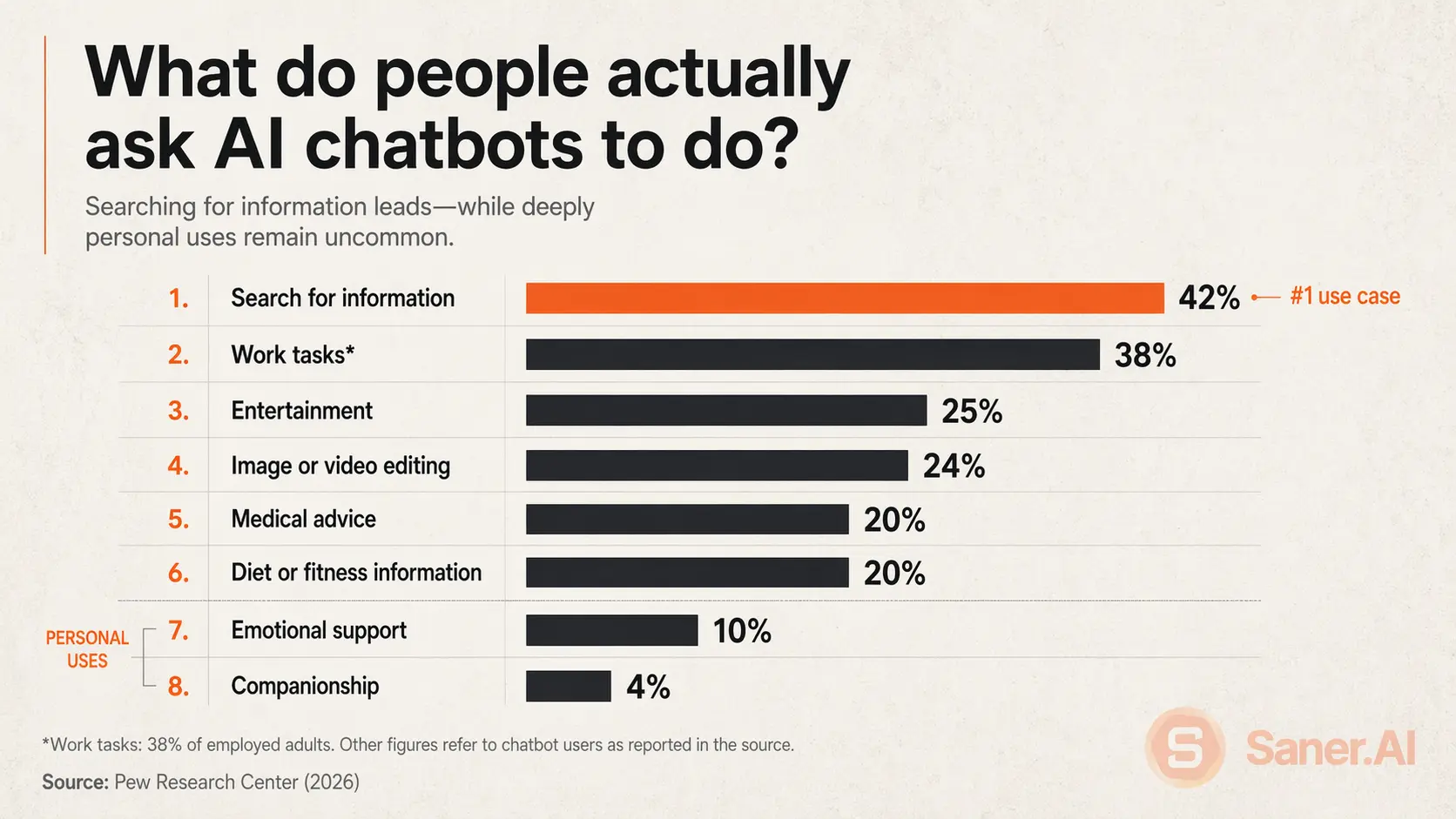
Search and work dominate.
- Pew found that 42% of US adults use chatbots to search for information, making it the single most common use case, ahead of work tasks (38% of employed adults), entertainment (25%), and image or video editing (24%).
- Getting medical advice and diet or fitness information each draw 20% of users.
- More personal uses remain a minority behavior: 10% use chatbots for emotional support and 4% for companionship (Pew Research Center, 2026).
What tasks are AI assistants actually replacing at work?
Gallup's data adds texture here: among employees whose organizations have adopted AI, 65% say it has improved their productivity and efficiency, regardless of how often they personally use it.
But the gains concentrate in specific, bounded tasks, drafting written content, summarizing information, generating ideas, rather than in redesigning how work gets done.
Only about one in ten employees strongly agree that AI has transformed how work happens in their organization. Leaders report bigger personal gains than individual contributors: 21% of leaders call AI's impact on their productivity "extremely positive," compared with 13% of individual contributors (Gallup, 2026).
3) Do AI assistants actually make people more productive?
What does the best evidence say about AI and productivity?
The most rigorous evidence comes from a randomized rollout of a generative AI-based conversational assistant across 5,179 customer support agents at a Fortune 500 company. Brynjolfsson, Li and Raymond found that access to the tool increased the number of issues resolved per hour by 14% on average.
The gains were not evenly spread: novice and low-skilled agents improved by roughly 34%, while the most experienced and highest-skilled agents saw minimal change.
The researchers argue the tool works by disseminating the tacit knowledge of top performers to everyone else, effectively letting a two-month agent perform like a six-month one. AI assistance also cut customer requests to escalate to a manager by nearly 25%.
A parallel body of evidence exists for coding assistants. In a peer-reviewed set of three field experiments spanning 4,867 developers at Microsoft, Accenture, and an anonymous Fortune 100 electronics manufacturer, developers given GitHub Copilot completed roughly 26% more pull requests per week than a control group (Cui et al., published in Management Science, reported via GitHub's research blog).
Worth flagging: this research was co-run by GitHub, Copilot's maker, alongside independent academic economists, and appears in a peer-reviewed journal rather than a vendor white paper. As with the customer-support study, the gains were not uniform, they were concentrated among developers with shorter tenure, while senior developers already familiar with their codebase showed little measurable speed-up.
Does self-reported productivity match measured productivity?
Not always, and the gap itself is one of the more useful findings in this dataset. Gallup's survey is self-report: employees say AI helps. The customer-support and coding-assistant studies above measured actual output. Where independent researchers have directly compared self-report to measurement in the same study, the picture gets more complicated. That comparison is the subject of the next section.
4) Where AI assistants over- and underperform, by the numbers
| Setting | Who benefits | Measured effect | Source |
|---|---|---|---|
| Customer support (conversational AI assistant) | Novice/low-skilled agents | +34% issues resolved/hour | Brynjolfsson, Li & Raymond, NBER |
| Customer support (same study) | Experienced/high-skilled agents | Minimal measured change | Brynjolfsson, Li & Raymond, NBER |
| Enterprise coding (GitHub Copilot) | Shorter-tenure developers | +26% average, concentrated here | Cui et al., Management Science |
| Enterprise coding (same study) | Senior/tenured developers | Little to no measurable speed-up | Cui et al., Management Science |
| Open-source coding (own repos, RCT) | Highly experienced maintainers | –19% (slower with AI tools) | METR, 2025 |
| Enterprise GenAI pilots (broad, cross-industry) | Organizations overall | 95% show no measurable P&L impact | MIT NANDA, 2025 |
| Firm-level, multi-country | Firms overall (executive report) | 90% report no employment/productivity effect in 3 years | Yotzov et al., NBER |
The pattern across every rigorously measured study is the same: the less experience someone has with a task, the more a generative AI assistant tends to help them. The more expertise someone already has, the closer the measured effect gets to zero, or in the case of the METR study, the more likely it flips negative.
5) When do AI assistants fail or backfire?
Does AI investment at the enterprise level actually pay off?
The starkest counterevidence comes from MIT's Project NANDA, which combined 52 structured interviews, 153 senior-leader survey responses, and a review of more than 300 publicly disclosed AI initiatives.
The headline finding: despite $30–40 billion in enterprise generative AI spending, 95% of organizations report zero measurable return on their pilots. Only 5% of integrated AI pilots are extracting significant, measurable value (MIT NANDA, "The GenAI Divide: State of AI in Business 2025").
The report's own explanation isn't that the models are too weak, it's that most deployed tools lack memory and don't adapt to a specific team's actual workflow, so they stall exactly where customization would matter most. Tellingly, the same report found that over 90% of surveyed employees use personal, unsanctioned AI tools for work even though only 40% of their employers have an official subscription, a "shadow AI economy" that the report says often outperforms the formal, IT-procured deployment sitting unused next to it.
A separate, independent multi-country study reaches a compatible conclusion from the executive side: nine-in-ten surveyed executives report no measurable impact on their firm's employment or productivity from AI over the past three years, even though most of their firms have adopted some form of it (Yotzov et al., NBER Working Paper 34836).
Can AI coding assistants actually slow experienced people down?
Yes, and this is the most-replicated counterintuitive finding in the dataset. METR ran a randomized controlled trial with 16 experienced open-source developers working in their own repositories (averaging over 22,000 GitHub stars and a million lines of code). Tasks were randomly assigned to allow or prohibit AI tool use. The result: developers took 19% longer to complete tasks when using AI tools than when they didn't. Before starting, they predicted AI would make them 24% faster. Afterward, despite the measured slowdown, they still believed AI had made them 20% faster (METR, 2025). METR is explicit that this doesn't generalize to every developer or every setting, it's a snapshot of experienced maintainers on their own complex codebases with early-2025 tools, and the enterprise-scale Copilot studies above found real gains for less-tenured developers in the same period. The reconciling variable across both studies is the same: prior task-specific expertise. AI assistants tend to compress the gap between novices and experts; they don't reliably extend an expert's ceiling, and for some experienced users the overhead of prompting, reviewing and correcting outweighs the time saved.
Is there a cognitive cost to relying on AI assistants?
A peer-reviewed 2025 study is the strongest evidence yet on this question. Michael Gerlich surveyed and interviewed 666 participants across age groups and education levels, measuring AI tool usage, cognitive offloading habits, and standardized critical-thinking performance. The study found a significant negative correlation between frequent AI tool usage and critical-thinking scores, mediated by cognitive offloading, and that younger participants showed both higher AI dependence and lower critical-thinking scores than older participants (Gerlich, Societies, 2025).
This doesn't mean AI use causes cognitive decline in any individual; the study is correlational, not causal, but it's a direct counterweight to the productivity-only framing that dominates most AI assistant coverage, and it echoes public sentiment: only 21% of Pew's respondents say chatbots help their creativity, while 11% say chatbots actively hurt it.
6) What these statistics mean for knowledge workers
Adoption has outrun trust, and both are true at once.
- Nearly half of US adults use AI chatbots and half of employed Americans use AI at work, yet 71% expect AI to make their personal data less secure and 63% think the technology is advancing too fast. People are adopting these tools while remaining skeptical of them, which suggests utility, not hype, is now the primary driver of use.
The productivity story is real but narrow, and it runs backward from where the marketing points.
- The clearest, most rigorously measured gains sit with novices and generalists: a two-month customer support agent performing like a six-month one, a junior developer closing the gap with a senior one. The clearest failures and slowdowns sit with specialists working in their own domain of deep expertise.
- That's a very different picture from "AI makes everyone better," and it has a practical implication: a generic, one-size-fits-all AI assistant bolted onto an existing workflow is exactly the pattern MIT NANDA found stalling in 95% of enterprise pilots.
- What worked in the studies above (the customer-support tool, the Copilot rollouts) was AI embedded in context, matched to a specific, repeatable task, with enough adaptation to reflect how that particular team actually works.
- That's the same gap our AI at work statistics roundup explored from the organizational side, and it's the reason purpose-built assistants that learn a person's actual planning patterns, rather than generic chat interfaces bolted onto unrelated software, are where the shadow-AI advantage MIT documented tends to show up for individual knowledge workers.
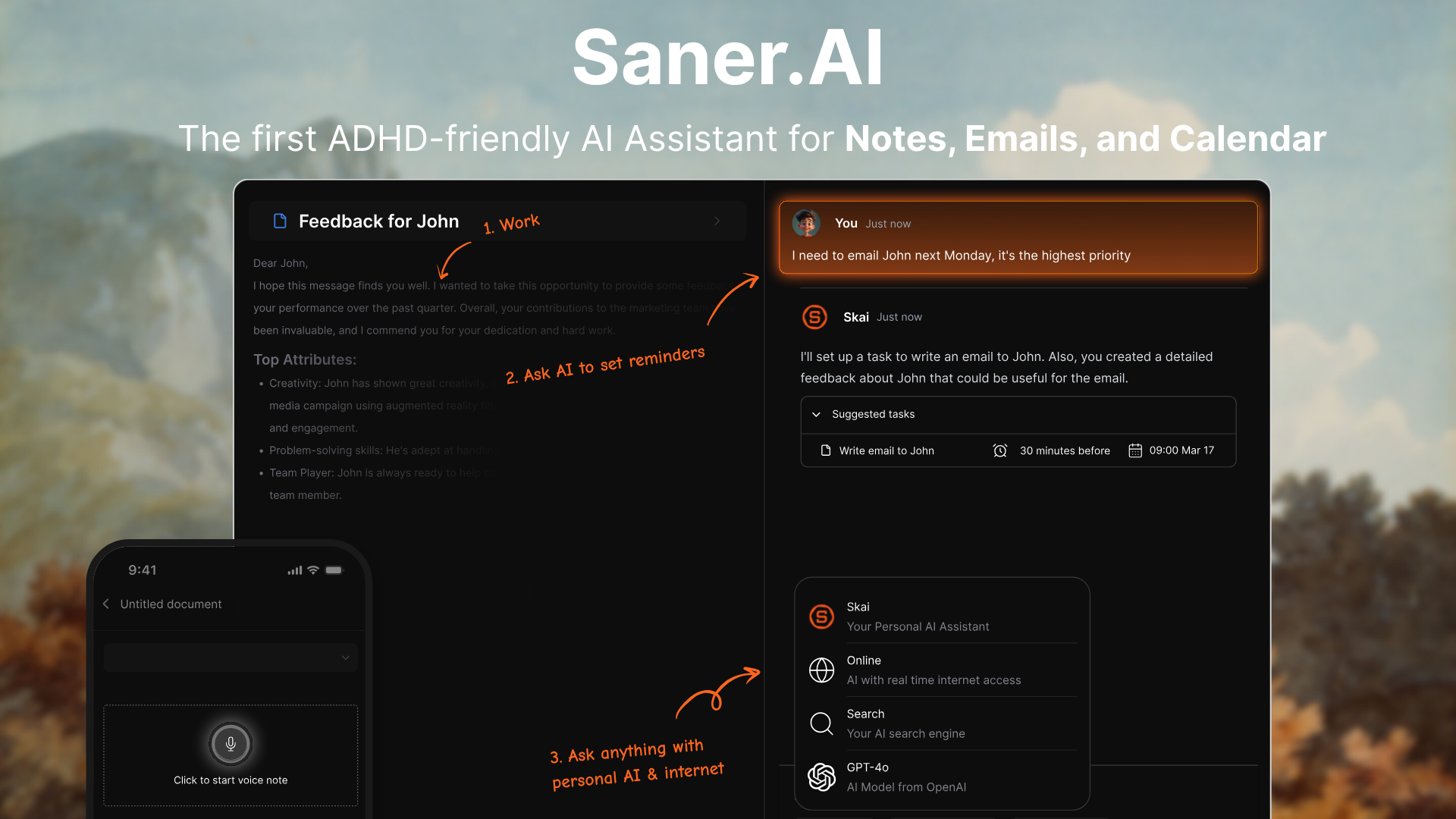
Tools like Saner.AI are built around that same principle: adapting to how one person actually plans and works, rather than asking the person to adapt to a static, generic assistant.
Stay on top of your work and life
The cognitive cost is under-discussed relative to the productivity gains. Gerlich's finding on cognitive offloading, paired with Pew's data showing only about one-in-five Americans think chatbots help their creativity, suggests the tradeoff isn't purely time-for-nothing.
Anyone integrating an AI assistant into daily work should weigh which tasks benefit from delegation (routine drafting, summarizing, first-pass research) against which tasks benefit from the friction of doing them yourself (judgment calls, creative synthesis, anything where the reasoning matters as much as the output).
Quotable AI assistant statistics
- According to Pew Research Center's February 2026 survey, 49% of US adults now use AI chatbots, up from 33% in 2024. (Pew Research Center)
- Gallup's Q1 2026 workforce survey found that 50% of employed Americans used AI in their job, more than double the 21% recorded in Q2 2023. (Gallup)
- A 2023 NBER field study of 5,179 customer support agents found generative AI assistance increased productivity by 14% on average, rising to 34% for novice workers. (NBER Working Paper 31161)
- MIT's Project NANDA found that 95% of enterprise generative AI pilots in 2025 showed no measurable impact on profit or loss, despite $30–40 billion in investment. (MIT NANDA, 2025)
- A 2025 METR randomized controlled trial found experienced open-source developers were 19% slower when using AI coding tools, despite believing afterward they had been 20% faster. (METR, 2025)
- A peer-reviewed field study of three RCTs covering 4,867 developers found GitHub Copilot users completed about 26% more pull requests per week, with gains concentrated among shorter-tenure developers. (Cui et al., Management Science, via GitHub Research)
- A 2026 multi-country NBER survey of nearly 6,000 executives found that while 69% of firms use AI, nine-in-ten executives report no measurable effect on employment or productivity over the past three years. (Yotzov et al., NBER Working Paper 34836)
- Edison Research's Infinite Dial 2026 study found 39% of Americans, an estimated 112 million people, now own a smart speaker. (Edison Research, Infinite Dial 2026)
- A peer-reviewed 2025 study of 666 participants found a significant negative correlation between frequent AI tool usage and critical-thinking scores, mediated by cognitive offloading. (Gerlich, Societies 2025)
FAQ
1. How many people use AI assistants in 2026?
About 49% of US adults use AI chatbots as of Pew's February 2026 survey, and 50% of employed Americans used some form of AI in their job during Q1 2026, according to Gallup. Both figures have roughly doubled since 2023.
2. Which AI assistant is most popular?
ChatGPT, by a wide margin. Pew found 44% of US adults report using it, compared with 24% for Gemini, 17% for Copilot, and single digits for Grok, Claude and Character.ai (Pew Research Center, 2026).
3. Do AI assistants actually make workers more productive?
It depends heavily on prior expertise. Novice and low-skilled workers show the largest, most consistently measured gains, up to 34% in one large customer-support study. Highly experienced specialists often show minimal gains, and in at least one rigorous study of coding assistants, measurably worse performance despite feeling faster (Brynjolfsson, Li & Raymond; METR, 2025).
4. Why do so many enterprise AI pilots fail to show ROI?
MIT's Project NANDA found that 95% of enterprise generative AI pilots showed no measurable P&L impact, and attributes this largely to generic tools that don't adapt to a specific team's workflow or retain context over time, rather than to model quality itself (MIT NANDA, 2025).
5. Can using AI assistants hurt critical thinking?
A peer-reviewed 2025 study of 666 participants found a significant negative correlation between frequent AI tool usage and critical-thinking performance, mediated by cognitive offloading, with the effect more pronounced in younger participants. The study is correlational, not causal, but it's a notable counterweight to purely productivity-framed AI coverage (Gerlich, Societies 2025).
7. How common are voice assistants and smart speakers in 2026?
Roughly 35–39% of Americans own a smart speaker, depending on which primary tracker you use (Pew: 35%, Edison Research: 39%), representing well over 100 million people. Ownership has been essentially flat for the past several years after a rapid climb from 2017–2020 (Edison Research, Infinite Dial 2026).
8. Do people trust AI assistants?
Not fully, even as they use them. 71% of US adults think increased AI use will make their personal information less secure, 63% think AI is advancing too quickly, and 67% have little to no confidence in the US government's ability to regulate it effectively (Pew Research Center, 2026).
9. What do people actually use AI chatbots for?
Search is the top use case (42% of US adults), followed by work tasks among employed adults (38%), entertainment (25%), and image or video editing (24%). Emotional support (10%) and companionship (4%) remain minority uses (Pew Research Center, 2026).
Sources
- Pew Research Center. "Americans and AI 2026: Chatbots, Smart Devices and Views on Impact." June 17, 2026. https://www.pewresearch.org/internet/2026/06/17/americans-and-ai-2026-chatbots-smart-devices-and-views-on-impact/
- Gallup. "Rising AI Adoption Spurs Workforce Changes." April 2026 (survey fielded Feb. 4–19, 2026). https://www.gallup.com/workplace/704225/rising-adoption-spurs-workforce-changes.aspx
- Yotzov, I., Barrero, J.M., Bloom, N., et al. "Firm Data on AI." NBER Working Paper No. 34836. February 2026. https://www.nber.org/papers/w34836
- Brynjolfsson, E., Li, D., & Raymond, L.R. "Generative AI at Work." NBER Working Paper No. 31161, April 2023 (revised arXiv version Nov. 2024); published in The Quarterly Journal of Economics, 2025, 140(2), 889–942. https://www.nber.org/papers/w31161
- MIT NANDA (Challapally, A., Pease, C., Raskar, R., & Chari, P.). "The GenAI Divide: State of AI in Business 2025." MIT Media Lab, July 2025. https://nanda.media.mit.edu/ai_report_2025.pdf
- METR (Becker, J., Rush, N., Barnes, E., & Rein, D.). "Measuring the Impact of Early-2025 AI on Experienced Open-Source Developer Productivity." July 2025. https://metr.org/blog/2025-07-10-early-2025-ai-experienced-os-dev-study/
- Cui, K.Z., Demirer, M., Jaffe, S., Musolff, L., Peng, S., & Salz, T. "The Effects of Generative AI on High-Skilled Work: Evidence from Three Field Experiments with Software Developers." Management Science, 2025 (forthcoming). Reported via GitHub's official research blog: https://github.blog/news-insights/research/research-quantifying-github-copilots-impact-in-the-enterprise-with-accenture/
- Gerlich, M. "AI Tools in Society: Impacts on Cognitive Offloading and the Future of Critical Thinking." Societies, 2025, 15(1), 6. https://www.mdpi.com/2075-4698/15/1/6 (correction: Societies, 2025, 15(9), 252)
- Edison Research. "The Infinite Dial 2026." March 2026. https://www.edisonresearch.com/wp-content/uploads/2026/03/The-Infinite-Dial-2026-Presentation.pdf