AI at Work Statistics 2026: Adoption, Productivity Data, and Where It's Not Working


Two things are true about AI at work in 2026, and most coverage only tells you one of them.
- The first: adoption has gone mainstream, and in specific, well-defined tasks, the productivity gains are real and measurable.
- The second: at the level of the whole organization, most of that gain disappears before it shows up on a P&L, and a landmark randomized trial just found that AI made experienced professionals slower, not faster. This isn't a contradiction. It's a pattern - and the data below shows exactly where the line falls.
Important AI at Work Statistics
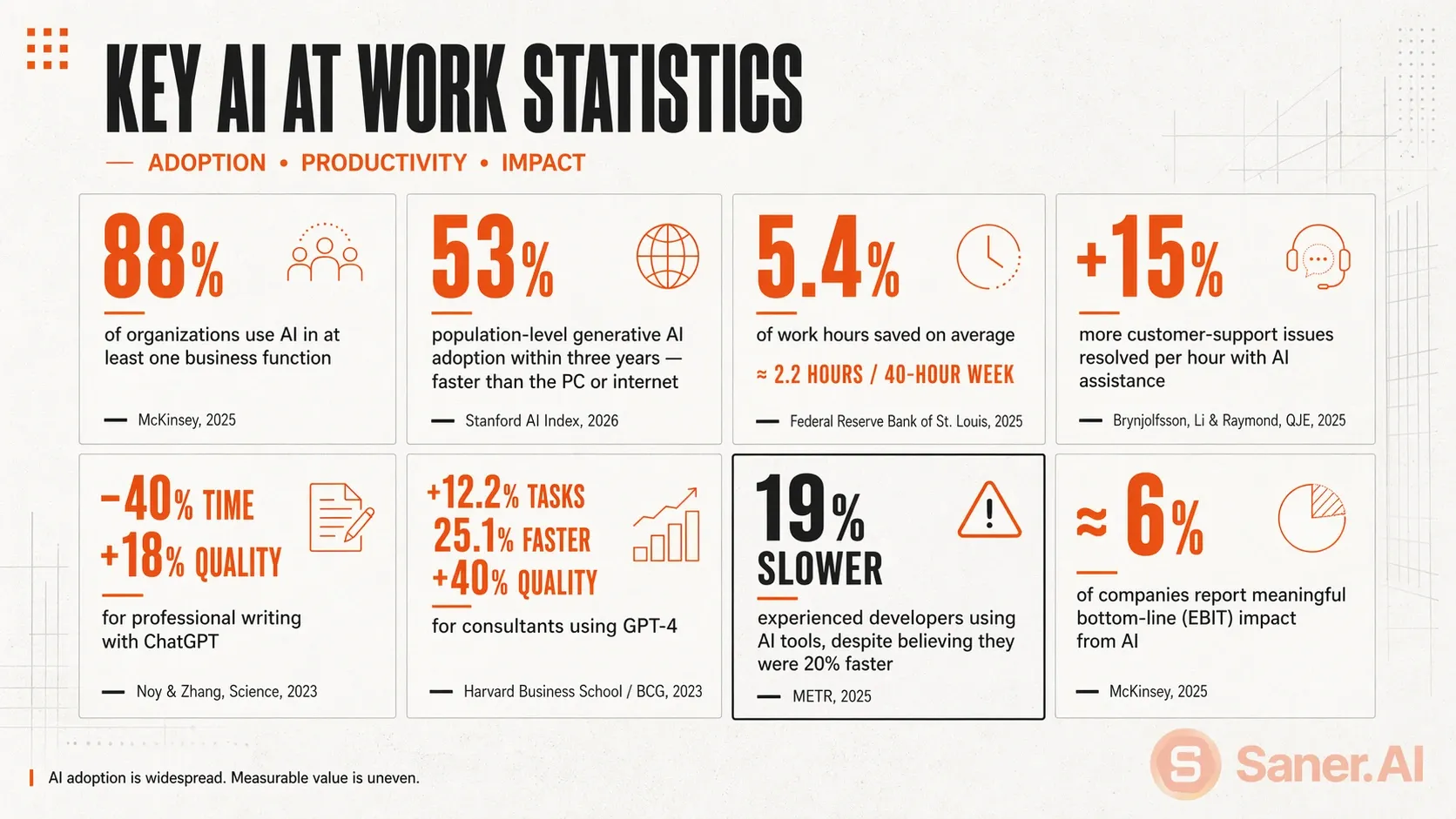
- 88% of organizations now use AI in at least one business function, up sharply from prior years. (Stanford HAI AI Index 2026)
- 89% of executives report AI had no measurable effect on their firm's labor productivity over the past three years, despite nearly seven in ten firms actively using it. (NBER Working Paper 34836)
- 14% average productivity gain for customer support agents using a generative AI assistant — rising to 34% for novice and low-skilled workers, with almost no effect on already-experienced agents. (Brynjolfsson, Li & Raymond, Quarterly Journal of Economics)
- Only 5% of enterprise generative AI pilots reach measurable P&L impact; the other 95% stall. (MIT NANDA, The GenAI Divide, 2025)
- Experienced open-source developers given AI tools completed real coding tasks 19% slower, not faster — reversing what both they and outside experts predicted. (METR, 2025)
- 50% of US employees now use AI at work at least a few times a year, up from 21% in mid-2023. (Gallup, February 2026)
- Inside their skill zone, BCG consultants using AI completed 12.2% more tasks, 25.1% faster, at 40% higher quality — but were 19 percentage points more likely to be wrong on tasks outside that zone. (Dell'Acqua et al., Organization Science, 2026)
- Just 16% of AI users qualify as "Frontier Professionals" who've actually redesigned their workflows around AI — the rest are still bolting it onto old ones. (Microsoft 2026 Work Trend Index)
Table of contents
2. How much productivity does AI actually add?
3. Who's actually winning with AI at work?
4. Does AI at work ever backfire?
5. What's happening to jobs and hiring because of AI?
6. What these statistics mean for the way you work
7. Quotable AI at work statistics
8. FAQ
9. Sources
1. What percentage of companies use AI in 2026?
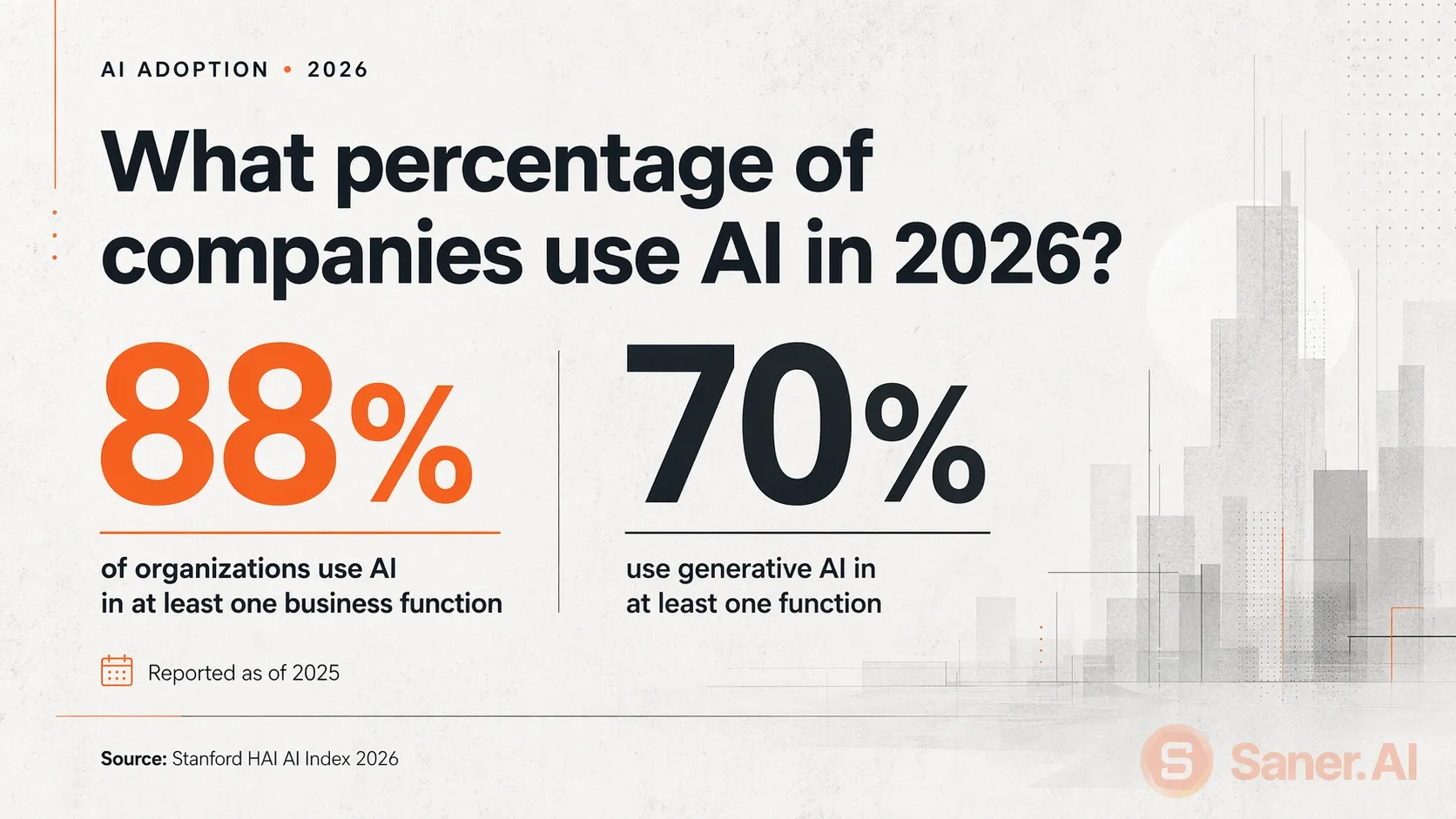
88% of organizations report using AI in at least one business function as of 2025, and 70% use generative AI specifically in at least one function, according to the Stanford HAI AI Index 2026.
That's an adoption curve steeper than anything the personal computer or the internet managed over a comparable stretch: generative AI reached 53% population-level adoption within three years of ChatGPT's launch, faster than either of those prior technologies.
Organizational adoption, notably, has outpaced individual habit formation - most companies have AI live somewhere in the building well before most of their employees use it regularly.
2. How many workers actually use AI on the job?
At the individual level, Gallup's February 2026 survey of nearly 24,000 US employees found that half of employed American adults now use AI in their role at least a few times a year — up from 46% the prior quarter and just 21% in mid-2023.
Frequent use is smaller but climbing fast: 13% use AI daily, and 28% use it daily or a few times a week. Globally, the picture skews even higher in certain markets — Stanford's Index found 58% of surveyed employees worldwide report semi-regular or regular AI use at work, with regular use topping 80% in India, China, Nigeria, the UAE, and Saudi Arabia, compared with 40–48% across most of North America and Europe.
3. Is organizational adoption the same as workflow transformation?
No, and this gap matters more than the headline numbers suggest.
Gallup found that while 41% of employees say their organization has formally integrated AI tools, only about one in ten employees at AI-adopting companies strongly agree that AI has actually transformed how work gets done there. Adoption is a checkbox; transformation is a redesign, and right now, most organizations have done the former without the latter.
4. How much productivity does AI actually add?
How much time does AI save in customer support?
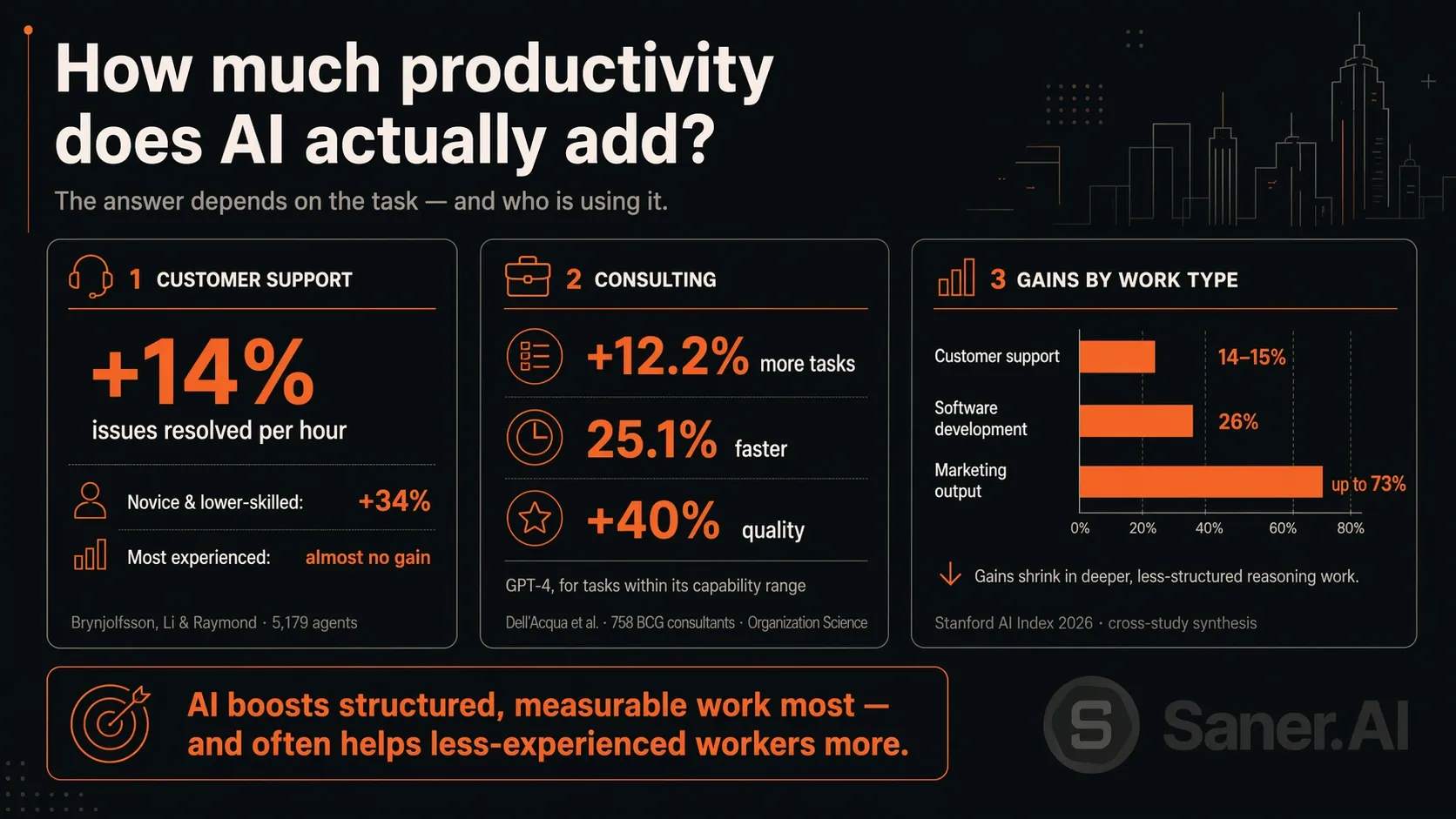
The most rigorous population-level estimate here comes from Brynjolfsson, Li, and Raymond's study, published in the Quarterly Journal of Economics after originating as an NBER working paper. Studying the staggered rollout of a generative AI assistant across 5,179 customer support agents, they found productivity — measured as issues resolved per hour — rose 14% on average.
That gain wasn't evenly spread: novice and lower-skilled agents improved by 34%, while the most experienced, highest-skilled agents saw almost no benefit at all. The tool functioned less like a universal booster and more like a fast-track to the performance level of your best people.
Does AI make knowledge workers faster and better, or just faster?
Dell'Acqua and colleagues' field experiment with 758 BCG consultants — now formally published in Organization Science after its influential 2023 debut as a working paper — found consultants using GPT-4 on tasks within its capability range completed 12.2% more tasks, finished 25.1% faster, and produced work rated 40% higher in quality than consultants working without it. That's a genuine triple win: more output, faster, better. The catch, covered in the counterevidence section below, is that this only held inside a specific zone of task difficulty.
Which functions see the biggest gains, and which see the smallest?
Stanford's 2026 Index aggregates results across studies and finds the size of the productivity gain tracks closely with how structured and measurable the work is. Reported gains run 14–15% in customer support, 26% in software development, and as high as 73% in marketing output — while gains shrink substantially in work that requires deeper, less-structured reasoning.
The pattern: AI adds the most value where the task has a clear right answer and an easy way to check it, and the least where judgment calls dominate.
7. Comparison: reported AI productivity effects by study and setting
| Study | Setting | Method | Reported effect |
|---|---|---|---|
| Brynjolfsson, Li & Raymond (QJE) | Customer support (5,179 agents) | Staggered rollout, field data | +14% average (+34% for novices) |
| Stanford AI Index 2026 | Software development | Aggregated study estimates | +26% |
| Stanford AI Index 2026 | Marketing output | Aggregated study estimates | +73% |
| Dell'Acqua et al. (Organization Science) | Management consulting, inside AI's capability zone | Preregistered field experiment, 758 consultants | +12.2% tasks, +25.1% speed, +40% quality |
| Dell'Acqua et al. (Organization Science) | Management consulting, outside AI's capability zone | Same experiment | −19 points accuracy |
| METR (2025) | Experienced open-source developers, mature codebases | Randomized controlled trial, real tasks | −19% (slower with AI) |
| NBER Working Paper 34836 | Firm-wide, self-reported by executives | Survey, ~6,000 executives, 4 countries | 89% report no effect |
The spread across this table is the story: the same underlying technology produces double-digit gains in one setting and measurable losses in another, largely depending on how well-scoped the task is and how experienced the human already is at it.
8. Who's actually winning with AI at work?
Do beginners or experts benefit more from AI?
The evidence consistently points to beginners.
Beyond the 34%-vs-near-zero split in customer support noted above, Microsoft's 2026 Work Trend Index — based on a survey of 20,000 knowledge workers across 10 countries, fielded by Edelman Data x Intelligence, alongside an analysis of Microsoft 365 Copilot telemetry (worth noting: this is Microsoft-funded research about its own Copilot product, flagged here for transparency) — found that AI compresses skill gaps rather than widening them for most routine work. The exception is highly familiar, expert-level work, where the METR findings below suggest AI can actively get in the way.
What separates power users from everyone else?
Microsoft's data identifies a group it calls "Frontier Professionals": workers who use AI agents for multi-step workflows, routinely redesign their processes around what AI does well, and participate in shared team standards for AI use. They're just 16% of AI users surveyed, but the gap between them and everyone else is stark. 80% of Frontier Professionals say they're producing work they couldn't have a year ago, versus 58% of AI users overall. They're also more disciplined about it: 43% deliberately do some work without AI to keep their own skills sharp (versus 30% of others), and 53% pause before starting a task to decide whether AI or a human should do it (versus 33%). The differentiator isn't tool access — it's a repeatable system for deciding when and how to use it.
Do leaders or individual contributors get more value from AI?
Leaders report meaningfully stronger results. Gallup found about seven in ten leaders who use AI say it's made them more efficient, compared with just over half of individual contributors. Microsoft's data shows a similar leadership skew and adds a structural reason for it: organizational factors — culture, manager support, and talent practices — account for more than twice the measured impact of individual mindset and effort (67% vs. 32%). Leaders are usually the ones setting those organizational conditions, which may explain why they also benefit most from them.
9. Does AI at work ever backfire?
A credible statistics post has to give the same rigor to the evidence that complicates the story, and on this topic, that evidence is unusually strong and unusually recent.
Can AI make experienced workers slower instead of faster?
Yes — and this is the most surprising finding in the current research. METR's 2025 randomized controlled trial recruited 16 experienced open-source developers (averaging five years and 1,500 commits on their own repositories) and randomly assigned 246 real coding tasks to either allow or disallow AI tools. The developers forecast AI would cut their completion time by 24%; after finishing, they still believed it had sped them up by 20%.
The measured result: tasks took 19% longer with AI allowed. Screen-recording analysis found developers spent less time actively coding and more time prompting, waiting on, and reviewing AI output — and accepted fewer than 44% of the AI's suggested changes. The researchers are careful to note this doesn't generalize to all software work; it's concentrated in large, mature codebases where developers already have deep tacit knowledge AI can't access.
Why do most enterprise AI pilots fail to show a return?
MIT NANDA's State of AI in Business 2025 report, based on interviews with business leaders, a survey of employees, and analysis of 300 public AI deployments, found that only 5% of enterprise generative AI pilots reach measurable P&L impact. The top barrier isn't model quality — it's that most enterprise tools don't retain feedback, adapt to context, or improve with use, so they never move past the pilot stage.
Tellingly, the report also documents a "shadow AI economy": more than 90% of surveyed workers use personal AI tools for job tasks even when their employer hasn't sanctioned any, often getting more value from those unofficial tools than from official ones.
Do executives see AI moving their productivity numbers at all?
Mostly, no — at least not yet. A 2026 NBER working paper surveying nearly 6,000 CFOs, CEOs, and senior executives across the US, UK, Germany, and Australia found that while 69% of firms actively use AI, 89% of executives report no measurable impact on labor productivity (sales per employee) over the past three years, and more than 90% report no impact on employment. Even executives who use AI themselves spend only about 1.5 hours a week with it. The same executives, though, are far more optimistic looking forward: they forecast AI will lift firm productivity by 1.4% and cut employment by 0.7% over the next three years — a pattern the researchers note echoes economist Robert Solow's famous 1980s observation that "you can see the computer age everywhere except in the productivity statistics."
How do these negative findings fit with the positive ones above?
The reconciling thread is the "jagged frontier" itself. Dell'Acqua's team didn't just find that AI helps — they found it helps sharply inside a boundary and actively hurts just outside it, and that boundary doesn't track with how difficult a task looks to a human. Layer that onto METR's finding that AI hurts most on tasks where a worker already has deep tacit expertise, and NANDA's finding that most enterprise tools can't adapt to context, and a consistent shape emerges: AI adds real value on structured, checkable, unfamiliar-to-the-worker tasks, and destroys value on tacit, judgment-heavy, already-mastered ones — and most organizations aren't yet sorting their AI rollouts by that distinction.
10. What's happening to jobs and hiring because of AI?
Is AI actually reducing headcount yet?
Modestly, and unevenly. Stanford's Index found employment for software developers aged 22–25 has fallen nearly 20% since 2024 — concentrated specifically among the youngest, least-experienced cohort, the same group other research shows benefits most from AI assistance in isolated tasks but has the least tacit expertise to fall back on when it doesn't.
More broadly, one-third of organizations surveyed expect AI to reduce their workforce in the coming year, even though Stanford notes large-scale job losses haven't yet shown up in aggregate employment data. Gallup's data adds nuance: employees at AI-adopting organizations report both more hiring (34% vs. 28% at non-adopting firms) and more workforce reduction (23% vs. 16%) — AI-adopting companies look more dynamic in both directions, not uniformly smaller.
What do employees expect AI will do to their jobs?
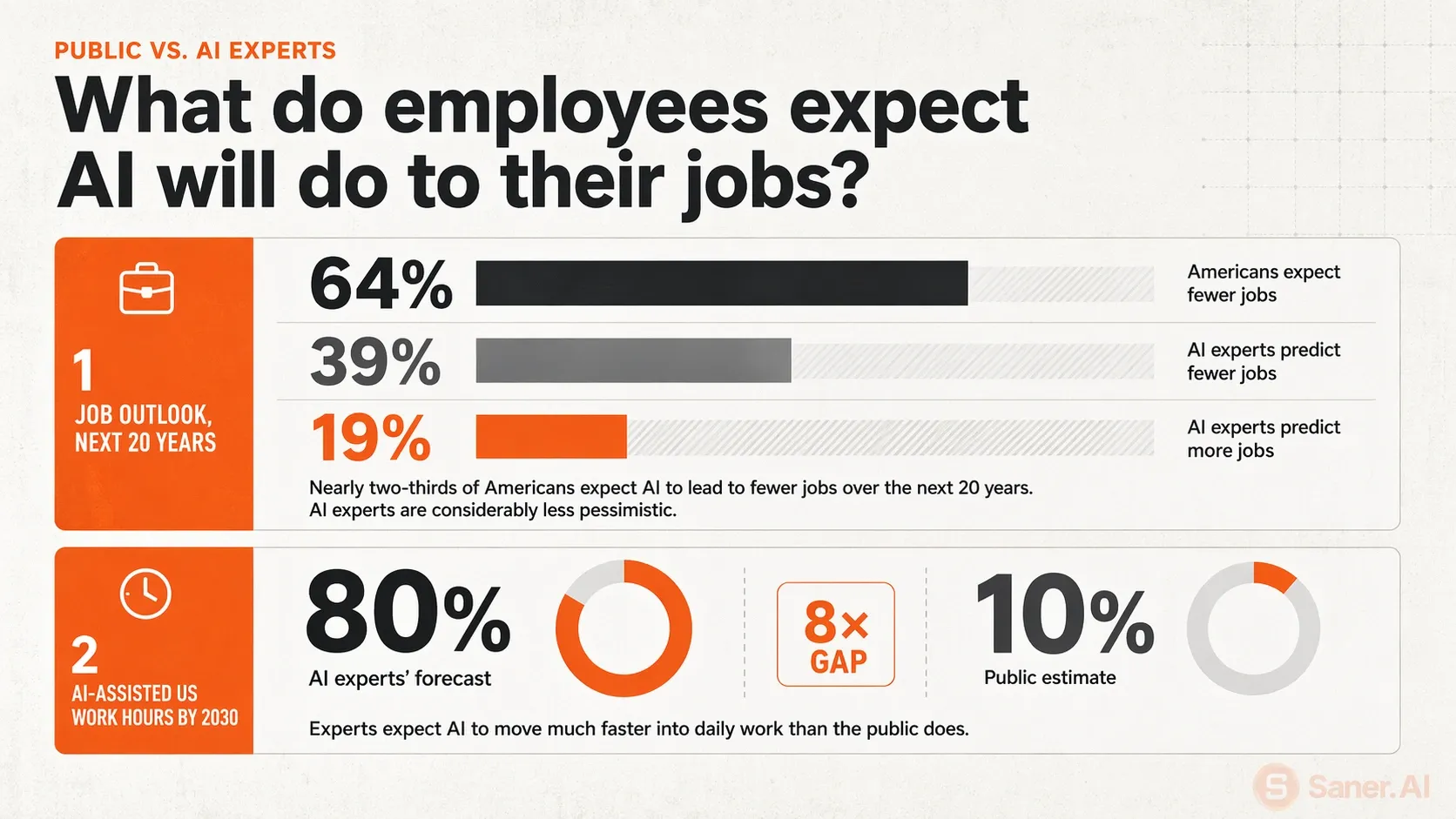
There's a wide gap between expert and public sentiment. Nearly two-thirds of Americans (64%) expect AI to lead to fewer jobs over the next 20 years, while AI experts are considerably less pessimistic — 39% predict fewer jobs, 19% predict more. Experts also expect AI to move much faster into daily work than the public does: they forecast AI will assist with 80% of US work hours by 2030, versus the public's own estimate of just 10%.
Conclusion: What these statistics mean for the way you work
The individual productivity story is real, but it's concentrated and conditional. Across every credible study here, the gain shows up reliably in structured, checkable work — customer support tickets, marketing drafts, code inside a task's comfort zone — and shrinks or reverses in judgment-heavy or highly familiar work.
Treating "AI at work" as a single monolithic effect, positive or negative, misreads nearly every study in this post.
The gap between individual and organizational results is a workflow problem, not a capability problem. Microsoft's finding that organizational factors carry twice the weight of individual effort, and MIT NANDA's finding that brittle, context-blind tools are the top reason pilots stall, point to the same root cause: most AI deployments hand someone a chat window and call it done, instead of building the repeatable system — the intake, the review step, the memory of what worked last time — that turns a one-off AI interaction into a compounding habit.
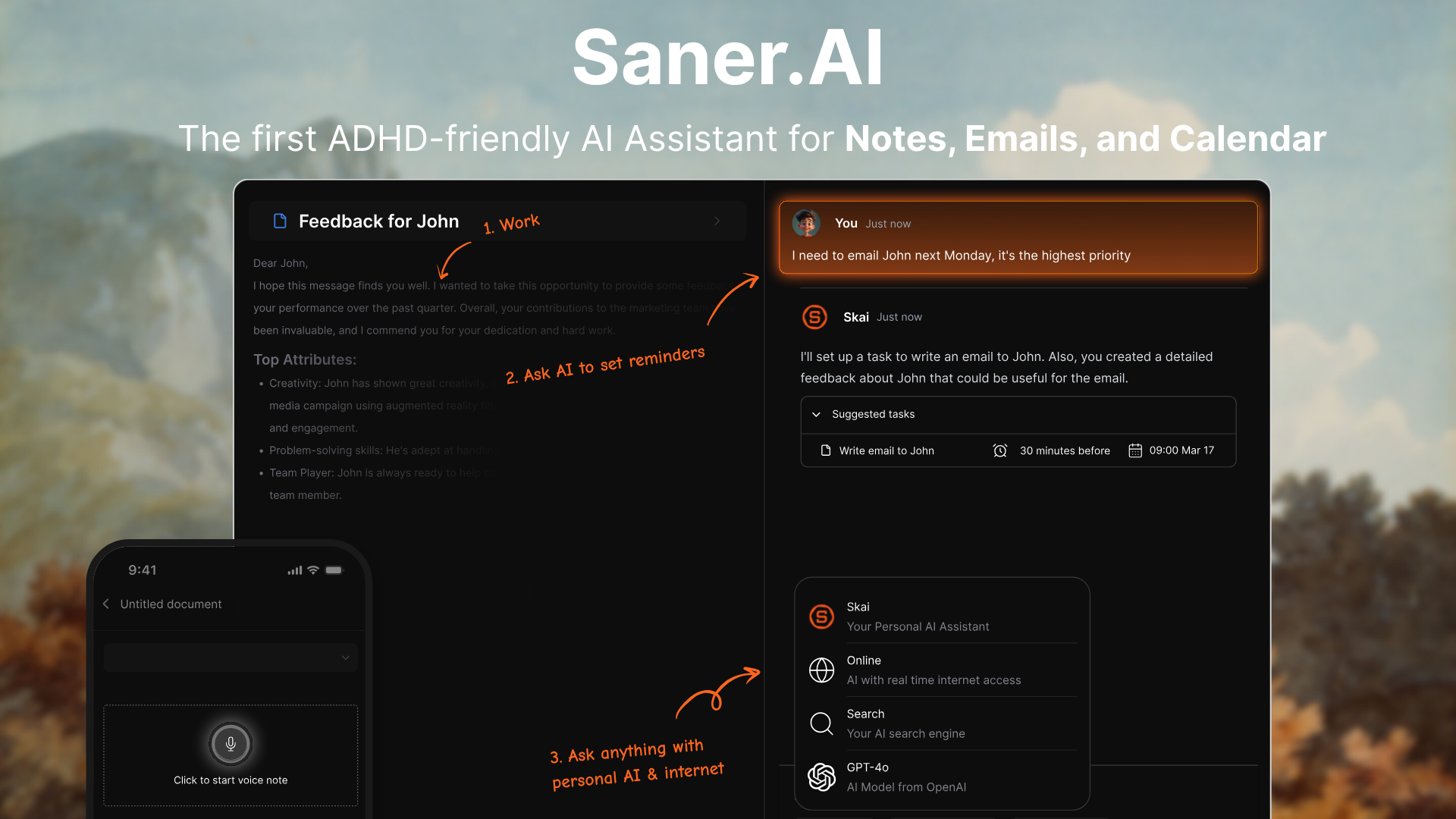
That's exactly the distinction that separates Microsoft's 16% of "Frontier Professionals" from everyone else: not better prompts, but a structure around when and how AI gets used. It's the same principle behind why a dedicated AI workspace built around memory and task context — like Saner.AI — tends to outperform a generic chat tab for people trying to make AI use stick day over day, rather than reset from zero each time.
The organizations and workers pulling ahead are the ones sorting tasks by the frontier, not by enthusiasm. The jagged-frontier research and the METR slowdown study both point to the same discipline: knowing when not to reach for AI is now as valuable a skill as knowing when to reach for it. The 5% of enterprise pilots that work, and the 16% of workers seeing outsized gains, share a habit of testing that boundary deliberately rather than assuming more AI use is automatically better use.
Stay on top of your work and life
👉 If you like this post, you may like our post about AI productivity statistics
Quotable AI at work statistics
Single-sentence, self-contained versions for citation:
- According to the Stanford HAI AI Index 2026, 88% of organizations now use AI in at least one business function. (Stanford HAI)
- A 2026 NBER survey of nearly 6,000 executives across four countries found 89% report no measurable impact of AI on their firm's labor productivity over the past three years. (NBER Working Paper 34836)
- Brynjolfsson, Li, and Raymond's field study of 5,179 customer support agents, published in the Quarterly Journal of Economics, found AI access raised productivity by 14% on average and 34% for novice workers. (NBER/QJE)
- MIT NANDA's 2025 State of AI in Business report found only 5% of enterprise generative AI pilots achieve measurable P&L impact. (MIT NANDA)
- A 2025 METR randomized controlled trial found experienced open-source developers completed real coding tasks 19% slower when allowed to use AI tools, despite believing AI had sped them up. (METR)
- Gallup's February 2026 survey of nearly 24,000 US employees found 50% now use AI at work at least a few times a year, up from 21% in mid-2023. (Gallup)
- Dell'Acqua et al.'s field experiment, published in Organization Science in 2026, found BCG consultants using AI within its capability range completed 12.2% more tasks, 25.1% faster, at 40% higher quality — but were 19 percentage points more likely to be wrong on tasks outside that range. (Organization Science)
- Microsoft's 2026 Work Trend Index, surveying 20,000 knowledge workers across 10 countries, found only 16% of AI users qualify as "Frontier Professionals" who have redesigned their workflows around AI. (Microsoft WorkLab)
- Stanford's AI Index 2026 reports employment for software developers aged 22–25 has fallen nearly 20% since 2024. (Stanford HAI)
FAQ
1. Does AI actually make workers more productive?
It depends heavily on the task. Structured, checkable work like customer support and marketing drafting shows consistent double-digit gains — 14% and up, per NBER/QJE and Stanford's AI Index — while tacit, expert-level, or highly familiar work can see AI reduce productivity, as METR's 2025 RCT found for experienced developers.
2. What percentage of companies use AI in 2026?
88% of organizations use AI in at least one business function, and 70% use generative AI specifically, according to the Stanford HAI AI Index 2026. A separate 2026 NBER survey put active firm-level AI use at 69% across the US, UK, Germany, and Australia. (NBER)
3. Why do most AI pilots fail to show a return?
MIT NANDA's research points to a lack of adaptability: most enterprise tools can't retain feedback, learn from context, or adjust to a specific workflow, so they stall in the pilot phase. Only 5% of pilots reach measurable P&L impact. (MIT NANDA)
4. Who benefits more from AI at work, beginners or experts?
Beginners and less-experienced workers see substantially larger gains. In customer support, novice agents improved 34% versus near-zero for experienced agents. (NBER/QJE) Experienced workers with deep tacit knowledge of their own domain can see AI slow them down instead. (METR)
5. Can AI make workers slower instead of faster?
Yes. METR's 2025 randomized controlled trial found experienced open-source developers completed real tasks 19% slower with AI tools allowed, contradicting both their own forecasts and independent expert predictions. (METR)
6. Is AI actually replacing jobs right now?
Large-scale job losses haven't yet appeared in aggregate employment data, per Stanford's AI Index, though employment for the youngest software developers (ages 22–25) has fallen nearly 20% since 2024, and one-third of organizations expect workforce reductions in the coming year. (Stanford HAI)
7. How many employees use AI daily?
13% of US employees use AI daily, and 28% use it daily or a few times a week, according to Gallup's February 2026 survey. (Gallup)
8. What separates the AI users who see the biggest gains from everyone else?
Microsoft's 2026 Work Trend Index identifies "Frontier Professionals" — just 16% of AI users — who deliberately redesign workflows around AI and decide upfront which tasks should go to AI versus a human. They report producing new-to-them work at nearly double the rate of typical AI users (80% vs. 58%). (Microsoft WorkLab)
9. Do executives see AI moving their company's productivity numbers?
Mostly not yet: 89% of executives surveyed in a 2026 NBER study reported no measurable impact on labor productivity from AI over the past three years, though the same executives forecast meaningful gains over the next three. (NBER)
Sources
- Maslej, N. et al. "The 2026 AI Index Report — Economy." Stanford Institute for Human-Centered AI (HAI), 2026. https://hai.stanford.edu/ai-index/2026-ai-index-report/economy
- Microsoft WorkLab. "2026 Work Trend Index: Agents, Human Agency, and the Opportunity for Every Organization." Microsoft, May 5, 2026. https://www.microsoft.com/en-us/worklab/work-trend-index/agents-human-agency-and-the-opportunity-for-every-organization
- Brynjolfsson, E., Li, D., & Raymond, L. R. "Generative AI at Work." Quarterly Journal of Economics, 140(2), 889–942, 2025 (originally NBER Working Paper 31161, 2023). https://www.nber.org/papers/w31161
- Dell'Acqua, F., McFowland III, E., Mollick, E. R., Lifshitz-Assaf, H., Kellogg, K. C., Rajendran, S., Krayer, L., Candelon, F., & Lakhani, K. R. "Navigating the Jagged Technological Frontier: Field Experimental Evidence of the Effects of AI on Knowledge Worker Productivity and Quality." Organization Science, March 2026 (DOI: 10.1287/orsc.2025.21838; originally HBS Working Paper, 2023). https://pubsonline.informs.org/doi/10.1287/orsc.2025.21838
- Becker, J., Rush, N., Barnes, B., & Rein, D. "Measuring the Impact of Early-2025 AI on Experienced Open-Source Developer Productivity." METR, July 2025. https://arxiv.org/pdf/2507.09089
- Challapally, A., Pease, C., Raskar, R., & Chari, P. "The GenAI Divide: State of AI in Business 2025." MIT NANDA / MIT Media Lab, July 2025. https://nanda.media.mit.edu/ai_report_2025.pdf
- Yotzov, I., Barrero, J. M., Bloom, N., Bunn, P., Davis, S. J., Foster, K. M., Jalca, A., Meyer, B. H., Mizen, P., Navarrete, M. A., Smietanka, P., Thwaites, G., & Wang, B. Z. "Firm Data on AI." NBER Working Paper 34836, 2026. https://www.nber.org/papers/w34836
- Gallup. "Rising AI Adoption Spurs Workforce Changes." Gallup Workplace, April 2026 (survey fielded Feb. 4–19, 2026, n=23,717 US employees). https://www.gallup.com/workplace/704225/rising-adoption-spurs-workforce-changes.aspx