
AI Productivity Statistics 2026: Adoption, Time Savings, and Real ROI Data

Every statistic below links directly to the primary source that produced the data — peer-reviewed journals, national research institutions, and original surveys — not secondary roundups.
Three years into the generative AI era, the question has shifted from "will AI make us more productive?" to "how much, for whom, and under what conditions?"
The research now includes randomized controlled trials published in Science and The Quarterly Journal of Economics, Federal Reserve surveys, and analyses of nearly a billion job ads. The picture they paint is more nuanced - and more useful - than the hype suggests.
Key AI productivity statistics
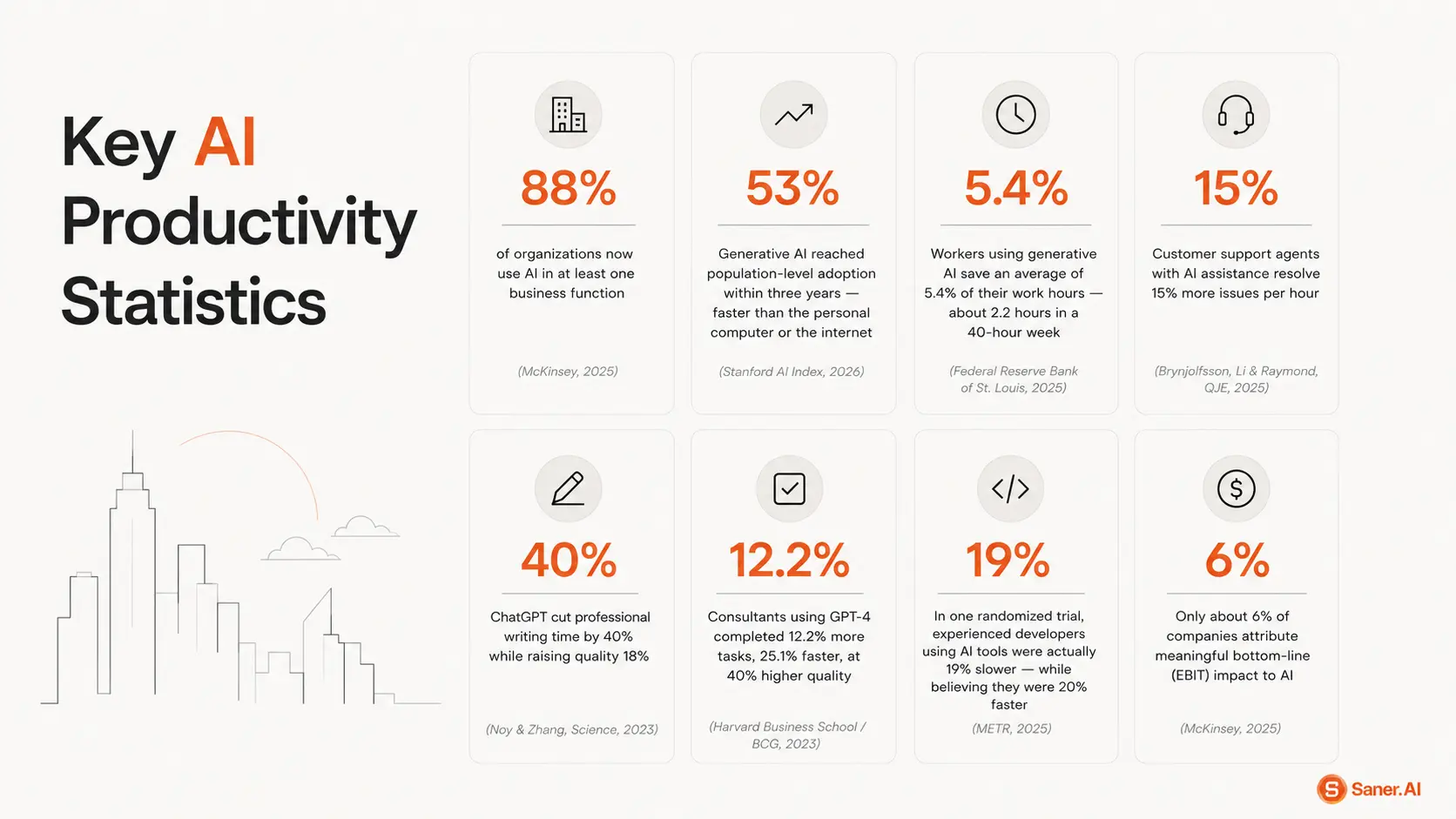
- 88% of organizations now use AI in at least one business function (McKinsey, 2025)
- Generative AI reached 53% population-level adoption within three years — faster than the personal computer or the internet (Stanford AI Index, 2026)
- Workers using generative AI save an average of 5.4% of their work hours — about 2.2 hours in a 40-hour week (Federal Reserve Bank of St. Louis, 2025)
- Customer support agents with AI assistance resolve 15% more issues per hour (Brynjolfsson, Li & Raymond, QJE, 2025)
- ChatGPT cut professional writing time by 40% while raising quality 18% (Noy & Zhang, Science, 2023)
- Consultants using GPT-4 completed 12.2% more tasks, 25.1% faster, at 40% higher quality (Harvard Business School / BCG, 2023)
- In one randomized trial, experienced developers using AI tools were actually 19% slower — while believing they were 20% faster (METR, 2025)
- Only about 6% of companies attribute meaningful bottom-line (EBIT) impact to AI (McKinsey, 2025)
1) How many people and companies use AI at work?
What percentage of companies use AI in 2026?
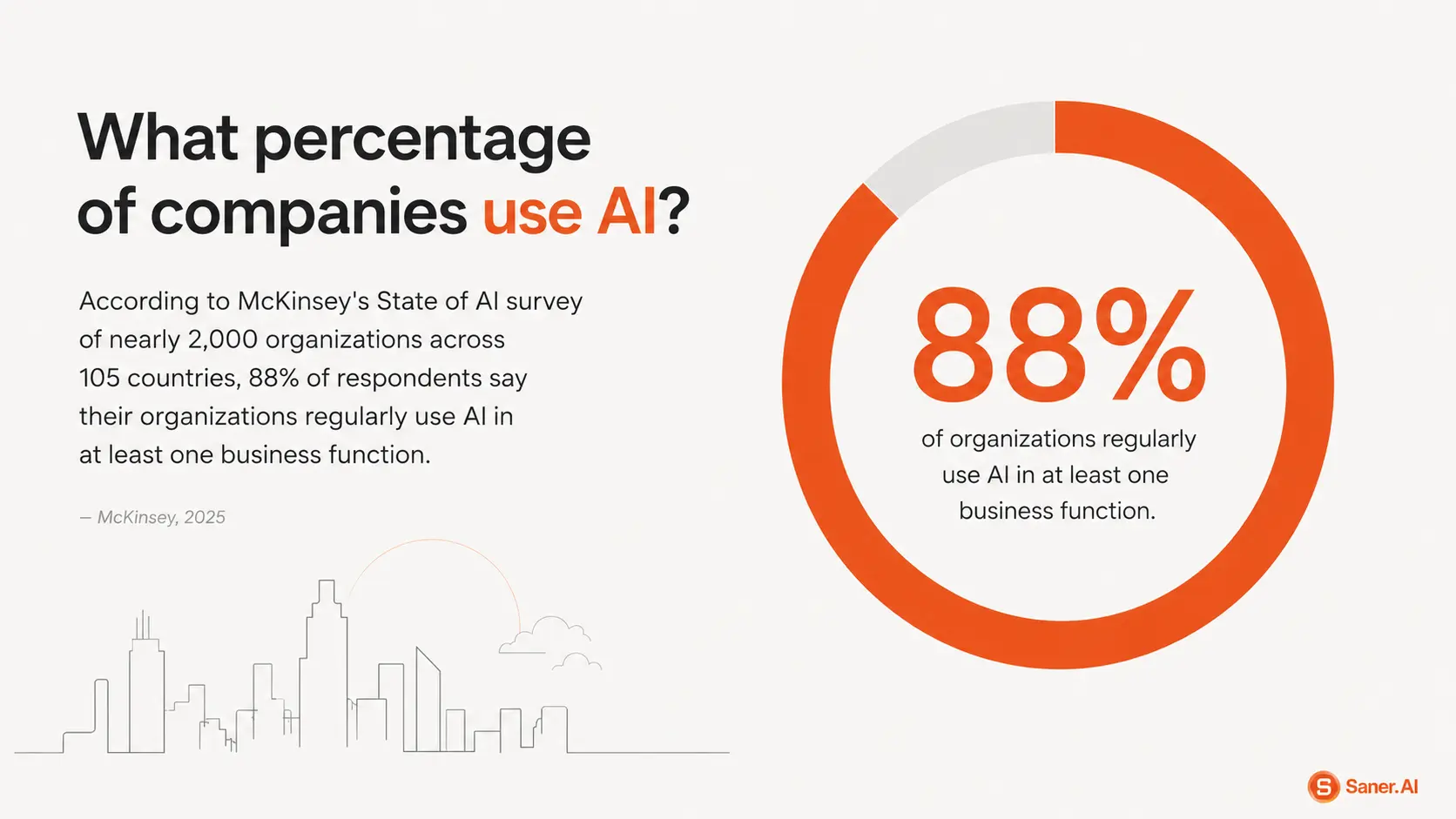
- According to McKinsey's State of AI survey of nearly 2,000 organizations across 105 countries, 88% of respondents say their organizations regularly use AI in at least one business function.
- The Stanford AI Index 2026 independently reports the same 88% organizational adoption figure, and finds that generative AI specifically is now used in at least one business function at 70% of organizations.
Adoption, in other words, is essentially solved. The open question — covered in the ROI section below — is how few of those adopters are converting usage into measurable business results.
How fast is generative AI being adopted compared to past technologies?
Faster than anything before it.
- The Stanford AI Index 2026 finds generative AI reached 53% population-level adoption within three years of launch — a faster diffusion curve than the personal computer or the internet.
- Earlier research from the Federal Reserve Bank of St. Louis found that by August 2024, nearly 40% of Americans aged 18–64 had used generative AI, versus a 20% adoption rate for personal computers three years after their introduction.
How much of the workday involves AI?
- More each quarter. The St. Louis Fed's ongoing survey found the share of total work hours spent using generative AI among US workers rose from 4.1% in November 2024 to 5.7% in August 2025.
- And in Microsoft's 2026 Work Trend Index, a survey of 20,000 knowledge workers who use AI at work, 66% say AI has allowed them to spend more time on high-value work and 58% say they're producing work they couldn't have produced a year ago.
2) How much time does AI actually save workers?
How many hours per week does AI save the average worker?
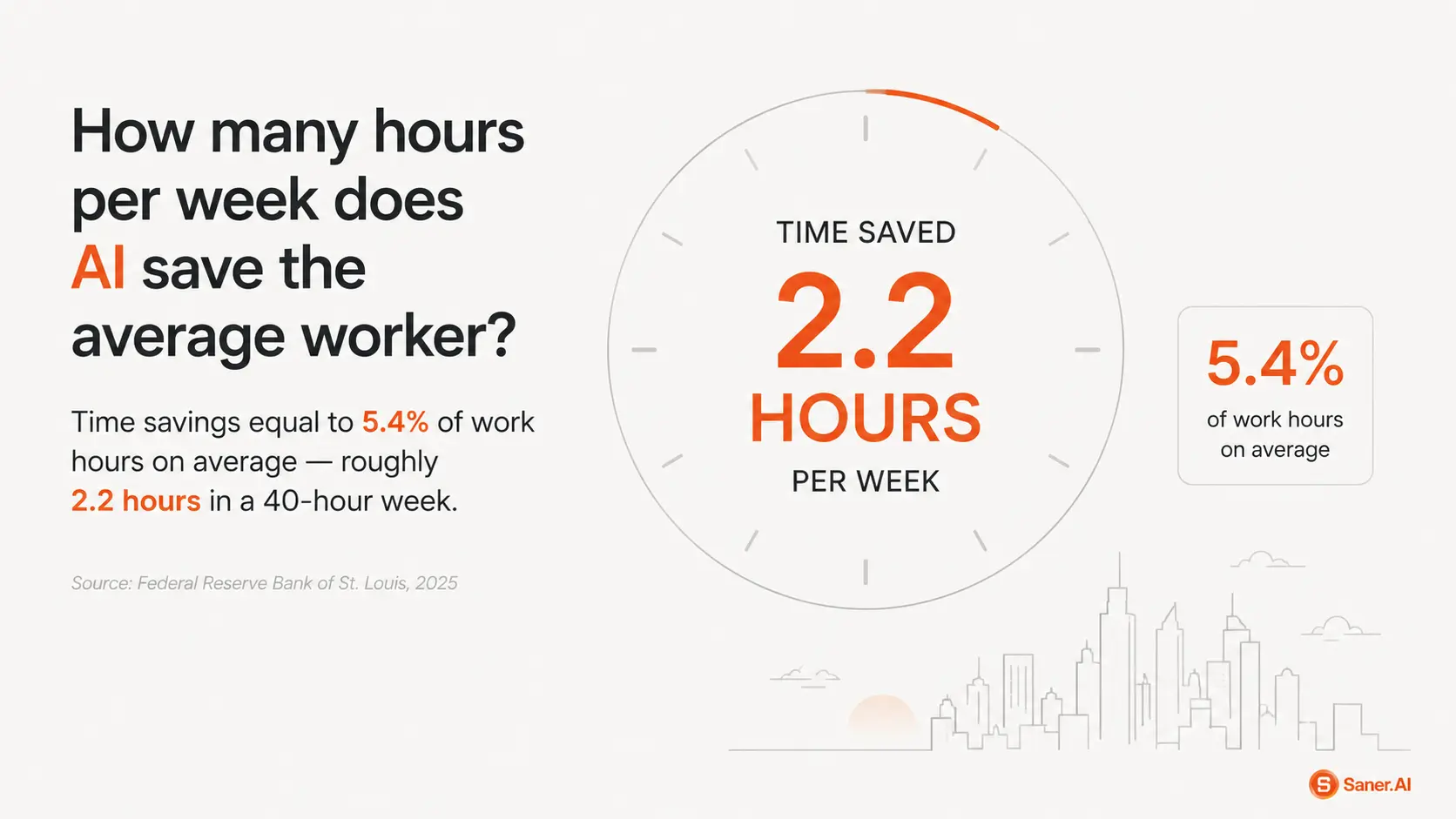
- The answer: time savings equal to 5.4% of work hours on average — roughly 2.2 hours in a 40-hour week.
- This comes from the most rigorous population-level estimate of Federal Reserve Bank of St. Louis, whose economists asked generative AI users how many additional hours they would have needed to complete last week's work without the technology.
Savings scale with usage intensity. In the same survey, 20.5% of weekly generative AI users said the technology saved them four or more hours that week, and among daily users the share saving four-plus hours rose to 33.5%.
Is AI showing up in economy-wide productivity numbers yet?
- Early signs, yes. Pooling their February, May, and August 2025 survey waves, St. Louis Fed researchers estimate that self-reported time savings from generative AI amount to 1.6% of all US work hours — which, fed into a standard production model, implies generative AI may have raised US labor productivity by up to 1.3% since ChatGPT's release.
- The researchers caveat that saved time only lifts measured productivity if it's redirected toward productive work rather than absorbed by lower-value tasks — a point worth sitting with, and one we return to below.
3) What do controlled studies say about AI productivity gains?
Surveys tell you what workers believe. Randomized controlled trials tell you what actually happened. Four landmark experiments — in customer support, writing, coding, and consulting — form the evidence base nearly every credible AI productivity claim traces back to.
How much does AI improve customer support productivity?
- In the first large-scale field study of generative AI deployed at work, economists Erik Brynjolfsson, Danielle Li, and Lindsey Raymond tracked the staggered rollout of a GPT-based assistant to 5,172 customer support agents at a Fortune 500 software company. Published in The Quarterly Journal of Economics in 2025, the study found access to AI assistance increased issues resolved per hour by 15% on average.
- The distribution of the gains matters as much as the average: less experienced and lower-skilled agents improved both the speed and quality of their work — the earlier working paper version measured a 34% improvement for novices — while the most experienced agents saw only small speed gains. The researchers' interpretation is that the AI captured and disseminated the tacit best practices of top performers, effectively compressing the experience curve for everyone else.
How much faster is professional writing with AI?
- In a preregistered experiment published in Science, MIT economists Shakked Noy and Whitney Zhang assigned incentivized, occupation-specific writing tasks to 453 college-educated professionals — managers, marketers, HR professionals, grant writers — and gave half of them access to ChatGPT.
- Average completion time fell 40%, and output quality, graded by independent evaluators, rose 18%. As in the customer support study, the weakest writers gained the most, narrowing the productivity gap between workers.
How much faster do developers code with AI?
It depends heavily on the task and the developer — this is the most contested domain in AI productivity research.
- The optimistic anchor is a controlled experiment by Peng et al., in which 95 professional developers were asked to implement an HTTP server in JavaScript. The group with GitHub Copilot finished 55.8% faster — 1 hour 11 minutes versus 2 hours 41 minutes, per GitHub's own write-up. But the task was a well-defined greenfield exercise, and the study was run by GitHub and Microsoft researchers — context that matters when weighing the result. The counterweight to this finding appears in the next section.
- The Stanford AI Index 2026 synthesizes the broader literature at roughly 26% productivity gains in software development — meaningful, but half the headline Copilot number.
Does AI help with complex knowledge work like consulting?
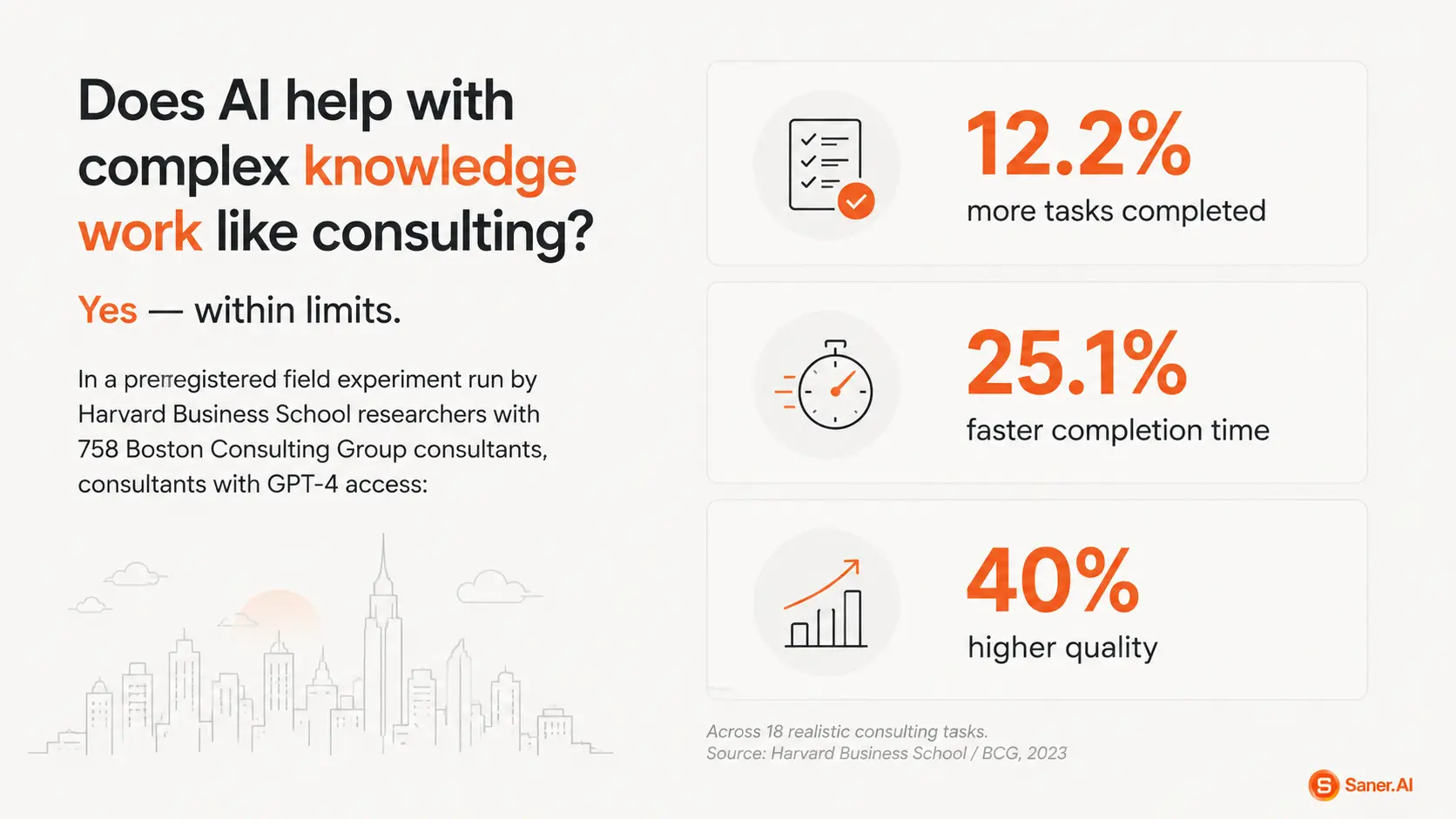
- Yes — within limits. In a preregistered field experiment run by Harvard Business School researchers with 758 Boston Consulting Group consultants (about 7% of BCG's individual-contributor workforce), consultants with GPT-4 access completed 12.2% more tasks, finished them 25.1% faster, and produced output rated over 40% higher in quality across 18 realistic consulting tasks. Below-average performers improved 43% against their own baseline, versus 17% for above-average performers — the same skill-compression pattern seen in support and writing.
The same study produced one of the most important negative findings in the field, covered next.
4) When does AI make people less productive?
A credible statistics page has to include the evidence that cuts the other way — because it's substantial, and because it explains why adoption hasn't translated into profit for most companies.
Can AI actually slow experienced workers down?
- Yes, in at least one rigorous test. In a 2025 randomized controlled trial by the research nonprofit METR, 16 experienced open-source developers completed 246 real tasks in mature codebases they'd worked on for years — each task randomly assigned to allow or disallow AI tools (primarily Cursor Pro with Claude 3.5/3.7 Sonnet). Developers forecast AI would make them 24% faster. Afterward, they estimated it had made them about 20% faster. The measured result: they were 19% slower with AI.
The perception gap is the headline here. Time saved typing was consumed — and then some — by prompting, waiting, reviewing, and correcting AI output. The contrast with the 55.8% Copilot speedup illustrates a consistent boundary condition: AI accelerates well-scoped, unfamiliar, or boilerplate-heavy work far more than expert work inside deeply familiar, high-context systems.
What is the "jagged frontier" of AI productivity?
- The HBS/BCG experiment coined the term: AI capability forms a "jagged technological frontier" where some tasks are easily handled and others — seemingly similar in difficulty — are not.
- For a task deliberately selected to sit outside that frontier, consultants using AI were 19 percentage points less likely to reach the correct answer than consultants working unaided. The AI didn't just fail to help; polished-but-wrong output actively misled skilled professionals.
Why do so few companies see bottom-line results from AI?
- Because usage isn't transformation. In McKinsey's 2025 State of AI survey, while 88% of organizations use AI, only 39% report EBIT impact at the enterprise level, and only about 6% qualify as "AI high performers" — attributing 5%+ of EBIT to AI alongside significant realized value.
- What separates that 6%? Workflow redesign. Across the variables McKinsey tested, fundamentally redesigning workflows around AI had one of the strongest associations with bottom-line impact — yet in the earlier 2025 survey wave, only 21% of gen AI adopters said they had fundamentally redesigned any workflows. Most companies bolted AI onto existing processes and, predictably, harvested existing results.
5) How is AI affecting company performance and wages?
Are AI-exposed companies and industries more productive?
- Substantially. PwC's 2025 Global AI Jobs Barometer, based on close to a billion job ads and thousands of company financial reports across six continents, found productivity growth nearly quadrupled in the industries most exposed to AI — from 7% (2018–2022) to 27% (2018–2024) — while revenue per employee in those industries grew three times faster (27%) than in the least-exposed industries (9%). The 2026 edition finds productivity growth running 40% higher at the companies most exposed to AI versus the least — and, notably, that those companies are raising both wages and headcount faster.
Do AI skills increase wages?
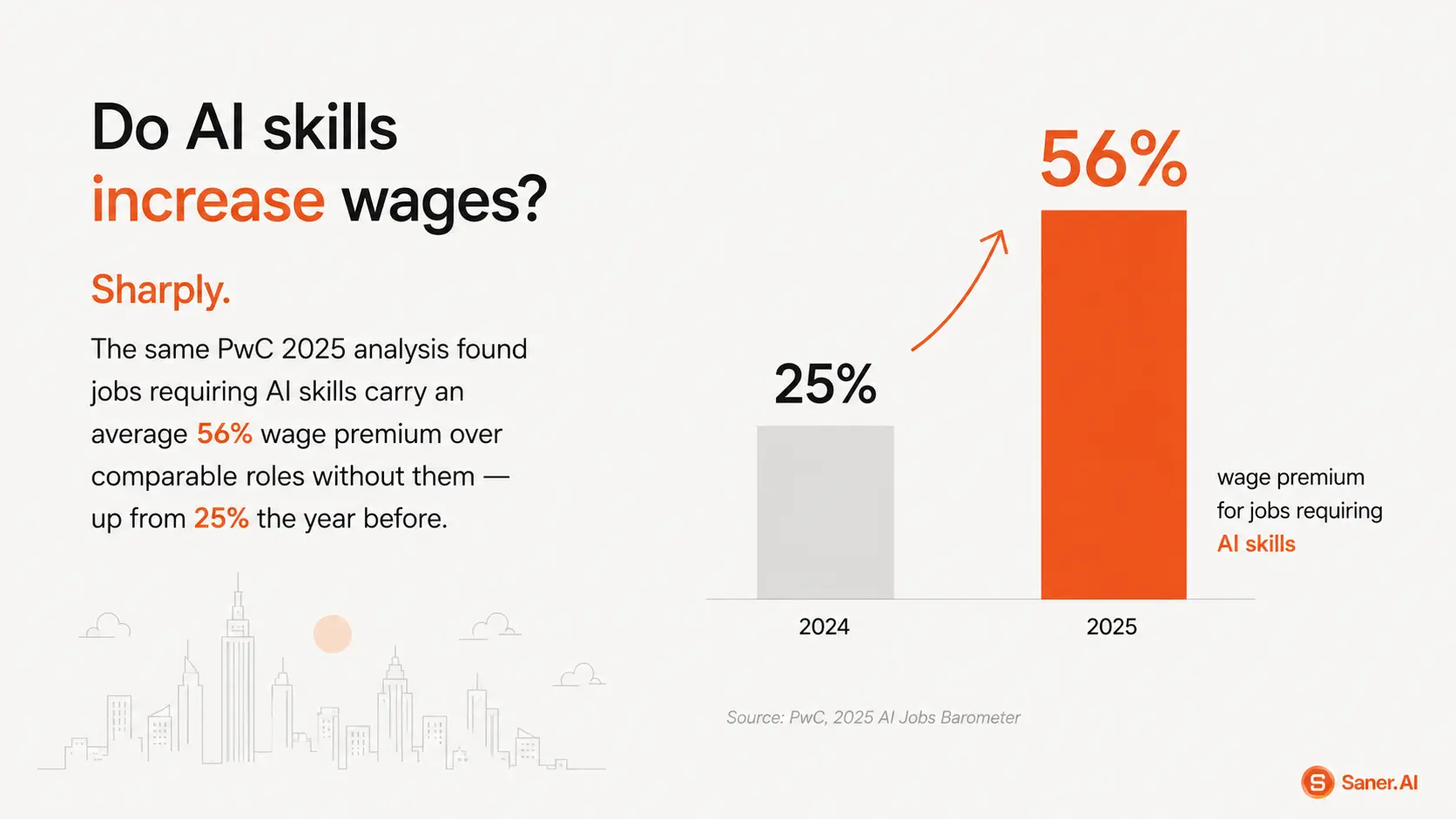
- Sharply. The same PwC 2025 analysis found jobs requiring AI skills carry an average 56% wage premium over comparable roles without them — up from 25% the year before.
- The 2026 Barometer adds that skills requirements in the most AI-exposed jobs are changing more than twice as fast as in the least-exposed jobs, and that roles being "professionalised" by AI are growing twice as fast as those being "democratised" by it, with 42% faster wage growth since 2021.
Where are AI productivity gains the largest?
- In structured, measurable work. The Stanford AI Index 2026 economy chapter synthesizes the research as follows: gains of 14–15% in customer support, 26% in software development, and up to 50% in marketing output — with smaller gains in tasks requiring deeper reasoning, and emerging concerns that heavy AI reliance may slow long-term skill development.
| Domain | Measured productivity gain | Primary source |
|---|---|---|
| Marketing output | Up to 50% | Stanford AI Index 2026 |
| Professional writing | 40% faster, +18% quality | Noy & Zhang, Science |
| Consulting tasks (within AI's capability) | 25.1% faster, +40% quality | HBS/BCG |
| Software development (literature synthesis) | ~26% | Stanford AI Index 2026 |
| Customer support | 15% more issues resolved/hour | Brynjolfsson et al., QJE |
| Expert coding in familiar codebases | −19% (slower) | METR |
6) What these statistics mean for knowledge workers
Read together, the research tells a consistent story with three threads.
The gains are real but conditional.
- Every rigorous study finds meaningful productivity improvements — 15% to 55% depending on the task — but only inside AI's capability frontier. Outside it, AI output can degrade performance while feeling helpful, which is the more dangerous failure mode.
AI compresses the skill gap.
- In customer support, writing, and consulting alike, the least experienced workers gained two to three times more than experts. AI functions less like a universal accelerator and more like a mechanism for distributing the tacit knowledge of top performers.
Time saved is not value captured.
- This is the quiet through-line from the St. Louis Fed's caveat to McKinsey's 6% figure. Workers save 2.2 hours a week, but those hours only become productivity if they flow back into meaningful work rather than dissolving into scattered follow-ups, tool-switching, and administrative residue.
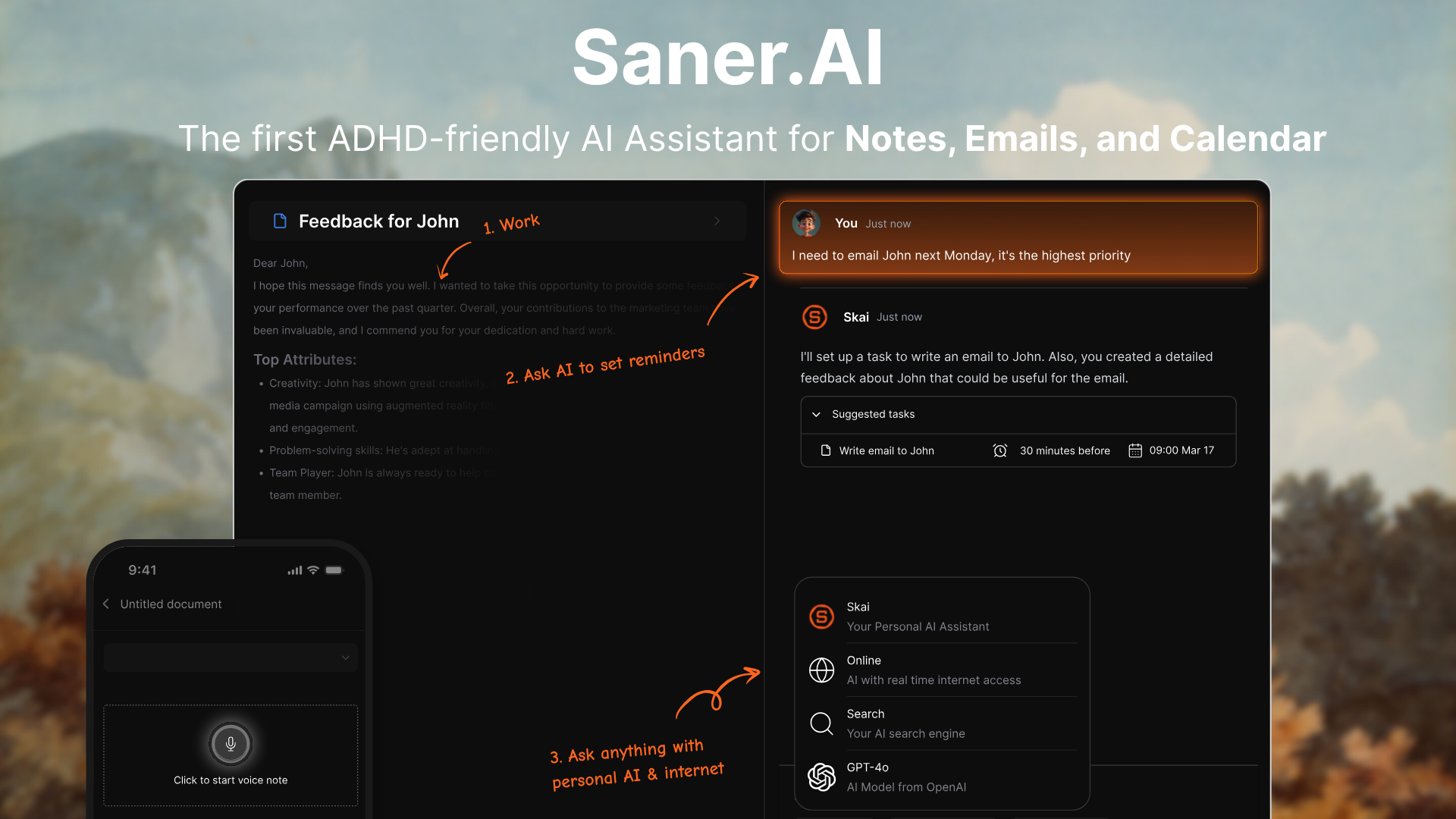
- The companies seeing real EBIT impact are the ones that redesigned workflows around AI; the same logic applies at the individual level. A worker who uses AI to draft faster but still fragments their day across disconnected notes, email, and task lists captures only a fraction of the available gain - which is why consolidating those layers into a single AI workflow, the approach tools like Saner.AI are built around, tends to compound the per-task gains the studies measure.
Stay on top of your work and life
The statistics point to a workplace where the question is no longer whether to use AI, but whether your workflows — organizational and personal — are structured to keep the time it gives back.
7) Quotable AI productivity statistics
Single-sentence, self-contained versions for citation:
- According to McKinsey's 2025 State of AI survey, 88% of organizations use AI in at least one business function, but only about 6% attribute 5%+ of EBIT to it. (McKinsey)
- Per the Stanford AI Index 2026, generative AI reached 53% population adoption within three years — faster than the PC or the internet. (Stanford HAI)
- Federal Reserve Bank of St. Louis research (2025) finds generative AI users save 5.4% of work hours — about 2.2 hours per 40-hour week. (St. Louis Fed)
- A 2025 study in The Quarterly Journal of Economics found AI assistance raised customer support productivity 15%, with the largest gains for the least experienced agents. (QJE)
- A randomized experiment published in Science (2023) found ChatGPT cut professional writing time 40% and raised quality 18%. (Science)
- In a 2023 Harvard Business School field experiment, BCG consultants using GPT-4 completed 12.2% more tasks 25.1% faster at 40% higher quality. (HBS)
- A 2025 METR randomized trial found experienced developers using AI tools were 19% slower — while believing they were 20% faster. (METR)
- PwC's 2025 Global AI Jobs Barometer found workers with AI skills earn a 56% wage premium, up from 25% a year earlier. (PwC)
8) FAQ
Does AI actually increase productivity?
Yes, for most tasks measured in controlled studies — gains range from 15% (customer support) to 40% (writing) to 55.8% (a scoped coding task). But the effect reverses outside AI's capability frontier: experienced developers in one randomized trial were 19% slower with AI, and consultants using AI on tasks beyond its abilities were 19 percentage points less likely to get the right answer.
How much time does AI save per week?
About 2.2 hours per week for the average generative AI user, per St. Louis Fed research — rising to four or more hours for a third of daily users.
What percentage of companies use AI in 2026?
88% use AI in at least one business function, per both McKinsey and the Stanford AI Index 2026.
Who benefits most from AI at work?
Less experienced workers, consistently. Novice support agents improved ~34% versus minimal gains for veterans; below-average consultants improved 43% versus 17% for above-average ones; weaker writers gained most in the Science experiment.
Has AI increased overall economic productivity?
Modestly so far. St. Louis Fed economists estimate generative AI may have raised US labor productivity up to 1.3% since ChatGPT's release, and PwC finds productivity growth nearly quadrupled in the most AI-exposed industries.
Why do most companies fail to see ROI from AI?
Because they adopt tools without redesigning workflows. McKinsey found workflow redesign is the factor most associated with EBIT impact from AI — yet only 21% of adopters have done it.
What are the most reliable sources for AI productivity statistics?
Peer-reviewed studies (Brynjolfsson et al. in QJE; Noy & Zhang in Science), the Stanford AI Index, Federal Reserve research, and large-scale primary surveys from McKinsey, PwC, and Microsoft's Work Trend Index. Prefer these over secondary roundups, which frequently miscite figures.
Sources
- Stanford HAI — The 2026 AI Index Report and Economy chapter
- Brynjolfsson, Li & Raymond — Generative AI at Work, The Quarterly Journal of Economics 140(2), 2025; earlier version: NBER Working Paper 31161
- Noy & Zhang — Experimental evidence on the productivity effects of generative AI, Science, 2023
- Peng, Kalliamvakou, Cihon & Demirer — The Impact of AI on Developer Productivity: Evidence from GitHub Copilot, 2023; GitHub research blog
- Dell'Acqua et al. — Navigating the Jagged Technological Frontier, Harvard Business School Working Paper, 2023
- METR — Measuring the Impact of Early-2025 AI on Experienced Open-Source Developer Productivity, 2025; arXiv paper
- Federal Reserve Bank of St. Louis — The Impact of Generative AI on Work Productivity, 2025 and The State of Generative AI Adoption in 2025
- McKinsey & Company — The State of AI (2025 surveys) and March 2025 wave
- PwC — 2025 Global AI Jobs Barometer press release and 2026 Global AI Jobs Barometer
- Microsoft — 2026 Work Trend Index and 2025 Work Trend Index